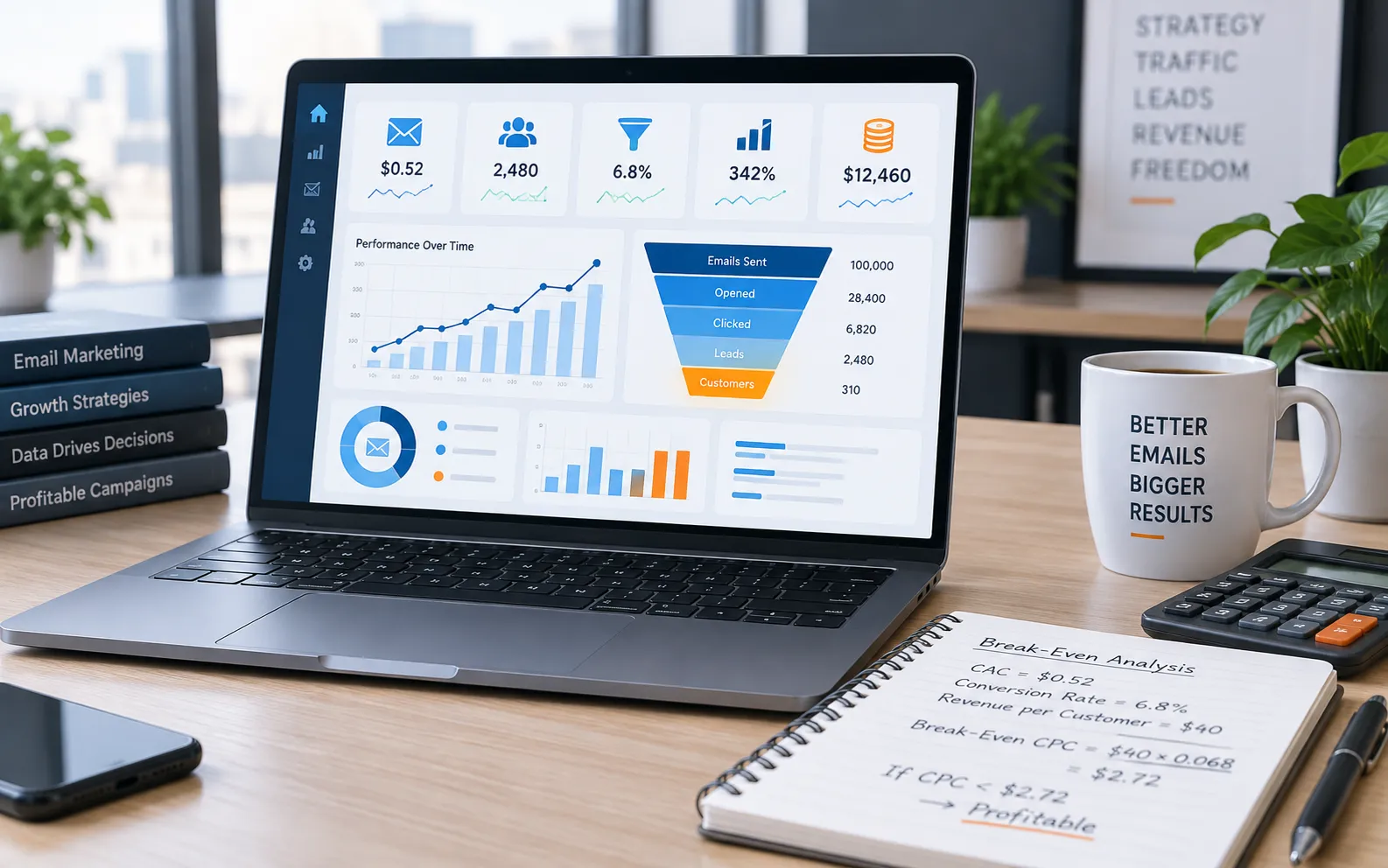

Paid email traffic can look simple on the surface.
You pay for a certain number of clicks, send those visitors to a landing page, and hope enough of them turn into subscribers or customers.
But there is one common mistake:
“Cheap clicks do not automatically mean profitable traffic.”
The cost per click is only the beginning of the calculation. What really matters is what happens after the click.
Start With the Total Traffic Cost
Imagine you buy 500 clicks at $0.50 per click.
Your total traffic cost is:
500 × $0.50 = $250
At this point, you know what you spent. But you still do not know whether the campaign was good or bad.
Now assume your landing page converts 35% of visitors into email subscribers.
That gives you:
500 × 35% = 175 leads
Your cost per lead becomes:
$250 ÷ 175 = $1.43 per lead
That number is already much more useful than CPC alone.
“The real question is not how much a click costs. It is how much a useful lead costs.”
What Happens After the Opt-In?
Getting subscribers is not the final goal.
Those subscribers still need to open emails, click offers and eventually generate revenue.
Suppose 2% of your 175 leads buy an offer.
That equals approximately:
3.5 sales
If your average commission is $80 per sale, estimated revenue would be:
3.5 × $80 = $280
You spent $250 and generated around $280.
That means the campaign produced a small profit.
But if your commission were only $50, the same traffic would lose money.
The traffic did not change.
The economics did.
Four Numbers Matter More Than Click Price
Before buying paid email traffic, I would estimate these numbers first:
- Cost per click (CPC): how much each visitor costs.
- Opt-in rate: what percentage of visitors become leads.
- Cost per lead (CPL): how much each new subscriber really costs.
- Conversion value: how much revenue those leads eventually generate.
These numbers work together.
A campaign with expensive clicks can still perform well if the landing page converts strongly and the leads are valuable.
A campaign with extremely cheap clicks can still be a bad purchase if almost nobody opts in or buys anything.
“Traffic quality matters more than traffic price.”
Find Your Break-Even Point Before You Buy
One of the easiest ways to evaluate a campaign is to ask:
How many sales do I need just to recover my traffic cost?
Using our previous example:
Traffic cost = $250
If each sale earns an $80 commission:
$250 ÷ $80 = 3.125 sales
So you need a little more than three sales to break even.
Anything above that becomes profit.
Anything below that becomes a loss.
This gives you something concrete to evaluate before spending money.
Instead of asking:
“Is $0.50 per click expensive?”
you can ask:
“Can my funnel realistically generate enough leads and sales from 500 clicks to recover $250?”
That is a much better question.
Small Changes Can Completely Change the Result
Suppose your landing page originally converts at 25%.
From 500 clicks, that gives you 125 leads.
At a $250 traffic cost:
$250 ÷ 125 = $2.00 per lead
Now improve the same landing page to a 40% opt-in rate.
You get 200 leads.
Your new CPL becomes:
$250 ÷ 200 = $1.25 per lead
The traffic source did not get cheaper.
Your funnel simply became more efficient.
The same is true after the opt-in. Better follow-up emails, stronger offers and better audience matching can all change whether the campaign becomes profitable.
Model the Campaign Before Spending Money
Before buying traffic, I like to test a few different scenarios.
For example:
- 500 clicks
- $0.50 CPC
- 35% opt-in rate
- 2% sales conversion rate
- $80 average commission
Then I compare that with a weaker and stronger scenario.
This quickly shows where the campaign starts to break even.
You can do the math manually, or use a free Solo Ad ROI Calculator to test different click costs, conversion rates and revenue assumptions.
The calculator is designed for solo ads, but the same basic logic can also be useful when evaluating other forms of paid email traffic.
Think Beyond the Click
A click is not the result.
It is only the first step.
The full path looks more like:
Click → Lead → Email engagement → Sale → Revenue
That is why comparing traffic sources only by CPC can be misleading.
A $0.70 click that produces engaged subscribers may be far more valuable than a $0.30 click that produces almost nothing.
“The cheapest traffic is not always the most profitable traffic.”
Before paying for a campaign, estimate the entire funnel.
Once you understand your CPC, opt-in rate, CPL, conversion rate and break-even revenue, it becomes much easier to decide whether a paid email traffic campaign is worth testing.
























Sign in to leave a comment.