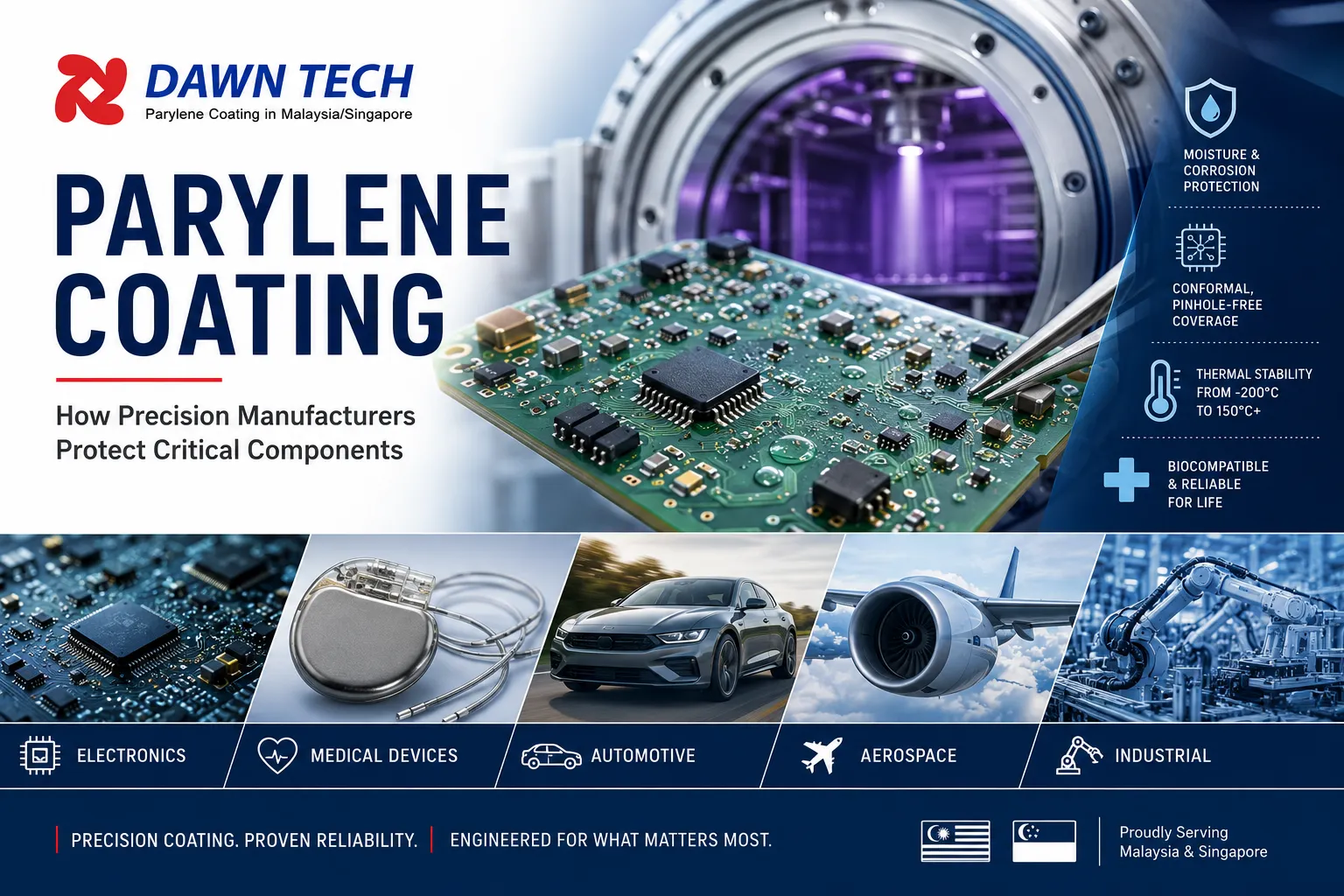

Electronics fail in quiet ways. Moisture creeps into a connector, a circuit board picks up a trace of corrosion, and months later a device stops working with no obvious cause. This is the exact problem Parylene Coating was engineered to solve. As Malaysia and Singapore's electronics, medical device, and automotive manufacturing sectors continue to expand, this coating technology has become a standard line item in the design-for-reliability conversation rather than an afterthought bolted on before shipping.
What Is Parylene Coating?
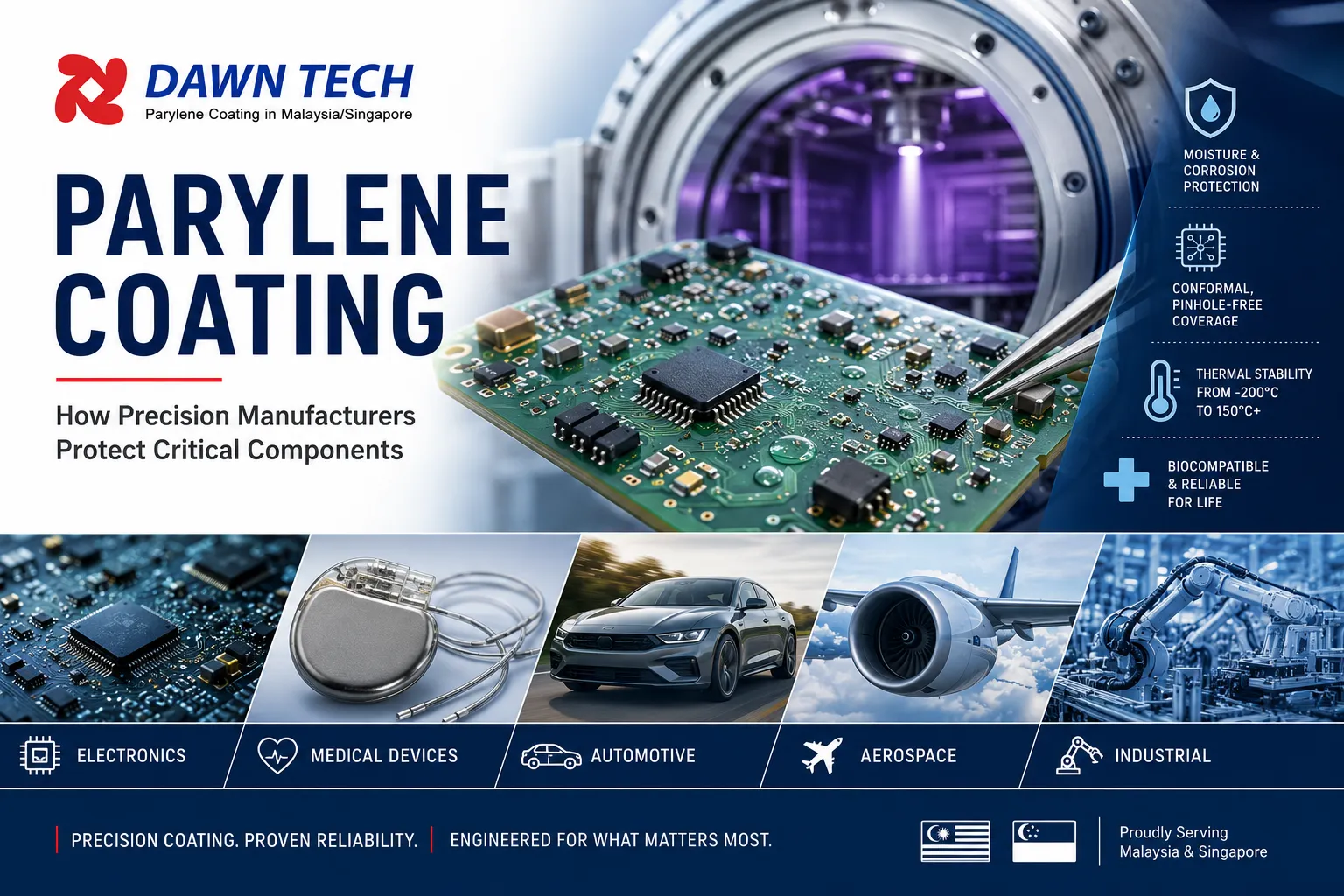
The name comes from para-xylylene, the chemical family behind a group of polymers applied through vapor deposition rather than liquid application. At its core, Parylene Coating is a vapor-deposited polymer film applied directly onto a component's surface. Unlike liquid coatings that pool, drip, or leave uneven thickness around edges and connectors, this process builds the film molecule by molecule inside a vacuum chamber. The result is a conformal, pinhole-free layer that follows every contour, crevice, sharp edge, and internal region on a part without adding meaningful weight or bulk.
That detail matters more than it sounds. A liquid conformal coating such as silicone, acrylic, or urethane might bridge a tight gap between two pins, creating a weak spot where moisture eventually finds its way in. Parylene doesn't bridge. It wraps.
Why Industries Rely on This Kind of Protection
Electronics and Medical Devices
Printed circuit boards, sensors, and other delicate electronic assemblies face constant exposure to moisture, solvents, and corrosive gases. A pacemaker, catheter, or surgical instrument that corrodes even slightly can mean a failed device inside a patient, which is why biocompatibility sits alongside chemical resistance as a non-negotiable property in this sector. That's not a risk anyone in medical manufacturing treats casually.
Automotive and Aerospace
Automotive sensors and control modules increasingly rely on this kind of protection to survive extreme temperatures, chemical exposure, and high humidity under the hood. Aerospace components deal with a different but equally demanding set of conditions: vacuum exposure, radiation, and sharp temperature swings at altitude. In both cases, an unprotected board is a liability waiting to surface during a production run or, worse, mid-flight.
Coating Grades and Their Applications
Not all Parylene Coating is identical. Two dimer variants dominate industrial use: Parylene C and Parylene N. Parylene C, built on a dichloro-di-para-xylylene structure, offers low permeability to moisture and gases like nitrogen, oxygen, and carbon dioxide, along with strong electrical properties, which is why it shows up so often in general electronics work. Parylene N, based on the simpler di-para-xylylene structure, penetrates surface irregularities more effectively and suits applications where higher surface and volume resistivity matters more than moisture barrier alone.
Choosing the wrong grade isn't catastrophic, but it does leave performance on the table. A component destined for a high-humidity environment gains little from a grade optimized purely for dielectric properties, and that distinction only matters if someone actually asks the question before production begins.
How the Coating Process Actually Works
The Parylene Coating Process relies on chemical vapor deposition carried out in three stages: vaporization, pyrolysis, and deposition. A solid dimer is first heated and vaporized under vacuum. That gas then passes through a pyrolysis stage, where it's cleaved into its monomeric form. Finally, inside a deposition chamber held at room temperature, the monomeric gas condenses onto the part's surface as an ultra-thin, transparent polymeric film.
This matters for anything with fine wire bonds or brittle solder joints. Because deposition happens at room temperature rather than through a heat-cure cycle, there's no thermal stress placed on delicate assemblies. Vapor deposition sidesteps that problem entirely, which is one reason the technique has held its place in high-reliability manufacturing for decades rather than being replaced by something faster or cheaper. Film thickness, typically measured in microns, can be adjusted according to the properties an application actually needs.
Factors That Influence the Process
Three practical variables shape how well a coating job turns out. The substrate material itself matters, since parylene adheres to plastic, metal, glass, elastomer, and even paper, though many surfaces are pretreated with a silane adhesion promoter beforehand. Cleanliness matters just as much. Oils, particulates, and residue from handling can all interfere with adhesion before the part ever enters the chamber. The third factor is masking. Because the coating penetrates every crevice and layer it touches, connectors and contact points that must stay exposed need to be carefully masked off before deposition begins, or the part won't function as intended once it leaves the chamber.
Common Industries and Real-World Applications
Beyond medical implants and aerospace hardware, this kind of protection shows up in places people rarely think about. Automotive sensor modules exposed to engine-bay heat and road salt rely on it. Telecommunications and industrial automation equipment benefit from the same moisture and dust resistance that protects consumer electronics, without adding the mass a liquid coating would introduce. The common thread across all of these is longevity under conditions the component wasn't necessarily designed to tolerate on its own.
Choosing the Right Coating Solution
Engineers evaluating a coating partner typically weigh a handful of practical factors: film thickness tolerances, turnaround time, masking capability for connectors that must stay exposed, and whether the vendor's quality management system can produce documentation suitable for regulatory audits. Dawn Tech, based in Iskandar Puteri, Johor, works across several of these industries throughout Malaysia and Singapore, and one pattern that comes up repeatedly is how often masking, not the coating chemistry itself, becomes the limiting factor in a project timeline.
In practice, a coating vendor's value often shows up less in the chemistry and more in the process discipline around it: consistent chamber loading, verified thickness readings, and traceable batch records.
Quality Standards and Where the Industry Is Heading
Documented reliability continues to matter more, not less, as medical and aerospace programs tighten their qualification requirements. At the same time, demand is shifting toward thinner, more uniform films as devices shrink and component density increases.
Dawn Tech and similar precision coating providers across the region are seeing more requests tied to miniaturized medical sensors and next-generation automotive electronics, where a few microns of film thickness can be the difference between a part passing qualification or failing it outright. The reality is that as electronics keep getting smaller and more densely packed, the margin for coating error keeps getting smaller too. That's not a trend easing off; if anything, it's accelerating.



























Sign in to leave a comment.