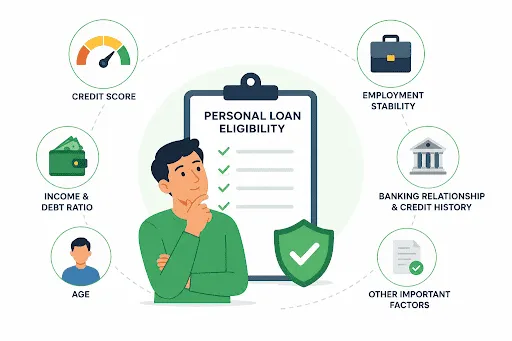


Before approving a personal loan, lenders assess a range of factors to determine both the applicant's risk profile and their capacity to repay. While specific criteria vary between institutions, most evaluations follow a similar underlying logic. Understanding what lenders typically look for can help applicants prepare a stronger case before submitting a formal application.
Age Requirements
Most lenders set a minimum and maximum age limit for personal loan applicants, generally ranging between 21 and 60 years, though this can vary by lender and employment type. The rationale is straightforward: lenders want assurance that the borrower has a stable earning period ahead to comfortably repay the loan within the chosen tenure.
Income and Employment Stability
Minimum Income Threshold
Lenders typically require applicants to meet a minimum monthly or annual income level, which can vary depending on the city and the lender's internal policies. This threshold helps ensure the borrower has sufficient earning capacity to manage EMI payments alongside other expenses.
Employment Type
Salaried and self-employed applicants are often assessed using different criteria. Salaried individuals are generally evaluated based on consistent monthly income and employer stability, while self-employed applicants may need to demonstrate steady business income through tax returns or bank statements over a longer period.
Employment Tenure
A minimum period of continuous employment or business operation—often six months to two years, depending on the lender—is commonly required. This helps lenders gauge income stability rather than relying on a single snapshot of earnings.
Credit Score and Credit History
Credit score remains one of the most heavily weighted factors in loan eligibility, since personal loans are typically unsecured. A higher score signals a strong track record of timely repayments, which can improve both approval chances and the interest rate offered. Beyond the score itself, lenders often review the broader credit report for patterns, such as frequency of credit inquiries, existing credit utilization, and any history of missed payments or defaults.
Debt-to-Income Ratio
Lenders calculate the proportion of income already committed to existing debt obligations, including other loans, credit card dues, and recurring liabilities. A lower debt-to-income ratio indicates more available capacity to take on a new loan, while a higher ratio can limit eligibility or reduce the approved loan amount, even if income levels are otherwise sufficient.
Existing Relationship with the Lender
Some lenders offer more favorable eligibility terms to applicants who already hold an account, credit card, or previous loan with them, since this existing relationship provides additional insight into the applicant's financial behavior. This is sometimes referred to as a pre-approved offer, though eligibility still depends on the applicant's overall profile.
Documentation Requirements
While specifics vary by lender, most applications require a similar set of supporting documents:
- Identity proof, such as Aadhaar, PAN, or passport
- Address proof, confirming current residence
- Income proof, including salary slips, bank statements, or income tax returns for self-employed applicants
- Employment verification, such as an offer letter or employment certificate, where applicable
Incomplete or inconsistent documentation is a common reason for delays, so having these documents organized in advance can smooth the application process.
Purpose of the Loan
While personal loans are generally flexible in use, some lenders ask applicants to specify the purpose—such as medical expenses, education, or debt consolidation—as part of the application. This isn't always a strict eligibility factor, but it can occasionally influence loan terms or serve as part of the lender's internal risk assessment.
How Eligibility Criteria Can Vary by Region
Eligibility thresholds aren't always uniform across the country, as lenders often adjust their criteria based on regional income levels and local economic conditions. For instance, someone exploring a Personal Loan Service in Faridabad may encounter income thresholds or documentation requirements that differ from those in other cities, based on how local lenders assess regional risk.
Similarly, borrowers in nearby areas researching a Personal Loan Service in Palwal or a Personal Loan Service in Gurgaon may find that eligibility benchmarks differ slightly depending on the lenders active in each city and the economic profile of the local population. Reviewing these regional nuances can help applicants understand which lenders may be more aligned with their specific circumstances.
Improving Eligibility Before Applying
Applicants looking to strengthen their eligibility profile before submitting a formal application can consider a few practical steps:
- Reviewing and correcting any errors on their credit report
- Paying down existing debt to improve the debt-to-income ratio
- Ensuring all income documentation is up to date and consistent
- Avoiding multiple loan or credit card applications in a short period, which can trigger multiple hard inquiries
Final Thoughts
Personal loan eligibility is determined through a combination of factors, including age, income, employment stability, credit history, and existing debt obligations. Since these criteria can also vary by lender and region, understanding what is typically assessed—and taking steps to strengthen one's financial profile in advance—can improve both approval chances and the terms ultimately offered.



























Sign in to leave a comment.