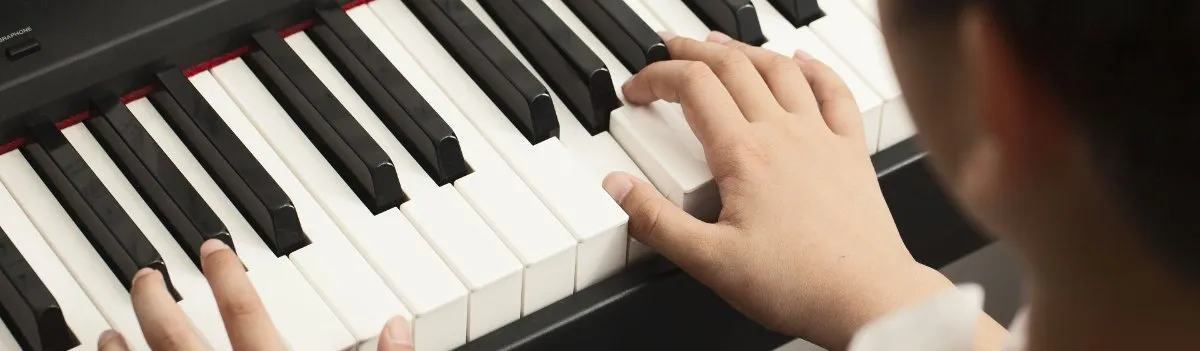

Your child has been tapping out tunes on every surface at home, or maybe a school friend just started lessons and now yours wants a turn. Either way, you're probably wondering the same things: how early is too early, what will a beginner actually do in the first few months, and how do you keep a seven-year-old interested past the second week? This guide covers piano lessons for beginner kids from a parent's point of view, with practical answers you can use before booking anything.
What Is the Right Age to Start Piano?
There is no single correct age. Many Singapore teachers are comfortable with children from about four, and some take pupils as young as three, but readiness matters more than the birthday. A child who can sit for ten to fifteen minutes, follow a simple instruction, and tell left from right is usually ready for structured lessons.
Younger children often begin with games, rhythm clapping, and singing, with note reading introduced gently. Children of six to nine tend to move faster with reading because their schoolwork already involves symbols and patterns. Older beginners are far from "late": they usually have longer attention spans and can practise more independently.
If you're unsure, a trial lesson is the easiest way to find out. Watching your child respond to a teacher tells you more than any age chart.
What Do Beginners Actually Learn?
The first few weeks
Expect plenty of basics: sitting at the right height, curved relaxed fingers, finding middle C, and telling high sounds from low ones. Teachers often use short songs the child can play by ear, because hearing a tune come out of the piano is what makes a child want to return next week.
After the first term
Children typically start reading simple notation, keeping a steady beat, and playing with both hands on easy pieces. Alongside this they build aural skills, such as recognising whether a melody goes up or down, and early theory like note values. Over time, many families choose to work towards graded exams such as ABRSM or Trinity, which give a clear sense of progress. Exams are optional, though, and some children do better with repertoire and performances first.
How to Build a Practice Habit That Lasts
Practice is where most beginners either thrive or stall. A few approaches tend to help:
- Short and regular beats long and rare. Ten to fifteen minutes most days works better than one long session before the lesson.
- Attach it to a routine. After dinner or before screen time is easier to defend than "whenever we have time."
- Ask for a performance, not a report. "Play me the one you like best" lands better than "Have you practised?"
- Let the teacher be the bad cop. Corrections about posture or fingering are easier to accept from the teacher than from a parent.
You don't need to read music to help. Sitting nearby, asking your child to teach you what they learned, and noticing small wins is enough.
What to Look for When Choosing Piano Lessons
A few questions are worth asking any school or teacher before you commit:
- Is the teacher experienced with young beginners specifically, not only advanced students?
- Are lessons one-on-one, and how long are they? Shorter sessions suit smaller children.
- Does the repertoire go beyond exam pieces, so your child can also play songs they recognise?
- Are there performance opportunities, such as recitals, where children can share what they've learned?
- Can you try a lesson first?
As one example, piano lessons at Methodist School of Music are one-on-one, with 45-minute sessions from beginner level to Grade 4. Teachers cover classical and contemporary pieces, prepare students for ABRSM and Trinity if families wish, and the school encourages a trial lesson so you can meet the teacher before enrolling. It also lists no fixed starting age, which is reassuring if your child is on the younger or older side of the usual range.
Common Questions From Parents
Do we need to buy a piano first?
Not necessarily. Many families start with a weighted-key digital piano, which is quieter for HDB living and holds its value reasonably well. Avoid very small toy keyboards: unweighted keys do not build finger strength the same way. Ask the teacher what they recommend.
How long until my child sounds good?
Most children can play a simple recognisable tune within the first few weeks. Playing fluently with both hands usually takes months, and that is normal. Progress is rarely a straight line.
What if my child wants to quit after a month?
The early novelty often wears off just as practice begins to feel like work. Before giving up, talk to the teacher. Adjusting the pieces, changing the pace, or adding a song your child picked can bring the interest back.
Starting Well
The best first step is a low-pressure one: book a trial lesson, let your child try the instrument, and pay attention to how they feel afterwards. Curiosity and a good rapport with the teacher matter more at the start than talent. Keep practice short, celebrate small progress, and give it a full term before judging whether piano suits your child.



















Sign in to leave a comment.