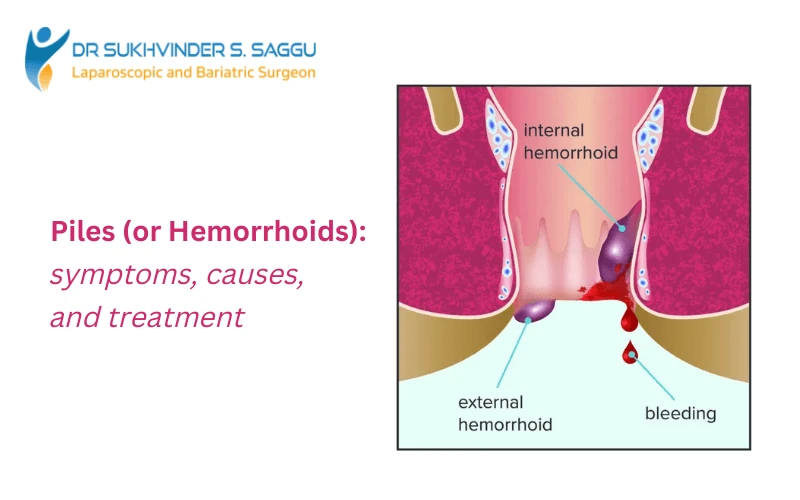

Piles (or Hemorrhoids) are a relatively common condition that may affect both men and women of any age. These are caused by chronically excessive venous pressure. Constipation, severe straining during bowel motions, and recurrent diarrhea are all possible reasons. There is also evidence of family inheritance. Women are especially prone to piles during pregnancy because the expanding uterus inhibits blood flow in the pelvic.
What are the grades of piles?
Piles may be either interior or exterior. Internal piles are categorized further into grades:
Grade I - No anus protrusion.Grade II - Protrusion through the anus during straining and defecation, but return spontaneously.Grade III - Protrude through the anus with defecation or straining, but manually reduced.Grade IV - Protrude and cannot be decreased gradually.What are the Causes of piles?
These are caused by persistently elevated pressure in the anal veins. Chronic constipation, severe straining during stool transit, a low fiber diet, or recurrent diarrhea are all possible causes.
Inheritance from family members is also an influence. Women are more prone to piles during pregnancy because the expanding uterus exerts pressure on the region and inhibits blood flow in the pelvic.
Lifestyle considerations can play a significant role. People are habitually constipated, overweight, and lead a sedentary lifestyle with no or minimal physical activity. Eating junk food, a low fiber diet, and drinking less water are all factors.
Symptoms and Signs of Piles
In most situations, piles of symptoms and indicators are not complicated. Piles usually dissolve on their own without requiring therapy after a few days, and you may not even need piles treatment.
You may encounter the following signs and symptoms if you have piles.You may notice that your intestines are still full after the bowel movement.A painful hard swelling around your anus may be felt. This firm mass might be coagulated blood. This type of piles is known as thrombosed external hemorrhoidsAfter passing the stool, you may notice clear red blood on it.You may feel discomfort when passing the stool.
The area surrounding the anus is painful, red, and itching.If piles are not addressed on their own, they may progress to a more severe condition.Extreme anal bleeding that may result in anaemiaFecal incontinence or inability to regulate bowel motionsInfection
Strangulated hemorrhoid occurs when the blood supply to the hemorrhoid is cut off. It may result in serious problems such as a blood clot and infection.
Doctors may advise you to have a piles procedure at this time.
Piles Diagnosis
Doctors diagnose piles via a physical examination. Doctors will inspect the anus area of the individual suspected of having piles before prescribing any prescription for piles therapy.
Doctors may also ask you the following questions about your discomfort:
What is the color of the stools?Does someone from your family have piles?Have your bowel motions recently changed?Do you have a sudden loss of weight?Is there any mucus or blood in your stools?Furthermore, for internal piles, the doctor may do a digital rectal examination or use a proctoscope. A proctoscope is a device that consists of a hollow tube with a light that enables the doctor to completely inspect the anal canal.
If your pile's symptoms are not concerning, your doctor may prescribe a colonoscopy. However, if your symptoms are severe and show evidence of colon cancer, you may be advised to have a piles surgery.
Treatment/Surgery for Piles
In the past, open surgery was the only option available. However, with the advent of minimally invasive techniques, physicians' approaches to patient care have been transformed. The 'Minimally Invasive Surgery for Piles' (MIPS), also known as 'Stapler Haemorrhoidectomy,' is a new procedure for hemorrhoids. It is less painful and allows for a quicker recovery.
The procedure employs a stapling device and takes advantage of the absence of pain-sensing nerve fibres high up in the anal canal. In this treatment, the mucosa above the dentate line (which contains a portion of the pile mass) is excised and stapled with a stapler gun, preventing bleeding and prolapse.
Inside the stapler, the pile masses are crushed into a cup-like chamber. When shot, the titanium staples cut and seal at the same time, resulting in minimum bleeding. There is minimal postoperative discomfort since the cut line is above the nerves. There is no incision in the perianal skin or lower section of the anal canal, and the wound in the anal mucosa is also largely closed with a stapler, thus no post-operative dressing is required.
CO2 Laser Nonsurgical Treatment of Piles
Haemorrhoids are anal vascular structures that aid in regular stool management. These are arterio-venous channels and connective tissue-based physiological cushions.
When these hemorrhoids get irritated, they expand and may move outwards. This medical condition is known as Piles. These can be internal, external, or mixed; and are graded as per appearance from I to IV.
Management
In recent times, patient care has revolutionized with the help of minimally invasive procedures.
Laser Hemorrhoidoplasty (LHP) is the most effective, safe, quick, easy, and affordable treatment option for Piles.
The most important technical innovation for the treatment of Piles is the C02 laser. It is equipped with the most powerful laser scalpel. It emits an infrared laser that closes the lymphatics while cutting through and evaporating the undesired tissue.
CO2 Laser Advantages
CO2 lasers are ideally suited for soft tissue operations and are very beneficial since water (the majority of biological tissues) absorbs this light frequency at par.
For Piles, management with CO2 laser demands very less surgical time (maximum 30 minutes), no to minimal bleeding, almost negligible risk of infection, and no post-operative pain and oedema. There is no surgical incision.
Doctors treat various types of haemorrhoidal illnesses, including internal hemorrhoids with rectal bleeding, thrombosed prolapsed hemorrhoids, and hemorrhoids with fissures. Other approaches, in addition to the CO2 laser, may be used in complex instances.
Other issues such as Fissure, Fistula, and Pilonidal Sinus may also be efficiently treated with this laser.
The therapy technique is thoroughly described to the patient ahead of time. There are no particular preparations required. Normal bowel movements are adequate. In the case of constipation, an enema might be administered before the therapy. Local anesthesia is employed in 98% of instances.
Overall, the patient's result is outstanding, and most significantly, the patient may return home the same day and return to work in 48 hours!
Interested in knowing more about Piles and wanting to get proper treatment? Visit Dr. Sukhvinder Singh Saggu, one of the best Bariatric surgeon in Delhi.
You may also read What exactly is abdominal wall reconstruction?
Thanks for reading!











Sign in to leave a comment.