
Playground Slides for Kids: Commercial Buyer & Facility Planning Guide
Selecting playground slides for kids is a planning decision, not simply an equipment choice. A well-specified slide can make efficient use of limited space, increase play value and throughput, and provide sensory experiences that support balance, coordination, confidence, and controlled risk-taking. For schools, daycares, parks, and shared residential facilities, operators also need to balance age-appropriate design and applicable safety requirements with materials and construction that can withstand frequent use, weather exposure, and years of service.
Critical Kinds of Slides for Commercial Buildings
Various types of slides meet different requirements of the site, including supervision:
- Tunnel/Tube Slides: The closed slides make full use of the vertical space, providing an unusual sensory experience. The enclosed slide structure provides shade for those using the slides, protecting them from sunlight and other weather conditions. It can be used in circumstances when the construction area is restricted with limited access and visibility.
- Spiral & Curved Slides: Curved slides, usually drawn-out slides by nature, present longer paths but have lower overall heights compared to the linear slides. They are especially efficient when designers desire to add longer sliding distance or height without significantly increasing the horizontal size of the structure. Nevertheless, designers should focus on the visibility, the direction of the entrance, the exit clearance, and the movement of people around the structure.
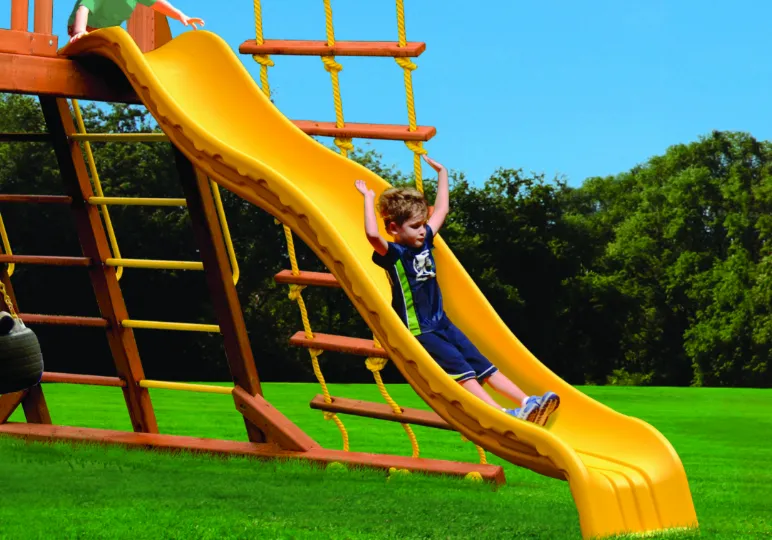
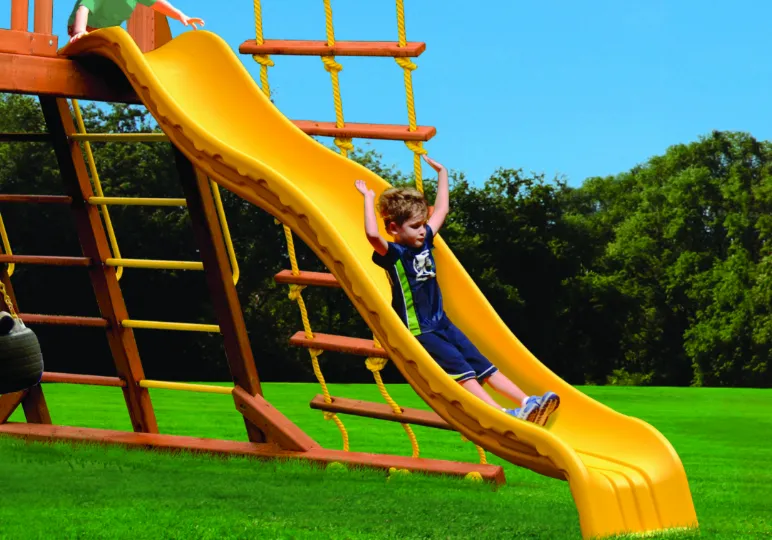
- Original Wave Slide: A classic open-bed wave design featuring gentle changes in elevation along the sliding path. In addition to allowing caregivers and employees to see everything that happens in this facility, there is a great design for kids. The simple construction is compatible with many types of commercial play equipment available on the market today.
- Supreme Super Ride Slide: The long slide is designed to offer the child as pleasurable an experience as possible thanks to its considerable length. When choosing playground slides for kids, it is recommended to consider the height of the platform, position of the slide, as well as its dimensions and the space around it.
Important Purchasing & Specification Criteria for Operators
One should not consider material specifications and safety specifications separately.
- Material Selection & UV Stabilization: Strong and durable plastic material that is rotomolded is used for commercial slides. The double-wall construction eliminates visibility of bolts and other outside reinforcements, thus reducing the chances of scratching or getting stuck on sharp edges. For certain structures, they use natural cedar, whereas facilities and equipment feature zinc and hot-dipped galvanized steel to avoid rust from weather exposure. Sun exposure and weather elements should also be taken into account when designing slides for children.
- Safety Standards Compliance: Ensure that the safety standards have been adhered to on the commercial playground and that the size of the playground is sufficient. In addition to this, ensure the existence of the entry hood, handhold, guardrail, as well as the transition platform and the exit zone. Lastly, check whether the safety, circulation, and fall zones of the entire installation have been correctly designed, and not only the slide section.
- Deck heights according to age groups: Deck heights based on age groups: Any playground equipment used for toddlers aged between 2 and 5 years should have a suitable height, considering their developmental ability in relation to accessible points and angles of incline. Similarly, for children aged 5-12, playground equipment should be designed to allow for higher deck heights as well as any movements requiring coordination and agility. Thus, when choosing playground slides for kids, having a proper deck height allows determining the slide angle and rate of sliding based on the child’s age.
Maintenance and Costs Associated With Owning Equipment
The overall cost of a piece of equipment goes beyond its original price. The operator needs to evaluate its ability to resist vandalism, cracking, fading, and thermal expansion of the material used, especially for regions with large temperature differences. The operators should have an established schedule for inspecting bolts, joints, decks, fences, and surfaces of slides. It would be good to invest in equipment that has available spare parts, so that repairs do not require reconstruction of the whole equipment.
Conclusion
The best playground slides for kids in commercial settings are those which match the venue, children’s ages, manner of supervision, safety requirements, and maintenance possibility. A disciplined specification procedure that addresses configuration, material, play zones, height of decks, climate, and replacement needs makes it possible for facility owners to give kids the latest in play areas.


























Sign in to leave a comment.