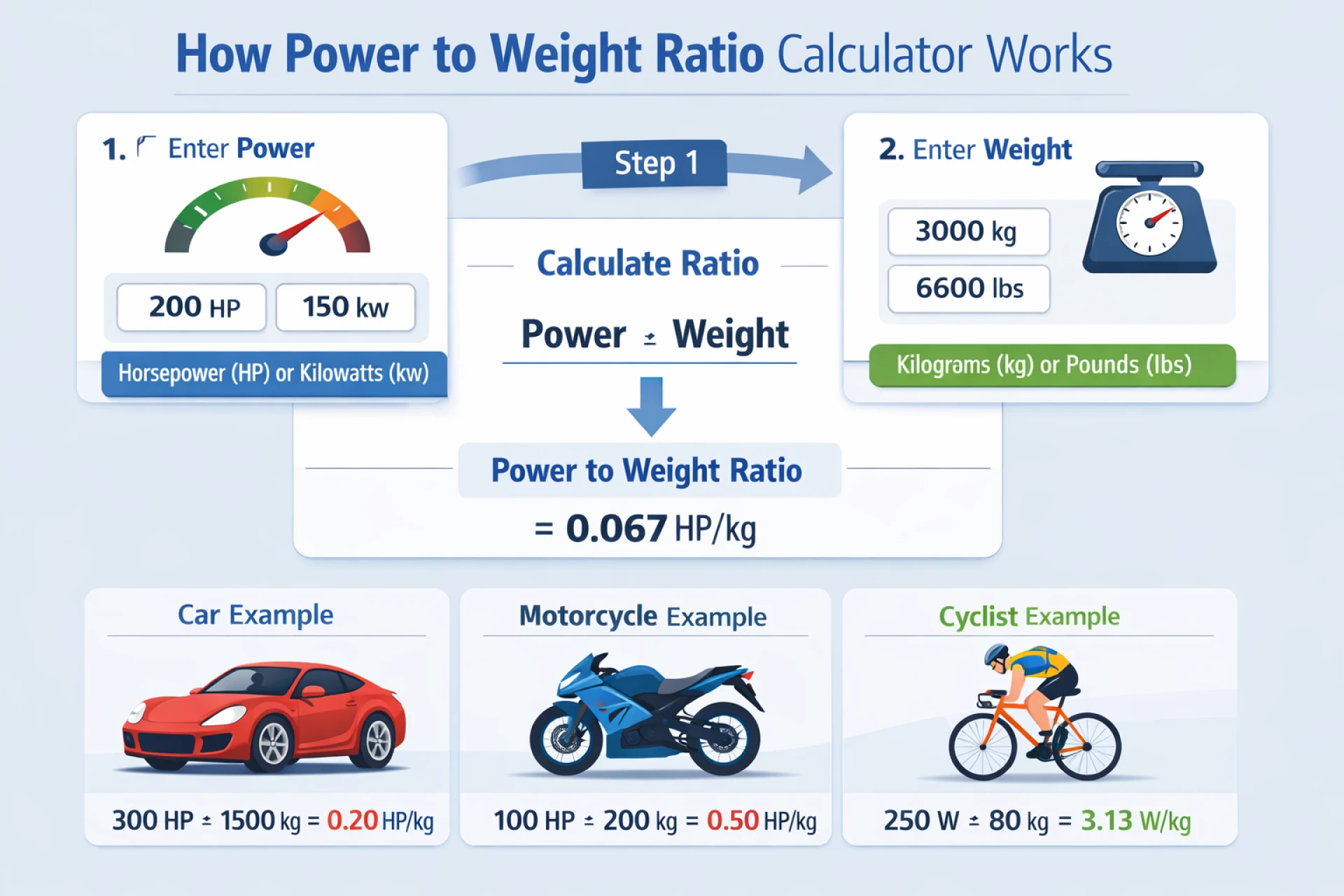

Have you ever wondered why some athletes or cars perform better than others? The secret behind this often comes down to something called the Power to Weight Ratio (PWR). In simple words, it is a measure of how much power a person, vehicle, or machine produces compared to its weight. Knowing this ratio can help you improve performance, make better training plans, or even choose the right vehicle for your needs.
What is Power to Weight Ratio?
The Power to Weight Ratio is a simple calculation. It shows the relationship between power and weight. The higher the ratio, the better the performance.
Formula:
Power to Weight Ratio=PowerWeight\text{Power to Weight Ratio} = \frac{\text{Power}}{\text{Weight}}Power to Weight Ratio=WeightPower
- Power is measured in Watts (for athletes) or Horsepower (HP) (for vehicles).
- Weight is measured in kilograms (kg) or pounds (lbs).
Example for Athlete
Imagine a cyclist who produces 300 Watts of power and weighs 75 kg.
PWR=30075=4 Watts per kg\text{PWR} = \frac{300}{75} = 4 \text{ Watts per kg}PWR=75300=4 Watts per kg
This number tells you how efficiently the cyclist is using their weight to produce power. Higher numbers mean better performance, especially when going uphill or during sprints.
Example for Vehicle
Now, let’s take a car with 200 HP and a weight of 1000 kg.
PWR=2001000=0.2 HP per kg\text{PWR} = \frac{200}{1000} = 0.2 \text{ HP per kg}PWR=1000200=0.2 HP per kg
Cars or bikes with higher PWR accelerate faster and handle better.
Why is Power to Weight Ratio Important?
Knowing your PWR is important for several reasons:
- Athletes and Fitness
- Cyclists, runners, and weightlifters use PWR to measure performance.
- A higher ratio means you are strong and light, which is ideal for endurance sports.
- Trainers use this number to adjust workouts and improve results.
- Vehicles
- Cars, motorcycles, and racing bikes use PWR to measure speed and acceleration.
- A vehicle with a better PWR can reach higher speeds faster, especially in racing or off-road conditions.
- Motivation
- For athletes, tracking PWR can help monitor progress.
- It gives clear evidence of how training is affecting strength and performance.
How to Calculate Power to Weight Ratio?
You don’t need complicated tools. Just follow these steps:
- Find Power
- For athletes, use a power meter or fitness tracker to measure output in Watts.
- For vehicles, check the engine’s horsepower in specifications.
- Find Weight
- For humans, weigh yourself with a scale.
- For vehicles, check manufacturer details.
Apply Formula
PWR=PowerWeight\text{PWR} = \frac{\text{Power}}{\text{Weight}}PWR=WeightPower
- Interpret Results
- Higher values = better performance
- Lower values = slower or less efficient performance
Example Table for Athletes
| Athlete | Power (Watts) | Weight (kg) | PWR (Watts/kg) |
|---|---|---|---|
| Cyclist A | 300 | 75 | 4 |
| Cyclist B | 250 | 70 | 3.57 |
| Runner C | 400 | 80 | 5 |
This table shows how even a small difference in weight or power can affect the overall ratio.
Benefits of Using a Power to Weight Ratio Calculator
Using a calculator makes it easier and faster to get accurate results. Here are some benefits:
- Time-saving – No need to manually calculate.
- Accurate numbers – Helps make better training or vehicle decisions.
- Compare easily – Athletes or vehicles can be compared directly.
- Motivation tool – Seeing numbers improve can inspire you to train more.
Tips to Improve Your Power to Weight Ratio
- Increase Power
- Train harder to increase muscle strength.
- Use interval training for athletes.
- Upgrade engine or modify vehicles for higher output.
- Reduce Weight
- For humans, a healthy weight reduction can improve PWR.
- For vehicles, remove unnecessary weight to improve speed and acceleration.
- Track Progress
- Regularly calculate PWR to see improvement over time.
- Adjust training or modifications based on results.
Common Misconceptions
- Only for Athletes or Cars?
Not really. PWR can be used for any machine or human activity where weight and power matter. - Higher Weight Always Bad?
No. For some activities, like weightlifting, muscle mass is more important than total weight. Balance is key. - PWR Alone Defines Performance
PWR is important but not the only factor. Endurance, technique, and environment also matter.
Conclusion
The Power to Weight Ratio Calculator is a simple yet powerful tool. Whether you are an athlete, cyclist, runner, or vehicle enthusiast, knowing your PWR can help you make better decisions and track performance. By understanding your power and weight, you can plan training, improve efficiency, and reach your goals faster.
























Sign in to leave a comment.