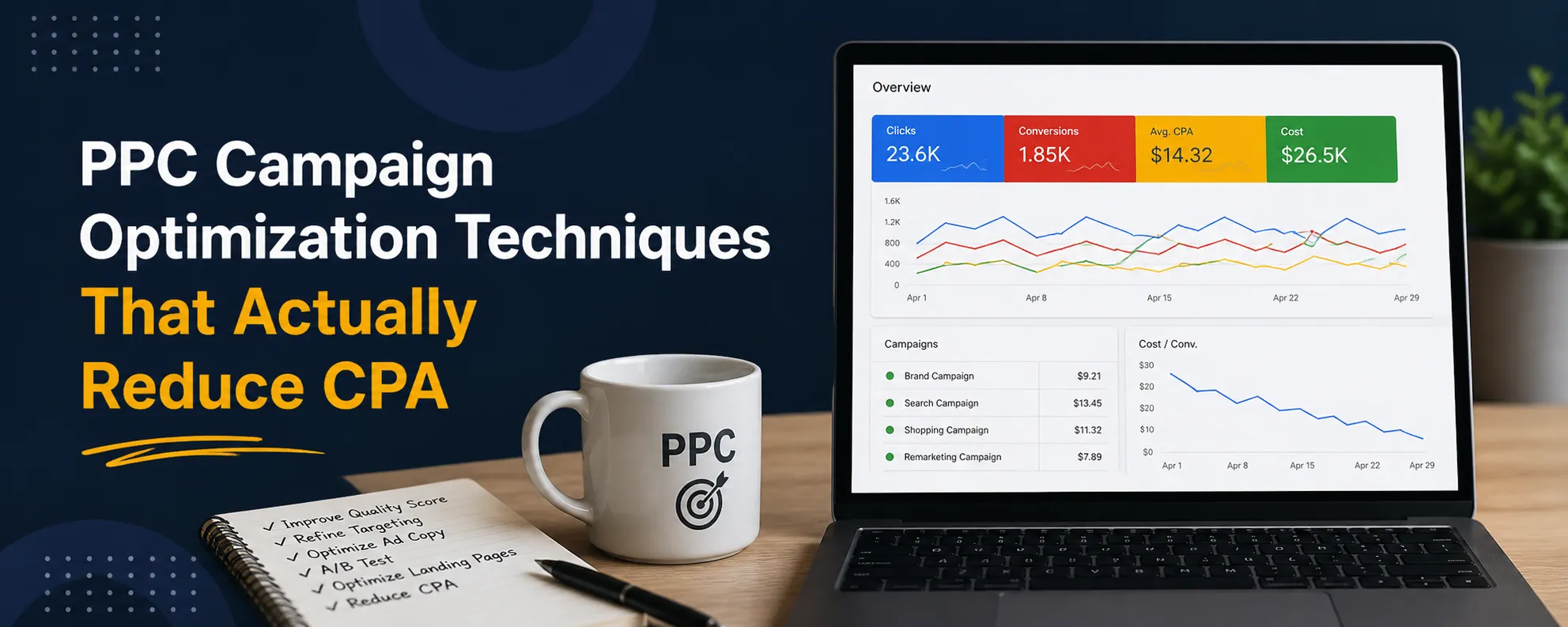

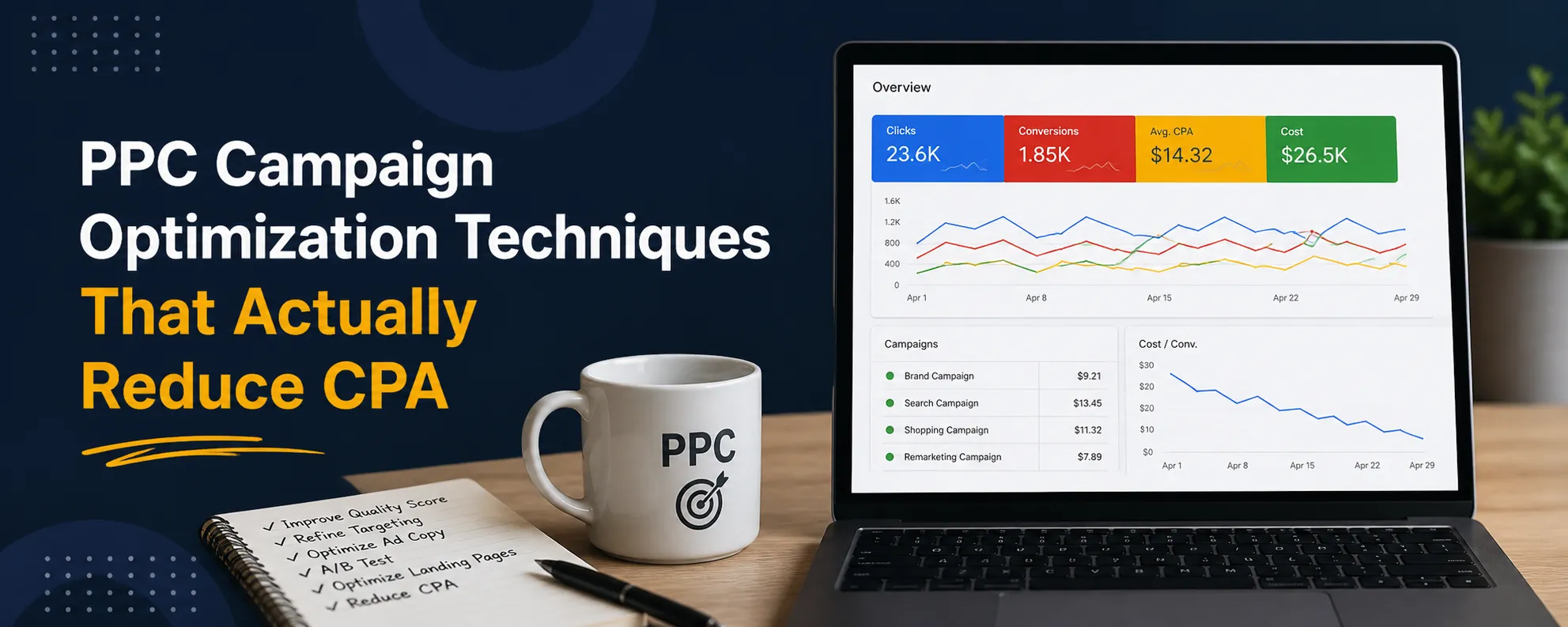
You are spending more on clicks every quarter, yet the cost per acquisition keeps creeping upward. Budgets expand, dashboards fill with impressions, but conversions stay stubbornly flat. For most businesses running paid search, this is not a Google problem — it is an optimization problem.
PPC advertising in the United States is more competitive than it has ever been. Average CPCs across industries have risen sharply, and the default campaign settings most advertisers rely on are deliberately designed to spend, not save. If you are working with PPC services in USA markets — whether in-house or through an agency — understanding where CPA bloat actually comes from is the first step toward eliminating it.
This guide walks through six concrete optimization techniques that go beyond the basics: from bid strategy selection and audience layering to quality score engineering and conversion path analysis. Each section explains what the technique is, why it moves the CPA needle, and how to implement it in a live account.
Understanding CPA and Why It Keeps Rising
Cost per acquisition (CPA) is the total ad spend divided by the number of conversions generated. A CPA of $40 means you spent $40 in ads to get one paying customer or lead. Simple arithmetic — but the drivers behind a rising CPA are anything but simple.
CPA rises when one or more of the following shift: click costs go up, conversion rates go down, or traffic quality degrades. Most advertisers obsess over CPCs and ignore the latter two. The real leverage in any PPC account sits in conversion rate improvement and traffic qualification — two areas where expert PPC services in USA consistently outperform self-managed campaigns.
The CPA formula that matters operationally
Rather than CPA = Spend ÷ Conversions, think of it as:
CPA = CPC ÷ CVR — where CVR is your conversion rate.
A 20% improvement in conversion rate has exactly the same CPA impact as a 20% reduction in CPC. Most advertisers chase cheaper clicks. The smarter play is almost always to improve what happens after the click.
Technique 1: Restructure Match Types Around Intent Stages
The single most overlooked source of CPA waste is match type misuse. Broad match keywords now use Google's machine learning to target based on "intent," which in practice means your ad for "CRM software" can trigger for "free spreadsheet templates." Unless your conversion funnel handles both audiences identically, your CPA will suffer.
How to structure match types for CPA control
- Exact match for proven, high-converting terms — protect these with dedicated ad groups and higher bids.
- Phrase match for qualified variations — test new angles without fully opening the floodgates.
- Broad match only with Target CPA or Target ROAS smart bidding active and a conversion history of at least 50 events per month — otherwise it is guesswork at your expense.
Real-world application: A SaaS company running PPC services in USA markets cut their CPA by 31% in one quarter simply by converting all broad match keywords to phrase match and adding 200+ negative keywords to eliminate informational intent queries.
Technique 2: Layer Audience Signals on Search Campaigns
Search campaigns by default treat all clickers as equal. They are not. A returning visitor who browsed your pricing page and a cold user who has never heard of your brand will rarely convert at the same rate — yet most accounts serve them identical bids.
Audience layering on search (RLSA — Remarketing Lists for Search Ads) lets you adjust bids, messaging, and even landing pages based on who a searcher is, not just what they typed.
Practical audience layers that move CPA
- Pricing/demo page visitors: Bid up by 30–50%. These users are bottom-funnel. They are worth more per click.
- Cart abandoners or form abandoners: Use customized ad copy referencing their previous visit. Relevance improves CVR.
- Customer match lists: Exclude existing customers from acquisition campaigns to stop spending on users who already converted.
- Similar audiences: Expand reach to lookalike users who mirror your best converters — particularly effective for PPC services in USA where audience data pools are deep.
Technique 3: Engineer Quality Score From the Ground Up
Quality Score (QS) is Google's rating of keyword-ad-landing page relevance on a scale of 1–10. A QS of 8 on a keyword means you pay roughly 20–30% less per click than a competitor with QS 5 targeting the same term — for the same ad position. This directly compresses CPA without touching bids.
The three components — expected CTR, ad relevance, and landing page experience — each require a different fix. Most advertisers only address one and wonder why QS stays low.
A systematic QS improvement workflow
- Expected CTR: Tighten ad groups to single keyword themes (SKAGs or close variants). Test 3–4 headlines per ad using Responsive Search Ads and pin proven performers.
- Ad relevance: Ensure the primary keyword appears in headline 1 and the display URL path. This signals to Google — and the user — that the ad is specifically about what was searched.
- Landing page experience: Mirror the ad's core keyword and promise on the landing page's H1 and first paragraph. Page load speed under 3 seconds on mobile is now a QS factor. Google measures it.
Technique 4: Build Micro-Conversion Funnels for Smart Bidding
Smart bidding strategies — Target CPA, Target ROAS, Maximize Conversions — learn from conversion data. The less conversion data you feed them, the worse they perform. This is the central failure mode for small and mid-size advertisers: they set Target CPA but have only 8 conversions per month, leaving Google's algorithm with almost no signal to optimize against.
The fix is micro-conversion tracking. Instead of tracking only "form submitted" or "purchase complete," track the steps users take on the way there.
Which micro-conversions to track
- Scroll depth beyond 60% of a landing page
- Video plays over 50% completion
- Pricing page visits from a paid click session
- Phone number clicks and chat initiations
- Time-on-site thresholds (e.g., 3+ minutes)
Assign these a fractional conversion value (e.g., 0.1 to 0.3) relative to your primary conversion. This feeds the algorithm 5–10× more signals, accelerating learning and stabilizing CPA — a technique widely used by leading PPC services in USA agencies running data-sparse accounts.
Technique 5: Run Systematic Negative Keyword Mining
Every dollar spent on an irrelevant click is a dollar that cannot convert. Negative keyword management is defensive budgeting — it does not generate conversions, but it protects the budget allocated to keywords that do.
Most accounts have a static negative keyword list built at campaign launch and never revisited. Within three months, search term drift means new irrelevant queries are bleeding the budget. Systematic mining should be a weekly — not monthly — task.
A repeatable negative keyword mining process
- Pull search terms report weekly, filtered by zero conversions and spend above your target CPA.
- Categorize irrelevant terms into themes: informational intent (how, what, free), competitor names (if not running conquest), geographic mismatches, unrelated industries.
- Add at the campaign level for broad exclusions and at the ad group level for nuanced control.
- Build a shared negative list across campaigns to prevent one campaign's new exclusions from benefiting only itself.
Technique 6: Align Landing Pages to Keyword Intent Clusters
Sending all traffic to a single homepage or a generic "contact us" page is the fastest way to destroy a healthy CPA. A user who searched "enterprise CRM pricing" and lands on a homepage with six navigation options and a generic headline about "transforming your business" will bounce — and you paid for that click.
Intent-matched landing pages are the highest-leverage CPA reduction move available to most advertisers, because landing page conversion rate is a multiplier on everything else. Improve CVR from 3% to 6%, and CPA halves — regardless of your bids, match types, or audience targeting.
How to build intent-matched landing pages
- Group keywords into intent clusters: awareness, consideration, decision, and competitor comparison.
- Create a distinct landing page for each cluster — each should reflect the specific language of that search intent in the headline, subheading, and CTA.
- Use dynamic keyword insertion sparingly for ultra-relevant headlines without creating hundreds of pages manually.
- A/B test one element at a time: headline first, then CTA, then social proof placement. Multi-variable testing without sufficient traffic volume produces inconclusive data.
Conclusion :
Reducing CPA in PPC is not about finding a magic bid adjustment or a secret keyword tactic. It is about systematically eliminating the gaps between intent and relevance at every stage of the paid click journey — from keyword matching to landing page message to conversion tracking architecture.
The advertisers who consistently achieve lower CPAs than their competitors are not necessarily spending more or using different platforms. They are operating with tighter feedback loops: weekly search term reviews, continuous QS audits, audience-informed bidding, and landing pages that actually match what was searched.
If you are evaluating PPC services in USA providers, use these six techniques as a diagnostic checklist. Any agency or in-house team worth their management fee should be actively working all six — not just setting bids and pulling reports. Your CPA reduction starts with knowing exactly which lever is loose, and having the discipline to tighten it.





























Sign in to leave a comment.