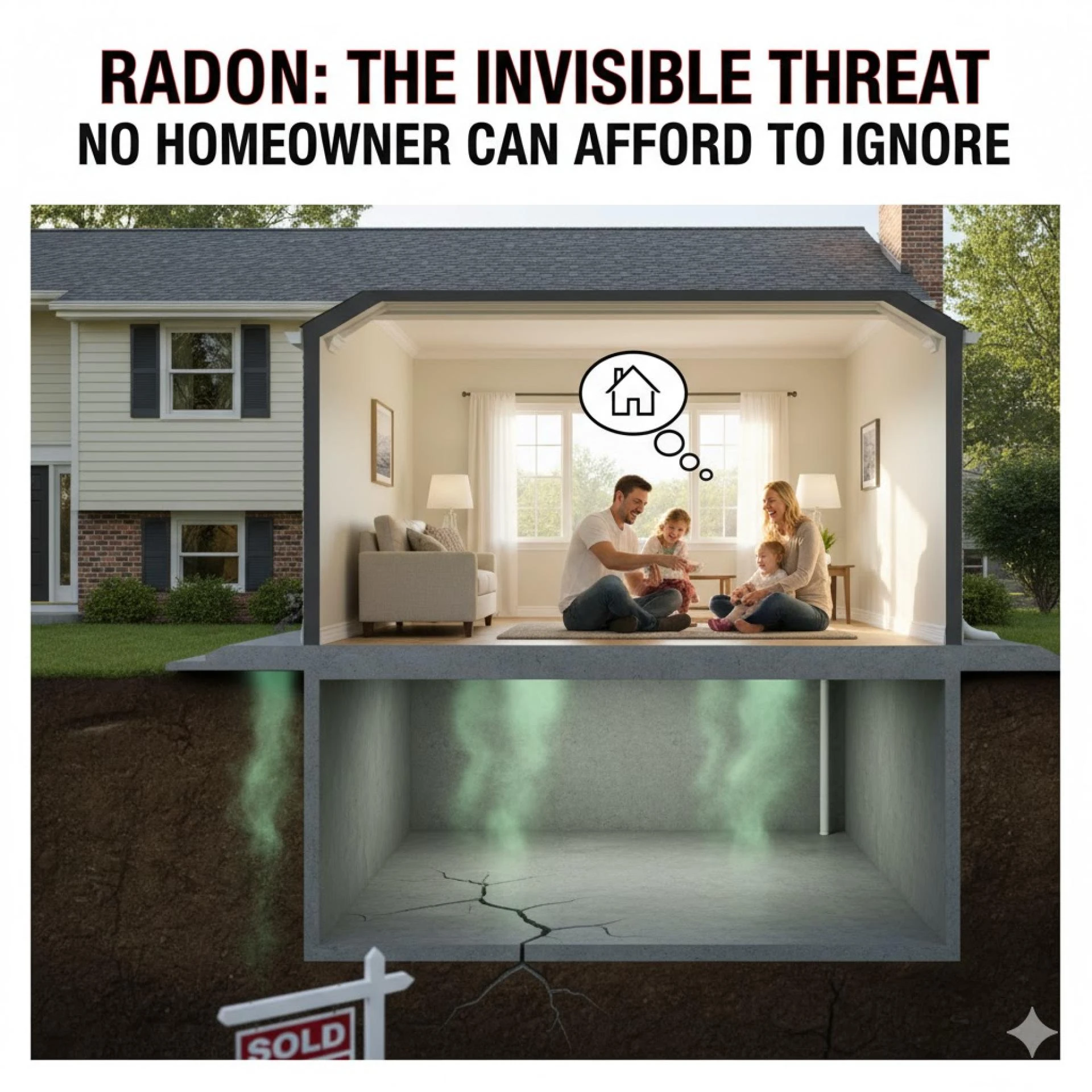

Imagine a gas that can enter your home silently—no smell, no color, no taste—and remain unnoticed for years while slowly damaging your health. You can’t detect it with your senses, and by the time symptoms appear, the damage might already be done.
That gas is radon, and it’s a hidden danger lurking beneath millions of homes across the country. The worst part? Most homeowners have no idea it’s even there.
In this guide, we’ll uncover what radon is, why it’s so dangerous, and what every homeowner must do to detect, prevent, and eliminate this invisible threat before it’s too late.
What Exactly Is Radon?
Radon is a naturally occurring radioactive gas produced when uranium in soil and rock breaks down. It seeps upward through the ground and can enter homes through small cracks in foundations, gaps around pipes, sump pump openings, and even the pores in concrete.
Once inside, radon can accumulate to dangerous levels, especially in basements and lower floors.
What makes radon particularly insidious is that it’s:
- Colorless
- Odorless
- Tasteless
- Completely undetectable without testing
You could be breathing radon every day without realizing it.
Why Radon Is a Serious Health Hazard
According to the Environmental Protection Agency (EPA), radon is the second leading cause of lung cancer in the United States—right after smoking. Each year, it’s responsible for an estimated 21,000 deaths nationwide.
When inhaled, radon particles release radiation that damages the lining of your lungs. Over time, this radiation causes cellular mutations, leading to cancer. The risk is even greater for smokers, but non-smokers aren’t safe either—in fact, radon is the leading cause of lung cancer among non-smokers.
How Radon Exposure Works
- You breathe in radon gas.
- Radioactive particles attach to your lung tissue.
- These particles emit radiation, damaging cells over time.
- Years of exposure can lead to lung cancer.
The frightening truth? You won’t feel anything until it’s too late. There are no immediate symptoms or warning signs—only prevention and testing can protect you.
Is Radon Really That Common?
Yes—and probably more common than you think.
The EPA estimates that 1 in 15 U.S. homes has unsafe radon levels above the recommended limit of 4 picocuries per liter (pCi/L).
Certain states, such as Iowa, Pennsylvania, Colorado, and Oregon, have areas with naturally higher radon concentrations due to geological factors. However, radon has been detected in every single state, making no home truly immune.
Even if your neighbor’s test came back low, your home could still have high levels. Radon travels independently through soil and can vary dramatically from one property to the next—even within the same block.
How Radon Enters Your Home
Radon gas naturally rises from the ground, seeking the path of least resistance. It can infiltrate your home through:
- Cracks in concrete foundations or basement floors
- Gaps in walls or between construction joints
- Openings around service pipes, cables, or drains
- Crawl spaces and sump pits
- Well water (in some cases)
Once it’s inside, modern energy-efficient homes—designed to be airtight—can actually trap radon inside, allowing levels to build up over time.
How to Know If Your Home Has Radon
The only way to know your radon levels is through testing. It’s simple, affordable, and takes minimal effort.
Short-Term Tests
- Measure radon levels over 2–7 days
- Great for quick checks or real estate transactions
- Available for under $25 at hardware stores or online
- Easy to use—place the kit in your home’s lowest livable level and send it to the lab afterward
Long-Term Tests
- Measure radon levels over 90 days or more
- Provide a more accurate average over time
- Recommended for annual or biannual monitoring
Professional Testing
For high accuracy, especially when selling or buying a home, consider hiring a certified radon professional. They use advanced equipment and can help interpret the results correctly.
Understanding Your Radon Test Results
Your radon test results will come back in picocuries per liter (pCi/L)—a measure of radioactive concentration in the air.
Here’s how to interpret them:
- Below 2 pCi/L: Excellent — low risk
- 2–3.9 pCi/L: Moderate — consider retesting or mitigation
- 4 pCi/L or higher: Action level — take immediate steps to reduce radon
Even small improvements can make a big difference. The EPA and World Health Organization both recommend lowering levels as much as possible, since no amount of radon exposure is completely safe.
How Radon Is Fixed: The Mitigation Process
If your test shows elevated radon levels, don’t panic—the problem can be solved.
A radon mitigation system is designed to vent the gas safely outside before it enters your living spaces. Here’s how it works:
- A suction pipe is installed beneath your foundation or slab.
- A quiet fan system pulls radon gas from the soil.
- The gas is vented outdoors, above your roofline.
- Cracks and openings in your foundation are sealed to prevent re-entry.
These systems typically cost between $1,200 and $2,500, and they can reduce radon levels by up to 99%. Most installations take less than a day.
Once installed, the system operates continuously and requires minimal maintenance—just an occasional fan check and retesting every few years.
DIY vs. Professional Radon Solutions
If you’re confident with basic home maintenance, a DIY test kit is a great first step. It’s inexpensive and provides a quick snapshot of your home’s radon levels.
However, professional testing offers more accuracy and reliability—especially when radon levels are borderline or when buying/selling a property.
Similarly, while radon mitigation is best handled by licensed professionals, homeowners can take preventive steps to minimize risk:
- Seal visible foundation cracks with caulk or epoxy
- Improve ventilation in lower levels
- Use air purifiers with activated carbon filters
- Maintain HVAC systems for proper air circulation
These measures won’t eliminate radon completely, but they can help reduce concentrations until professional mitigation is complete.
The Real Cost of Ignoring Radon
Some homeowners delay radon testing because they assume it’s “not urgent.” But that mindset can be dangerous—and costly.
Here’s what ignoring radon could mean:
- Increased lung cancer risk over time
- Medical costs that can exceed hundreds of thousands of dollars
- Reduced property value if high radon levels are discovered later
- Failed home inspections that delay or derail sales
A simple radon test costs less than $25 and takes minutes to set up. Compared to the potential consequences, that’s a small investment for lifelong safety.
Radon Myths That Put Homeowners at Risk
Let’s debunk a few common misconceptions:
- Myth 1: “Radon isn’t a problem in new homes.”
- Fact: New, airtight homes often trap more radon than older ones.
- Myth 2: “My neighbor tested, so I don’t need to.”
- Fact: Radon levels vary dramatically—even between houses next door.
- Myth 3: “I’ll know if there’s radon by how I feel.”
- Fact: Radon has no symptoms until it’s too late.
- Myth 4: “Mitigation is too expensive.”
- Fact: Most systems are affordable, quick to install, and highly effective.
Radon and Real Estate: A Deal-Breaker or Deal-Maker
Radon testing is becoming a standard part of home inspections. In many areas, sellers are legally required to disclose past radon results.
If you’re selling, a low radon report or an existing mitigation system can increase buyer confidence and even boost your home’s market value.
If you’re buying, always request radon test results or perform your own test during the inspection phase. It’s a small step that ensures you’re not inheriting a hidden hazard.
How Often Should You Test for Radon?
Testing isn’t a one-and-done process. You should retest your home every 2–3 years, or sooner if:
- You’ve completed renovations or foundation repairs
- You’ve added insulation or sealed your home for energy efficiency
- You’ve installed a new HVAC system that changes airflow
Radon levels can change over time due to weather, soil movement, and structural changes—so make testing part of your regular home maintenance routine.
Conclusion: Protect Your Home, Protect Your Health
Radon may be invisible, but its effects are devastatingly real. As a homeowner, the power to detect and eliminate it is in your hands.
Testing takes minutes, mitigation is affordable, and the benefits last a lifetime. There’s no excuse to wait, and no home that’s automatically safe.
Don’t ignore the invisible threat beneath your home. Visit https://www.radonmitigationpdx.com/ to schedule a professional radon test or learn more about simple, effective mitigation options.
Test for radon today—and breathe easier knowing you’ve protected your family from one of the most preventable health risks out there.






















Sign in to leave a comment.