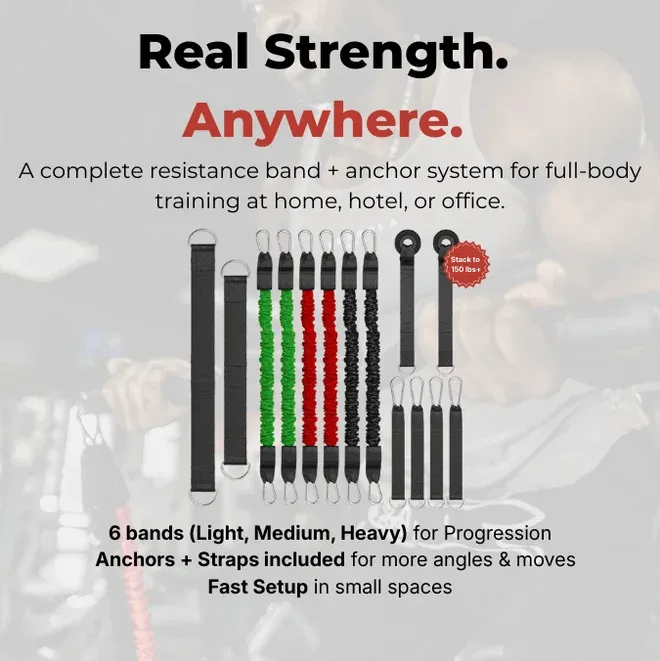

Resistance bands have become a popular choice for people who want to exercise at home, while traveling, or without relying on large gym equipment. They are lightweight, easy to store, and can be used for many different movements. Unlike traditional weights, resistance bands create tension as they stretch, which makes them useful for strength training, mobility work, warm-ups, and conditioning.
For beginners, choosing the right equipment can sometimes be confusing because resistance bands are available in different shapes, sizes, and resistance levels. This guide explains how resistance bands work, what to look for in a set, and how they can fit into a regular workout routine.
What Are Resistance Bands?
Resistance bands are elastic exercise tools designed to provide resistance during movement. As the band stretches, it creates tension that your muscles have to work against. The amount of resistance depends on the band's thickness, length, material, and how far it is stretched.
They can be used for both upper- and lower-body exercises. Depending on the type, a band can be used for movements such as rows, presses, squats, curls, lateral walks, and assisted pull-ups.
One advantage of bands is that they do not take up much space. A few bands can easily fit into a small bag or drawer, making them practical for home workouts and travel.
Why Use a Set Instead of One Band?
A single resistance band may be useful for specific exercises, but having several resistance levels provides more flexibility.
Different muscles and exercises require different amounts of resistance. For example, you may need lighter resistance for shoulder exercises but significantly more resistance for squats or rows.
Resistance bands sets usually include multiple levels, allowing you to change the difficulty depending on the exercise. They can also help you gradually increase resistance as your strength improves.
Another benefit is that some sets allow bands to be combined. This can provide additional resistance when a single band is no longer challenging enough.
Common Types of Resistance Bands
Not all resistance bands are designed for the same purpose. Understanding the main types can make it easier to choose equipment that matches your workouts.
Loop Bands
Loop bands form a continuous circle and are commonly used for lower-body exercises. They can be placed around the thighs or ankles for movements such as lateral walks, glute exercises, and squats.
Larger loop bands can also be used for strength exercises and assisted pull-ups.
Tube Bands With Handles
These bands usually have handles attached to their ends. They are useful for exercises that resemble cable-machine movements, including chest presses, rows, shoulder presses, and biceps curls.
Some sets also include accessories such as door anchors or ankle straps, which can increase the number of exercises you can perform.
Mini Bands
Mini bands are smaller loops designed mainly for hip and lower-body movements. They are often used during warm-ups or activation exercises before strength training.
Flat Resistance Bands
Flat bands are long, flexible strips that can be used for stretching, mobility exercises, light resistance training, and rehabilitation movements. Their simple design makes them easy to carry and store.
Benefits of Resistance Band Training
Resistance bands can be useful for several types of training.
Portable workouts: Bands are considerably easier to carry than most traditional gym equipment, making them suitable for travel or small workout spaces.
Adjustable difficulty: Changing the band's resistance, stretch length, or position can make an exercise easier or harder.
Full-body training: With the right combination of bands and exercises, you can train your legs, back, chest, shoulders, arms, and core.
Variable resistance: Unlike free weights, bands generally become harder to stretch as their length increases. This creates a different resistance pattern throughout an exercise.
Space-saving: A collection of bands takes up very little storage space compared with dumbbells or larger exercise machines.
Resistance-band training can also be used alongside traditional weights rather than replacing them completely. Some people use bands for warm-ups, accessory exercises, or movements where they want a different type of resistance.
How to Choose the Right Resistance Band Set
There is no single resistance band set that works perfectly for everyone. Your choice should depend on your experience, training goals, and the exercises you plan to perform.
Consider Your Fitness Level
If you are new to resistance training, starting with lighter resistance can make it easier to learn proper technique. More experienced users may prefer medium, heavy, or multiple resistance levels.
Look at the Resistance Range
Check how the resistance levels are described before choosing a set. Band colors are not standardized between manufacturers, so the same color does not necessarily mean the same resistance across different brands.
Think About the Exercises You Want to Do
If you mainly want to train your hips and legs, loop or mini bands may be enough. If you want to perform exercises such as rows, presses, and curls, tube bands with handles may offer more versatility.
Check the Accessories
For some workouts, accessories can make a difference. Handles, door anchors, ankle straps, and other attachments can provide additional exercise options.
Simple Exercises to Try
Resistance bands can be incorporated into a basic full-body workout. Some beginner-friendly movements include:
- Band squats for the legs and glutes
- Standing rows for the back
- Chest presses for the chest and arms
- Biceps curls for the arms
- Shoulder presses for the shoulders
- Lateral band walks for the hips and glutes
- Glute bridges for the lower body
- Pallof presses for the core
Start with resistance that allows you to maintain good control throughout the movement. As your technique improves, you can gradually increase the resistance or repetitions.
Resistance Bands vs. Traditional Weights
Resistance bands and free weights both have their place in strength training. Dumbbells and barbells provide a more consistent load based on gravity, while bands increase tension as they stretch.
Bands can be particularly useful when portability and storage are important. Free weights, on the other hand, may be preferable for people who want to work with clearly defined loads and progressively heavier weights.
For many people, the two can also complement each other. There is no requirement to choose only one type of equipment.
Safety Tips When Using Resistance Bands
Proper setup and technique are important when training with elastic bands. Before each workout, inspect the band for cracks, tears, thinning, or other visible damage.
Make sure the band is securely positioned or anchored before starting an exercise. Avoid overstretching it beyond its intended range, and maintain controlled movement rather than allowing the band to snap back suddenly.
If an exercise causes unusual pain, stop and reassess your technique or resistance. Beginners who are unsure about exercise selection or have existing injuries may benefit from guidance from a qualified fitness professional or healthcare provider.
Final Thoughts
Resistance bands can be a practical addition to many workout routines. Their small size, adjustable resistance, and range of available styles make them suitable for beginners as well as more experienced users.
When choosing resistance bands sets, focus less on having the largest collection and more on getting resistance levels and band types that match your training goals. A well-chosen set can provide enough variety for full-body workouts while remaining easy to store and transport.



















Sign in to leave a comment.