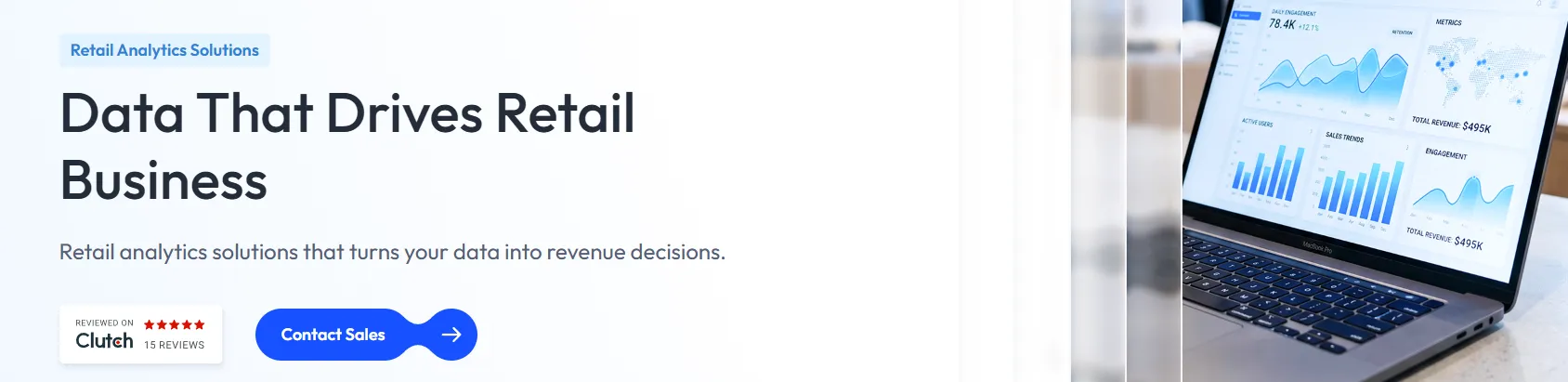

The retail industry has undergone a remarkable transformation over the last decade. What once relied heavily on intuition, historical trends, and manual decision-making is now powered by advanced analytics, artificial intelligence, and real-time data. Retailers that successfully embrace data-driven strategies are improving customer experiences, optimizing inventory, increasing profitability, and gaining a significant competitive advantage.
Retail analytics has become one of the most valuable assets for modern businesses. From global retail giants to fast-growing e-commerce brands, organizations are using data to understand customer behavior, predict demand, personalize marketing campaigns, and streamline operations.
This article explores several retail analytics success stories and demonstrates how data-driven decision-making is helping companies achieve sustainable growth. We will also examine the key lessons retailers can learn from these examples and why investing in modern retail analytics solutions has become essential for long-term success.
The Growing Importance of Retail Analytics
Retail analytics refers to the process of collecting, analyzing, and interpreting data from various sources, including:
- Point-of-sale systems
- Customer loyalty programs
- E-commerce platforms
- Mobile applications
- Supply chain systems
- Social media channels
- Customer service interactions
By transforming raw data into actionable insights, retailers can make smarter business decisions across every area of operation.
Today’s consumers expect personalized experiences, seamless omnichannel interactions, and immediate product availability. Meeting these expectations requires visibility into customer preferences, inventory levels, and market trends in real time.
Retailers that leverage analytics effectively are able to:
- Improve customer retention
- Increase sales conversions
- Optimize inventory management
- Reduce operational costs
- Enhance pricing strategies
- Forecast demand more accurately
- Deliver personalized shopping experiences
The following examples demonstrate how some of the world's most successful retailers have turned data into measurable business growth.
Walmart: Optimizing Inventory Through Data
Walmart is frequently cited as one of the most advanced users of retail analytics. Operating thousands of stores worldwide requires precise inventory management and supply chain coordination.
The company processes enormous volumes of transactional and operational data every day. By analyzing customer purchasing patterns, seasonal trends, weather conditions, and regional preferences, Walmart can forecast demand with exceptional accuracy.
The Challenge
Managing inventory across thousands of locations presents significant challenges:
- Avoiding stockouts
- Preventing overstock situations
- Reducing waste
- Maintaining customer satisfaction
Even small forecasting errors can result in millions of dollars in lost revenue or excess inventory.
The Analytics Strategy
Walmart utilizes predictive analytics and machine learning models to:
- Forecast product demand
- Optimize replenishment schedules
- Improve warehouse operations
- Adjust inventory levels by location
Rather than applying the same inventory strategy across all stores, Walmart analyzes local purchasing behavior to tailor inventory decisions to specific regions.
Results
The company's data-driven approach has helped:
- Improve inventory availability
- Reduce stock shortages
- Increase operational efficiency
- Enhance customer satisfaction
Walmart’s success demonstrates how analytics can transform inventory management from a reactive process into a proactive growth driver.
Target: Using Customer Data for Personalized Marketing
Target is another retailer that has become synonymous with advanced data analytics.
The company has invested heavily in understanding customer behavior and creating highly personalized shopping experiences.
The Challenge
Consumers are exposed to thousands of marketing messages every day. Generic campaigns often fail to generate engagement or conversions.
Target needed a way to deliver relevant offers that matched individual customer needs and preferences.
The Analytics Strategy
Target analyzes multiple customer data points, including:
- Purchase history
- Product preferences
- Shopping frequency
- Loyalty program interactions
- Digital behavior
Using predictive analytics, the company identifies patterns that help anticipate future purchasing decisions.
Target’s analytics platform enables highly targeted marketing campaigns that reach customers with personalized promotions at the right time.
Results
The benefits include:
- Higher customer engagement
- Improved conversion rates
- Increased customer loyalty
- Better marketing ROI
This success story highlights the power of customer analytics in building stronger relationships and increasing revenue.
Starbucks: Turning Customer Data into Loyalty
Although Starbucks is often viewed as a coffee company, it is also one of the most sophisticated users of retail analytics.
The Starbucks Rewards program generates valuable customer insights that help the company personalize experiences and improve retention.
The Challenge
Maintaining customer loyalty in a highly competitive market requires more than offering quality products.
Starbucks needed a way to increase customer engagement while encouraging repeat purchases.
The Analytics Strategy
Starbucks combines data from:
- Mobile app usage
- Rewards program activity
- Purchase history
- Location data
- Seasonal trends
Advanced analytics helps the company recommend products, send personalized offers, and identify customer preferences.
For example, customers may receive promotions based on their previous orders, visit frequency, or preferred store locations.
Results
The company has achieved:
- Increased loyalty program participation
- Higher customer retention
- Greater average order value
- Improved customer satisfaction
Starbucks demonstrates how analytics can create highly personalized customer journeys that drive long-term growth.
Amazon: Mastering Product Recommendations
No discussion of retail analytics success stories would be complete without Amazon.
The company has built much of its success around data-driven decision-making.
The Challenge
With millions of products available, helping customers find relevant items quickly is essential.
Without personalization, customers can become overwhelmed by choice.
The Analytics Strategy
Amazon analyzes:
- Browsing behavior
- Purchase history
- Search activity
- Product ratings
- Shopping cart data
Its recommendation engine uses sophisticated algorithms to predict what customers are most likely to purchase.
The system continuously learns from customer interactions and adapts recommendations in real time.
Results
Amazon's recommendation technology contributes significantly to:
- Increased cross-selling
- Higher conversion rates
- Improved customer experience
- Greater customer lifetime value
The company's success illustrates how predictive analytics can directly influence revenue growth.
Zara: Data-Driven Fashion Retail
Fashion retail is notoriously difficult because trends change rapidly.
Zara has become a global leader by leveraging analytics to respond quickly to customer demand.
The Challenge
Fashion retailers face constant uncertainty regarding:
- Consumer preferences
- Seasonal trends
- Product demand
- Inventory allocation
Producing too much inventory can result in costly markdowns.
The Analytics Strategy
Zara collects data from stores worldwide, including:
- Sales performance
- Customer feedback
- Product returns
- Store-level demand
This information allows the company to identify emerging trends and adjust production accordingly.
Rather than relying solely on long-term forecasts, Zara uses near-real-time analytics to make inventory and production decisions.
Results
Benefits include:
- Faster trend identification
- Reduced excess inventory
- Higher sell-through rates
- Improved profitability
Zara’s model demonstrates how analytics can increase agility and responsiveness in fast-moving retail environments.
Sephora: Personalization at Scale
Beauty retailer Sephora has embraced analytics to deliver personalized shopping experiences across digital and physical channels.
The Challenge
Beauty consumers often struggle to find products that match their unique preferences and needs.
Sephora wanted to simplify product discovery while increasing customer engagement.
The Analytics Strategy
The company uses analytics to analyze:
- Customer profiles
- Purchase behavior
- Product preferences
- Loyalty program activity
AI-powered recommendation engines suggest products tailored to individual customers.
Sephora also uses data to improve in-store experiences and support beauty advisors with customer insights.
Results
The company has achieved:
- Higher customer satisfaction
- Increased loyalty
- Better product recommendations
- Stronger omnichannel engagement
Sephora’s success highlights how analytics can create highly personalized retail experiences at scale.
Common Success Factors Behind Data-Driven Growth
Although these retailers operate in different sectors, their success stories reveal several common themes.
1. Customer-Centric Decision Making
Successful retailers place customer data at the center of their strategy.
Rather than making assumptions, they use analytics to understand actual customer behavior and preferences.
2. Predictive Analytics
Forward-looking insights are often more valuable than historical reporting.
Predictive models help retailers anticipate demand, identify trends, and respond proactively.
3. Real-Time Visibility
Access to real-time data enables faster decision-making and greater operational agility.
Retailers can quickly adapt to changing customer needs and market conditions.
4. Personalization
Personalized experiences consistently drive higher engagement and conversion rates.
Analytics makes it possible to deliver relevant recommendations, promotions, and communications at scale.
5. Continuous Optimization
Leading retailers treat analytics as an ongoing process rather than a one-time initiative.
They continuously refine models, test strategies, and improve performance based on new insights.
The Role of Technology Partners in Retail Analytics Success
Building advanced analytics capabilities requires more than data collection. Retailers need scalable technology infrastructure, integration expertise, and advanced engineering support.
This is where technology partners play a critical role.
Companies such as Zoolatech help retailers develop and implement modern digital platforms that support advanced analytics, artificial intelligence, and data-driven decision-making. By combining engineering expertise with retail industry knowledge, organizations can accelerate innovation and unlock greater value from their data investments.
Modern retail analytics solutions enable businesses to consolidate data from multiple sources, create unified customer views, automate reporting, and deploy predictive models that drive measurable business outcomes.
As retail becomes increasingly digital, the ability to transform data into actionable intelligence will continue to separate industry leaders from their competitors.
Looking Ahead: The Future of Retail Analytics
Retail analytics is evolving rapidly with advancements in:
- Artificial intelligence
- Machine learning
- Computer vision
- Generative AI
- Real-time analytics
- IoT-enabled retail environments
Future retail environments will become even more personalized, predictive, and automated.
Retailers will be able to:
- Predict customer needs before they arise
- Optimize pricing dynamically
- Automate inventory decisions
- Enhance customer experiences across channels
- Improve operational efficiency at unprecedented levels
Organizations that invest in analytics today will be better positioned to compete in the increasingly data-driven retail landscape of tomorrow.
Conclusion
The success stories of Walmart, Target, Starbucks, Amazon, Zara, and Sephora demonstrate the transformative power of retail analytics. These companies have shown that data is no longer simply a reporting tool—it is a strategic asset that drives growth, improves customer experiences, and creates sustainable competitive advantages.
Whether through personalized marketing, predictive inventory management, customer loyalty programs, or recommendation engines, analytics has become a fundamental component of modern retail success.
For retailers seeking long-term growth, investing in data capabilities and advanced retail analytics solutions is no longer optional. It is a strategic necessity. Companies that successfully harness their data will be better equipped to anticipate market changes, meet customer expectations, and thrive in an increasingly competitive retail environment.






























Sign in to leave a comment.