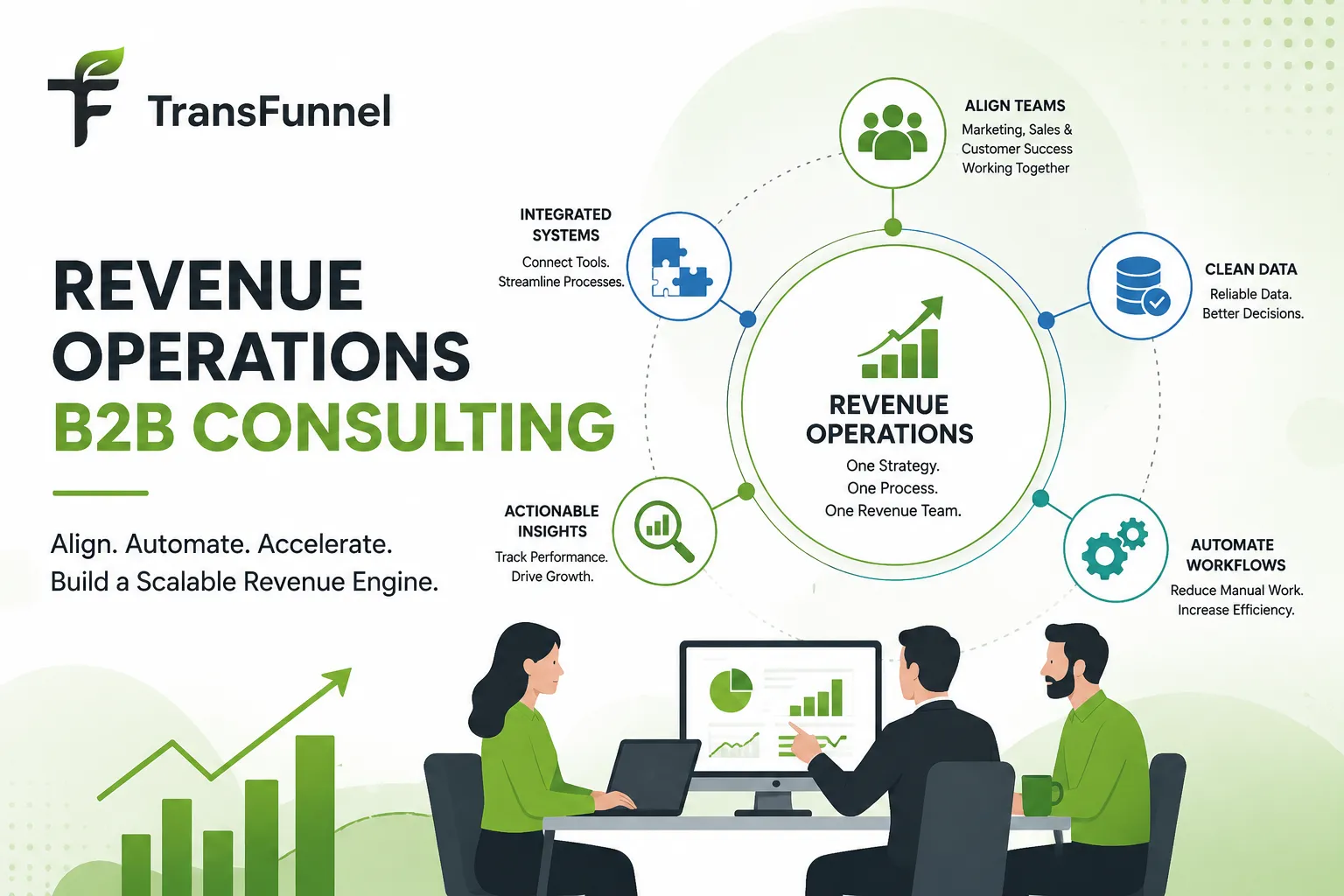

B2B growth becomes harder when marketing, sales, and customer success teams are working with different processes, tools, and goals. Leads may be generated but not followed up consistently; sales teams may lack reliable pipeline data, and leadership may struggle to understand where revenue is being won or lost.
This is where Revenue Operations B2B Consulting can make a meaningful difference. Instead of optimizing one department at a time, Revenue Operations (RevOps) looks at the complete revenue journey and finds ways to make people, processes, data, and technology work together.
What Does Revenue Operations Consulting Actually Solve?
RevOps is not simply about implementing another CRM or adding more automation. The goal is to create a connected operating model that makes revenue generation easier to manage and measure.
A B2B company may benefit from consulting when it experiences challenges such as:
- Marketing and sales disagreeing about lead quality
- Different teams using inconsistent customer data
- Manual reporting taking hours every week
- Sales pipelines becoming difficult to forecast
- Too many disconnected business applications
- Customer handoffs being inconsistent
- Revenue teams spending time on repetitive administrative work
These issues can appear small individually, but together they can slow growth and make the customer journey harder to manage.
Why B2B Companies Are Turning to RevOps
As companies grow, their revenue processes naturally become more complicated. More employees, customers, tools, campaigns, and sales opportunities mean more information needs to move between teams.
Without a clear operating structure, businesses often respond by adding more software or creating manual processes. Unfortunately, more tools don't necessarily solve an underlying process problem.
Revenue Operations takes a different approach. It starts by understanding how revenue currently moves through the business and then identifies opportunities to improve the process.
For example, a RevOps strategy might connect lead generation with automated qualification, improve lead routing, standardize sales stages, and create reporting that gives leadership a clearer view of pipeline performance.
5 Areas a RevOps Consultant Can Improve
1. CRM and Data Management
A CRM should help teams make decisions, not create additional confusion. Consulting can help businesses improve data quality, standardize lifecycle stages, remove unnecessary duplication, and establish better CRM governance.
2. Marketing and Sales Alignment
When marketing and sales operate around different definitions of success, opportunities can fall through the cracks. RevOps helps establish shared processes, definitions, KPIs, and handoff rules.
3. Workflow Automation
Manual lead assignments, repetitive data entry, reporting, and follow-ups can consume valuable employee time. Well-designed automation can reduce these tasks while creating more consistent processes.
4. Pipeline Visibility
Leadership needs to know what is happening across the revenue funnel. Better dashboards and standardized reporting can make it easier to identify bottlenecks, understand pipeline health, and plan resources.
5. Customer Lifecycle Management
Revenue doesn't end when a prospect becomes a customer. Onboarding, retention, renewals, expansion, and customer advocacy all contribute to long-term growth. RevOps brings these stages into the broader revenue strategy.
When Should a Business Consider Revenue Operations Consulting?
There isn't a single company size at which RevOps suddenly becomes necessary. Instead, businesses should look for operational warning signs.
If your team is constantly fixing CRM data, manually combining reports, struggling with sales forecasts, or adding new tools without improving productivity, your revenue operations may need attention.
The same applies when a business is growing quickly. Processes that worked for a small team may not work when there are multiple sales teams, markets, products, or customer segments.
A structured RevOps assessment can help identify whether the problem lies in technology, processes, data, team alignment—or a combination of all four.
Choosing the Right RevOps Consulting Partner
The right consultant should look beyond individual software platforms and understand the business behind the technology.
Before choosing a partner, consider their experience with:
- B2B revenue processes
- CRM implementation and optimization
- Marketing and sales alignment
- Workflow automation
- System integrations
- Revenue analytics and reporting
- Change management and user adoption
It's also worth asking how they measure success. A good engagement should connect operational improvements to meaningful business outcomes rather than simply delivering a list of technical changes.
Build a Revenue Engine That Can Scale
Revenue Operations is ultimately about creating a business that can grow without allowing operational complexity to grow at the same pace.
With the right strategy, B2B companies can create clearer processes, more reliable data, stronger collaboration, and better visibility across the customer journey.
If you're evaluating your current revenue operations or planning a more structured RevOps strategy, a detailed guide to RevOps consulting for B2B companies can help you understand the areas worth evaluating before choosing your approach.
The goal isn't to make your teams work harder. It's to build an operating system that allows them to work better, faster, and with greater visibility into revenue performance.

























Sign in to leave a comment.