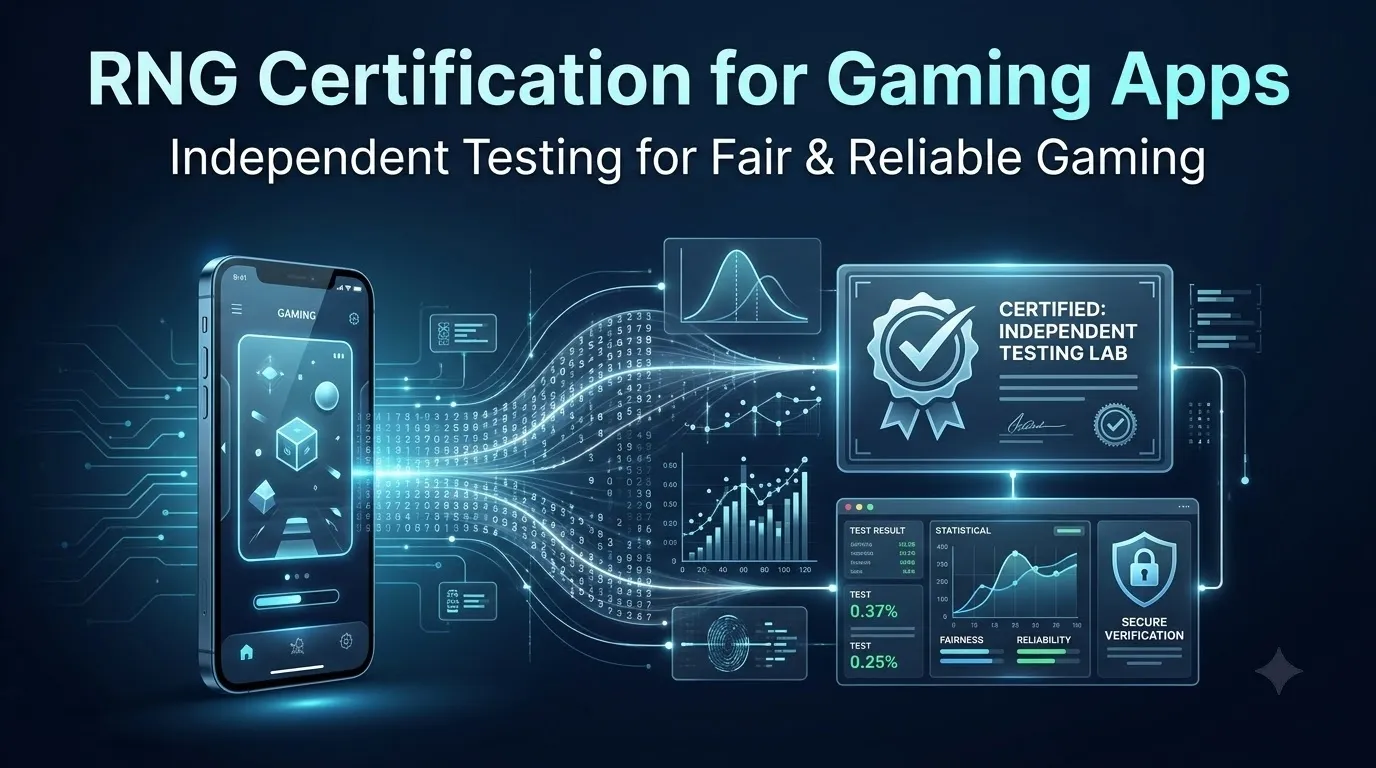

Random outcomes are an essential component of any digital game. From cards, dice, slots, numbers, and other sources of randomness each game outcome can be affected, so verifying fairness and lack of manipulation is crucial. Such verification is provided by RNG certification for gaming apps.
A random number generator (RNG) is a hardware- or software-based system that generates random values that can be used to create random game outcomes.
The RNG certification process ensures that these outcomes are truly random and not biased toward the operator. However, there is more to RNG certification than the standard “it’s certified” seal. The specifics of the test largely depend on the product type and the jurisdiction.
What Is RNG Certification?
RNG certification is an independent technical audit of a Random Number Generator implemented in a gaming product. The audit is performed by an approved testing laboratory that assesses the implementation and the outcomes produced by the RNG for conformity to specific technical criteria.
For instance, Gaming Laboratories International develops RNG evaluation for iGaming products that comprise source-code examination, RNG period, range, seeding, and background activity tests, and statistical analyses. The audit aims to verify that the random number generator operates as designed and not otherwise.
Why RNG Certification Matters for Gaming Apps
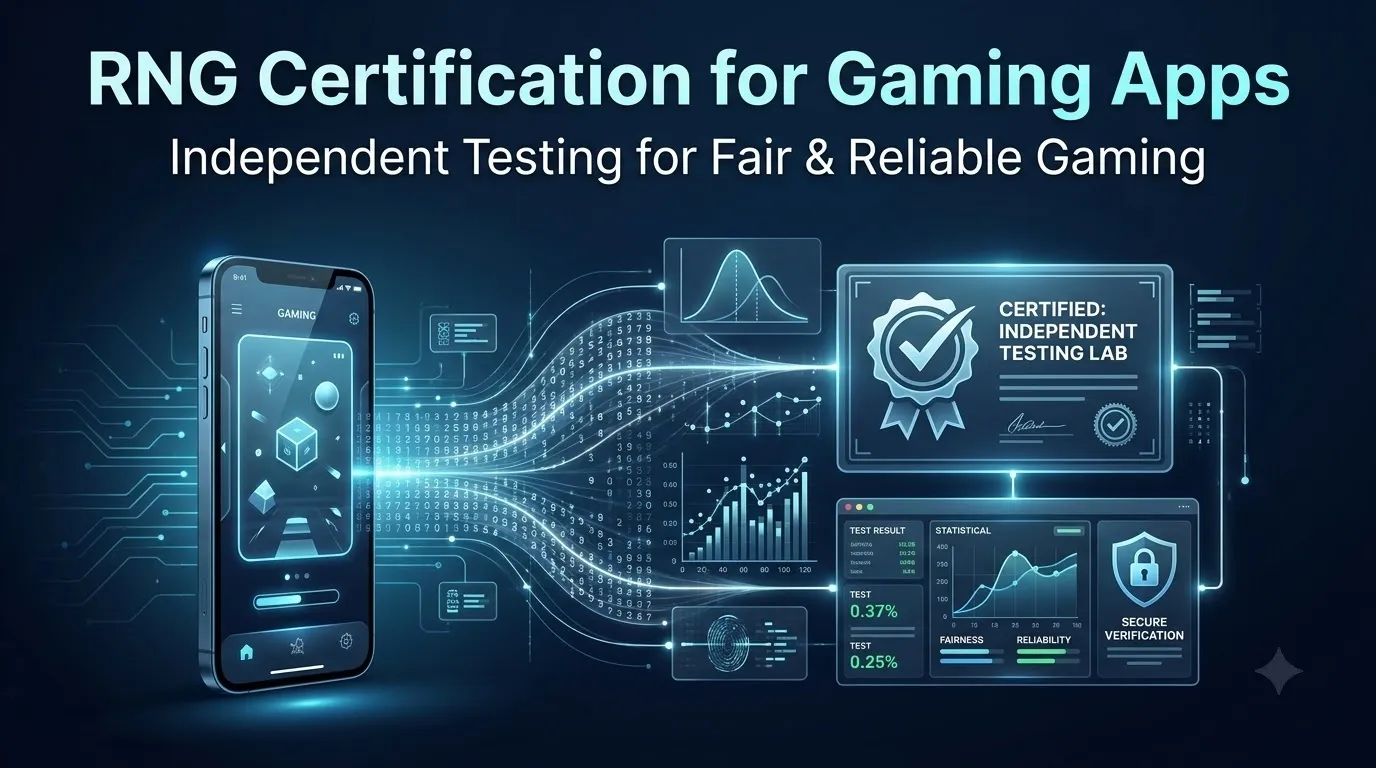
1.Helps ensure fair game outcomes
Outcomes that are determined by chance must be unpredictable and exhibit proper randomness to meet technical requirements. This typically involves verifying that results from an RNG are independent, appropriately distributed, and unpredictable.
Independent assessment helps ensure that a game outcome has met key technical standards.
2. Helps Meet Regulatory Requirements
Gaming regulations vary from country to country, and a gaming application must meet certain requirements to be allowed in the jurisdiction.
Therefore, developers must identify the requirements for each target jurisdiction instead of banking on a single approval that can gain access to multiple markets.
3. Builds Trust
Players, operators, platforms, and regulators all have an interest in ensuring that the technology underlying a game is functioning honestly. An independent audit provides much stronger assurance than a self-published declaration that a game is "random".
4. Identifies Technical Problems
Testing is necessary because it helps reveal the issues that would not come out during the actual gameplay. For example, it is vital to ensure that there are no seeding, scaling, shuffling, implementation, or statistical distribution errors.
What Is Tested During RNG Certification?
The exact scope depends on the RNG and the relevant standard, but an independent laboratory assessment can include the following:
Source Code Review
Testing labs may evaluate the source code implementing the fundamental algorithms related to the RNG, such as the source of the randomness, scaling, shuffling processes, and others. According to GLI’s Interactive Gaming Standard, source-code review is one of the requirements for RNG certification.
Statistical Testing
The lab will analyze the results of the RNG to ensure that the generated values meet the required distribution and independence criteria.
Depending on the standard and the specific requirements, statistical tests may include frequency, runs, serial tests, and others. According to GLI, statistical analysis is part of the RNG evaluation, which also contains a specific test suite.
Seeding and Reseeding
The laboratory will assess how the RNG is seeded or reseeded throughout the application lifecycle.
Implementation and Output
While the RNG under test may differ depending on the client’s needs and product requirements, the implementation should represent the production code. According to GLI submission instructions, the test application should include the same RNG functions, calls, variables, and scaling as the production application under certification. This step is essential because testing a simplified version of the RNG would not adequately represent the final product.
RNG Certification Process for Gaming Apps
Although the process might differ depending on a laboratory and jurisdiction, developers usually have to prepare their software and technical documentation beforehand.
The RNG Certification Procedure consists of six steps:
Step 1: Determine Applicable Requirements
The first step is to identify the jurisdiction where the gaming app is planned to be launched and establish technical requirements.
Step 2: Prepare the Implementation of the RNG
Prior to testing, the development team needs to ensure that the final implementation is properly documented and stable enough to undergo the procedure.
Step 3: Prepare Technical Documentation
Based on the specific laboratory and its requirements, developers might have to provide source-code documentation and description, rules, parameters, hardware specification, tools for data collection, checksums, and other documents.
Step 4: Submit the RNG for Independent Testing
The testing laboratory analyzes the submitted implementation and data following the specific test plan.
Step 5: Remediate the Issues (if any)
If any deficiencies are found during the testing phase, the development team should address them and resubmit an updated build of the software for review.
Step 6: Obtain the Evaluation or Certification
The laboratory issues the evaluation report or certification based on the requirements and jurisdiction.
RNG Certification vs. Game Certification
These terms should not be used interchangeably.
RNG certification covers the randomization mechanism and its implementation/output within the tested scope.
Game certification, on the other hand, may cover game mathematics, functionality, rules, paytables, and other elements.
Platform/system certification, in its turn, may cover a wider scope of checks, including those related to interactive systems, security, communications, etc.
The exact scope depends on the relevant regulatory framework and testing laboratory. In particular, GLI distinguishes between RNG testing, game mathematics, platform testing, and other areas related to iGaming certification.
How Developers Can Prepare for Testing
When preparing for RNG certification for gaming applications, developers should consider the compliance and testing aspects at early stages of the cycle. To ensure that all points are covered before submission, an individual could create a preparation checklist, which would include such items as
keeping production implementation of the RNG under control,
making sure that seeding, reseeding, scaling, and shuffling procedures are properly documented,
having a consistent game rules document and outcome logic relative to the submitted build under control,
preparing test data and technical documentation in advance,
excluding undocumented switches or parameters that could affect the outcome,
becoming aware of the requirements that apply to the target market,and
selecting a competent independent lab that would perform the testing.
Choosing an Independent Testing Laboratory
Not all certification requirements are the same; therefore, depending on the target market, a laboratory may need to be chosen that is approved or recognized by the relevant regulator.
For example,
regulators may have lists of approved independent testing laboratories and what systems they can test. For instance, the Nevada Gaming Control Board has a list of registered laboratories and the tests they are approved to perform.
Therefore, regulatory approval should also be considered when selecting a testing laboratory.
Conclusion
RNG certification for gaming applications can be seen as an essential procedure to establish trust in chance-based digital games. Such audits provide an independent evaluation of software’s randomization mechanisms, which supports addressing technical and regulatory requirements.
First of all, thorough preparation is required before submitting an application to independent reviewers. In this regard, it is critical to define the target market, ensure the production readiness of the developed RNG, organize relevant documentation, and select an appropriate testing organization.
Most importantly, certification cannot be viewed as a short-term goal. Instead, the discussed procedure should be embedded as a continuous process within the company’s quality-assurance framework. This way, alongside fulfilling technical and regulatory requirements, RNG certification will help achieve long-term product quality objectives.





















Sign in to leave a comment.