

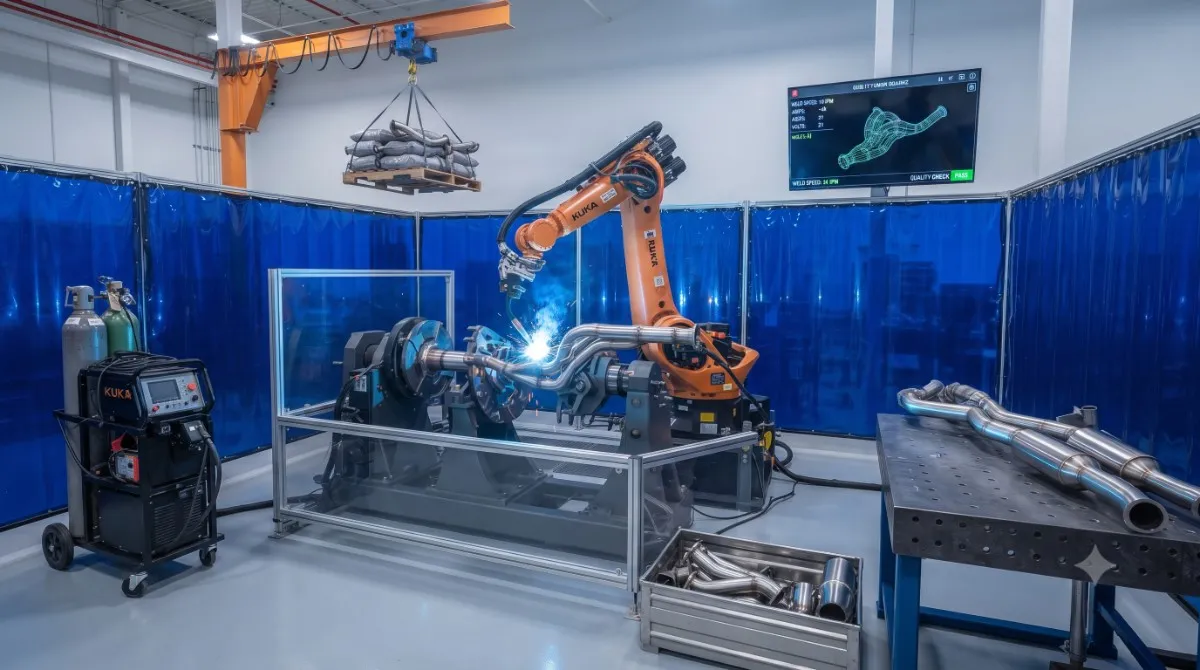
The automotive industry depends on manufacturing processes that deliver reliable quality, repeatable results, and efficient production. Exhaust systems are an important part of this process because their components must withstand high temperatures, vibration, and demanding operating conditions. To meet these requirements, automotive manufacturers are increasingly using robotic welding to improve the precision and consistency of exhaust production.
Robotic welding combines industrial robots, welding equipment, positioning fixtures, and programmed movements to join metal components. When properly designed and integrated, these systems can help manufacturers improve weld repeatability, streamline production workflows, and maintain consistent manufacturing standards.
1. Understanding Robotic Welding in Exhaust Manufacturing
Automotive exhaust systems consist of various components, including pipes, flanges, brackets, mufflers, and other assemblies. These parts must be joined accurately to create a durable system that meets engineering and vehicle packaging requirements.
Traditional manual welding can be suitable for certain operations, but repetitive production tasks may present challenges in maintaining consistent torch movement, weld positioning, and cycle times. Robotic welding addresses these challenges by following programmed paths and controlled welding parameters.
A typical robotic welding cell may include an industrial robot, a welding power source, a torch, component fixtures, safety equipment, and a controller. Depending on the production requirements, the cell may also incorporate positioners, automated loading systems, and inspection technologies.
The objective is not simply to replace manual work. It is to create a controlled and repeatable joining process that supports the quality requirements of exhaust manufacturing.
2. Why Precision Matters in Exhaust Welding
Precision is particularly important when joining exhaust components because small variations can affect assembly fit, joint integrity, and downstream production operations.
For example, incorrectly positioned pipes or flanges may create alignment problems during final assembly. Inadequate weld quality can lead to rework or leakage, depending on the joint design and application.
Robotic welding helps manage these challenges through:
- Repeatable torch movement: Programmed paths help maintain consistent welding movements across production cycles.
- Controlled welding parameters: Appropriate settings for current, voltage, travel speed, and other process variables support repeatable results.
- Accurate component positioning: Fixtures help hold parts in the required location during welding.
- Consistent joint access: Robot programming can support suitable torch angles and access to defined welding locations.
- Reduced process variation: A controlled setup helps minimize differences between repeated operations.
However, precision depends on more than the robot itself. Fixture accuracy, component tolerances, joint preparation, calibration, and welding process development all influence the final result.
3. Improving Weld Consistency and Product Quality
Consistency is a major priority in automotive manufacturing, particularly when the same component must be produced repeatedly over long production runs.
Manual welding quality can vary with operator technique, fatigue, accessibility, and working conditions. Robotic welding can reduce some of this variation by executing a validated program under controlled conditions.
Manufacturers can establish standardized welding parameters and monitor process performance to identify deviations. Depending on the application, additional technologies such as weld monitoring, vision systems, or automated inspection may help detect issues earlier.
Robotic welding can support more consistent joints, but it does not automatically guarantee defect-free production. Proper programming, equipment maintenance, process validation, and inspection remain essential.
A well-managed welding process helps manufacturers reduce avoidable rework and maintain consistent production standards.
4. Increasing Production Efficiency Through Automation
Production efficiency depends on how effectively equipment, people, materials, and manufacturing processes work together. Robotic welding can contribute to productivity by performing repetitive joining operations at predictable speeds.
Potential benefits include:
- Repeatable cycle times: Programmed welding operations help make production timing more predictable.
- Reduced repetitive manual work: Robots can handle suitable repetitive welding tasks, allowing workers to focus on setup, supervision, maintenance, and quality activities.
- Improved production flow: Integrated handling and positioning equipment can reduce delays between operations.
- Lower rework requirements: Consistent processes may reduce defects associated with process variation.
- Extended equipment utilization: Depending on staffing, safety arrangements, and maintenance needs, automated cells may support longer operating schedules.
The actual productivity improvement depends on component complexity, loading and unloading time, welding duration, equipment availability, and the overall production-line design. Manufacturers should evaluate the complete process rather than considering robot welding speed alone.
5. The Role of Fixtures and Automated Material Handling
Even an advanced welding robot requires components to be positioned correctly. Fixtures are therefore a critical part of exhaust manufacturing automation.
A well-designed fixture holds pipes, flanges, brackets, and other components in the correct position while providing access for the welding torch. Repeatable locating features help maintain alignment and reduce variation between assemblies.
Automated material handling can further improve the process by transferring components between workstations or positioning them for welding. In more complex systems, robotic loading, part identification, and automated clamping may be integrated into the production cell.
These technologies help reduce unnecessary handling and support a more predictable manufacturing workflow. Fixture design must also consider accessibility, thermal distortion, component variation, and the need for maintenance or changeovers.
6. Integrating Robotic Welding into an Exhaust Production Line
Robotic welding delivers the greatest value when it is integrated into a manufacturing process designed around the complete product and production requirements.
A typical exhaust production workflow may include:
- Component preparation: Pipes and metal parts are cut, formed, bent, or otherwise prepared.
- Component positioning: Fixtures locate the parts and establish the required joint geometry.
- Robotic welding: The robot performs the programmed joining operations.
- Assembly and handling: Welded parts move to subsequent assembly or finishing stations.
- Quality inspection: Components are checked against dimensional, weld, and other applicable requirements.
- Process monitoring: Production information is reviewed to identify recurring issues and opportunities for improvement.
The exact arrangement depends on the exhaust system design, production volume, product variety, and required quality standards.
Integrated production equipment can help reduce bottlenecks and improve coordination between workstations. However, successful integration requires careful planning of cycle times, material flow, robot reach, safety systems, maintenance access, and production changeovers.
7. Challenges in Robotic Exhaust Welding
Although robotic welding offers important advantages, manufacturers must address several challenges before and after implementation.
Initial investment: Robots, welding equipment, fixtures, safety systems, and integration can require significant capital expenditure.
Programming and setup: Different components may require specific welding paths, fixture configurations, and process parameters.
Component variation: Differences in pipe dimensions, fit-up, or joint gaps can affect welding results if they exceed the process capability.
Maintenance and downtime: Welding torches, consumables, fixtures, and robot components require regular inspection and maintenance.
Workforce training: Employees need suitable skills in robot operation, programming, troubleshooting, welding processes, and safety procedures.
Manufacturers can address these challenges through detailed process planning, appropriate equipment selection, operator training, preventive maintenance, and continuous quality monitoring.
8. The Future of Robotic Welding in Exhaust Manufacturing
Advances in automation are creating opportunities to make welding systems more flexible, connected, and responsive to manufacturing needs.
Vision-guided robotics may help locate components and accommodate certain variations in part positioning. Welding sensors and monitoring systems can provide information about process conditions. Production data can also help manufacturers identify recurring defects, improve maintenance planning, and evaluate equipment performance.
Digital manufacturing systems may connect robotic welding cells with broader production-management platforms, improving visibility into cycle times, downtime and quality trends.
These technologies are not necessary for every application. Their value depends on the production environment, technical requirements and business objectives. Selecting the right level of automation is essential to achieving practical, measurable results.
Conclusion
Robotic welding is an important technology in modern exhaust manufacturing because it can improve repeatability, support consistent weld quality, and make production processes more predictable. By combining industrial robots with well-designed fixtures, suitable welding equipment, material handling, and effective quality control, manufacturers can build more controlled and efficient production systems.
Successful implementation requires a complete approach that considers component design, welding parameters, equipment integration, worker safety, maintenance and inspection. When these elements work together, robotic welding can contribute to improved manufacturing performance and reliable exhaust system production.
HIROTEC provides automotive manufacturing and production equipment solutions, including exhaust production technologies. Learn more about its capabilities on the HIROTEC Exhaust Production page.
Frequently Asked Questions
1. What is robotic welding in exhaust manufacturing?
Robotic welding uses programmed industrial robots and welding equipment to join exhaust pipes, flanges, brackets, and other components with repeatable movements and controlled process parameters.
2. How does robotic welding improve exhaust production?
It can improve process repeatability, make cycle times more predictable, reduce repetitive manual work, and support consistent welding quality when properly configured and maintained.
3. Which components can be robotically welded in exhaust production?
Depending on the design and welding process, applications may include exhaust pipes, flanges, brackets, pipe joints, and selected muffler or exhaust subassemblies.
4. Does robotic welding eliminate the need for quality inspection?
No. Inspection and process monitoring remain important. Manufacturers must verify that welds and completed assemblies meet their engineering and quality requirements.
5. What should manufacturers consider before automating exhaust welding?
Important factors include production volume, component variety, weld accessibility, fixture design, cycle-time requirements, capital investment, safety, maintenance, and workforce training.
What do you think matters most in automated exhaust production: welding precision, production speed, or consistent product quality? Share your perspective in the comments.

















Sign in to leave a comment.