
Before you request robotics dataset requirements, it helps to understand why two robotics training data quotes can describe the same number of hours yet cover very different deliverables.
One supplier might offer first-person video of a person preparing food. Another might propose synchronized robot-camera feeds, joint states, action commands, and event annotations for the same task. Both could describe their deliverable as 100 hours of manipulation data. The similarity largely ends there.
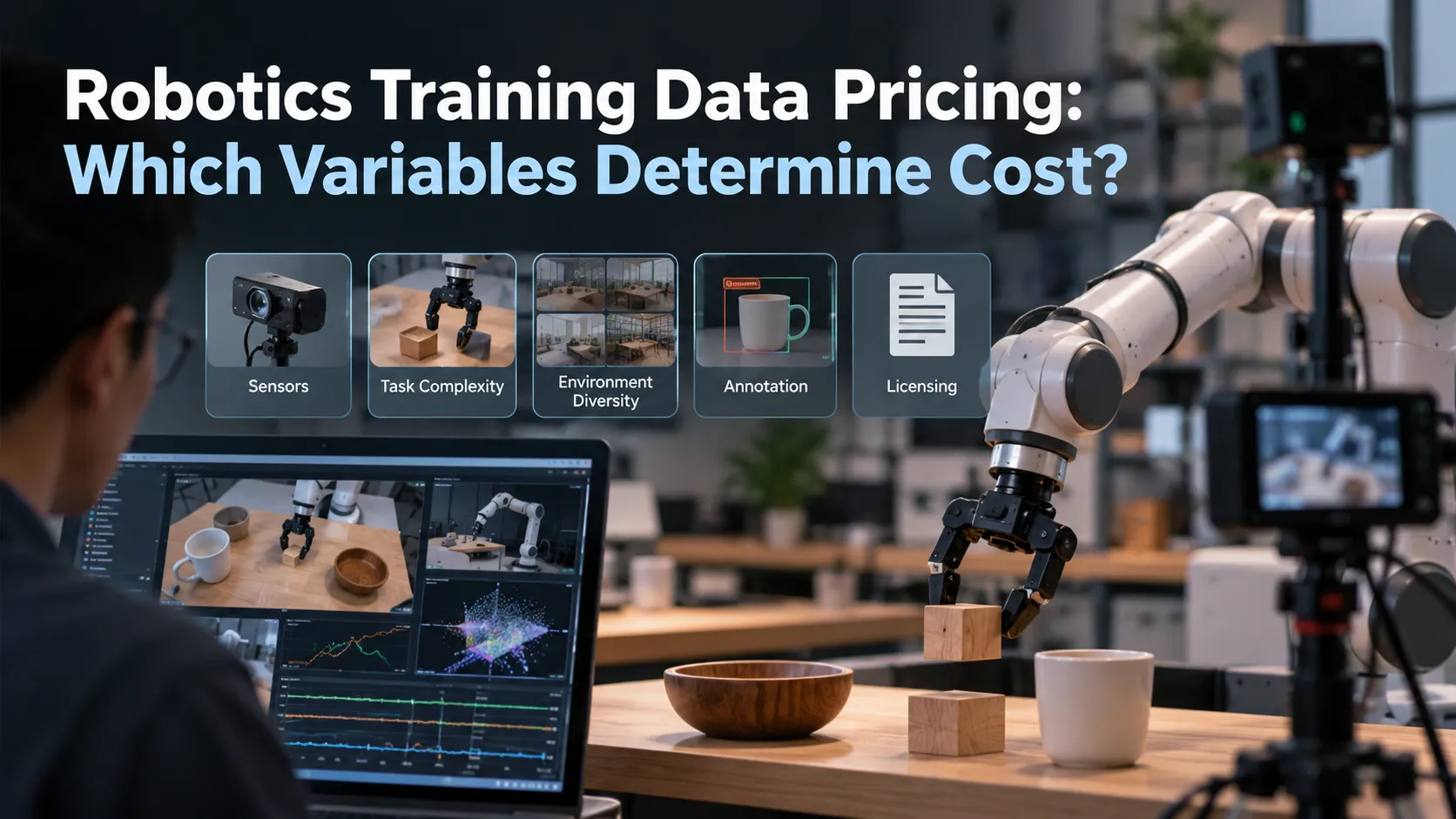
This is what makes robotics training data pricing difficult to compare. Collection hours matter, but they rarely explain the full cost. Sensor configurations, operator expertise, task complexity, hardware, quality requirements, and licensing terms all influence what a buyer ultimately pays.
For robotics founders, machine learning engineers, and procurement teams, the practical question is not simply how much data costs per hour. It is how much usable, correctly specified data a project can obtain within its budget.
A good quotation should make that answer reasonably clear before a company commits to production.
Why Robotics Training Data Has No Universal Price Per Hour
Video datasets, robot demonstrations, and teleoperation episodes are often grouped under the same commercial category. Technically, they serve different purposes.
A first-person video dataset may be useful for visual representation learning, task understanding, or predicting future observations. A teleoperation dataset may contain the actual commands applied to a robotic platform, along with corresponding states and observations. An imitation-learning dataset might require demonstrations captured through a particular gripper configuration or action representation.
Those differences affect equipment, labor, processing, and validation.
Consider three hypothetical requests.
A research team wants human demonstrations of objects being sorted on a tabletop. Its model primarily needs visual observations and task descriptions.
Another team wants dual wrist-camera recordings with synchronized hand or gripper trajectories.
A third team needs a physical robot to execute the sorting task through teleoperation, recording every relevant action and state transition.
Although the task description is almost identical, these projects require fundamentally different production workflows.
The first may involve relatively accessible recording equipment. The second adds specialized sensing and alignment requirements. The third introduces robot hardware, setup, maintenance, supervision, operator control, and potentially more complex failure handling.
A quotation that treats all three as interchangeable would be misleading.
The Seven Variables That Drive Robotics Training Data Pricing
1. Collection method: human demonstration or robot execution?
Collection methodology is often the largest structural difference between proposals.
Human demonstration datasets record people performing tasks, commonly through egocentric cameras or other body-mounted sensors. They can capture natural task sequences and physical interactions without requiring a robot to execute every action.
Robot-executed datasets involve the target platform or another specified embodiment. Depending on the learning approach, they may contain controller commands, proprioceptive measurements, end-effector poses, and task observations.
Teleoperation adds another layer: someone must control the robot while maintaining the required task quality and recording integrity.
This distinction matters because human demonstration and teleoperation datasets are not automatically interchangeable.
A robot policy trained on a particular action space needs data compatible with that action representation. Human video alone does not necessarily provide corresponding executable robot commands.
For procurement, the starting point should be the intended training objective.
If the model needs visual demonstrations, paying for full robot execution may be unnecessary. If it needs action-conditioned trajectories, purchasing inexpensive video without usable action information could create a much larger downstream problem.
The cheapest collection method is only economical when it produces signals the model can actually use.
2. Sensors, camera placement, and synchronization
A single RGB video stream is materially different from a synchronized multimodal episode.
A robotics team might request an egocentric camera, left and right wrist cameras, depth sensing, inertial measurements, joint states, or tactile information. Each additional modality introduces some combination of hardware, calibration, data transfer, processing, and verification work.
Even seemingly straightforward specifications can affect cost.
Higher recording resolutions create larger files and increase storage or transfer demands. Higher frame rates can increase data throughput. Multi-camera systems need stable mounting and a method for relating the streams to a shared timeline.
For robot learning, timing is especially consequential.
Imagine a gripper closing around an object. The video shows contact, while the corresponding action record indicates the gripper has not yet closed. If timestamps are inconsistent, the learning system may receive misleading observation-action pairs.
A dataset can look perfectly acceptable during casual video review while being unsuitable for the intended training pipeline.
Buyers should therefore distinguish recording specifications from synchronization specifications.
Instead of asking only for video resolution and frames per second, define the required timestamp convention, sensor relationships, calibration information, and acceptable alignment error.
Those requirements influence both production complexity and the amount of validation needed before delivery.
3. Task complexity and the difference between recorded hours and usable hours
Not every hour of recording produces an hour of accepted training data.
A simple repetitive task in a controlled environment may be relatively easy to capture consistently. A task involving deformable materials, awkward grasps, changing object arrangements, or tight tolerances can require more attempts and operator attention.
Some episodes may fail because the task was performed incorrectly. Others may be rejected because an important interaction was outside the camera view, the capture system lost a stream, or a required metadata field is missing.
This creates an important distinction between raw collection time and accepted output.
Suppose a project records 100 hours, but only 80 hours satisfy its acceptance criteria. If the buyer pays for all recorded hours, the effective cost per accepted hour is higher than the quoted raw-hour rate.
The underlying relationship is simple:
Effective cost per accepted hour = total eligible project cost ÷ accepted dataset hours
The example is illustrative, not a claim about typical rejection rates.
Before requesting a quote, determine whether the supplier charges for operator time, recording time, submitted footage, or accepted dataset hours.
Also establish how rejected and reworked episodes are handled.
A lower hourly quote can become more expensive if the contract leaves all quality-related losses with the buyer.
4. Environment diversity and collection geography
Recording the same action repeatedly in a single environment is different from collecting it across multiple homes, warehouses, kitchens, or workstations.
Environment diversity can be important for generalization. Real deployments expose robots to changing lighting, object arrangements, surfaces, backgrounds, and operating conditions.
But diversity has a production cost.
A collection program involving multiple sites may require site permissions, equipment transport, setup time, operator coordination, and additional review procedures.
Geographic distribution can introduce further differences in labor conditions, logistics, privacy requirements, and contractual obligations.
Consider a household manipulation dataset.
Collecting demonstrations in one standardized kitchen may simplify camera placement and protocol enforcement. Collecting comparable demonstrations across different kitchens can expose the model to more varied layouts and objects, but it also increases operational complexity.
The buyer needs to decide what diversity is valuable.
Requesting broadly varied environments without defining which variables should change makes a project difficult to quote and difficult to evaluate.
A better specification identifies relevant variation, such as countertop materials, object sizes, available workspace, lighting, or background clutter.
That gives a supplier a concrete collection target rather than an open-ended instruction to capture more diversity.
5. Annotation depth and metadata requirements
Data labeling ranges from simple task-level descriptions to detailed temporal and spatial annotations.
A basic episode might include a task name, start time, end time, and success status.
A more demanding dataset might require timestamps for contact, grasp closure, object lifting, placement, release, operator intervention, and recovery.
Other projects may need object identifiers, bounding boxes, segmentation masks, hand poses, or structured subtask descriptions.
Each annotation type involves different work.
Temporal event labels require consistent definitions and boundary decisions. Spatial labels may require specialized tools or calibration. Human pose and object pose estimates need their own verification procedures.
Annotation cost is also affected by ambiguity.
For example, when exactly does a grasp begin? At first contact, gripper closure, or stable object retention?
If annotators use different definitions, label consistency suffers even when each annotation appears reasonable.
A procurement brief should include a small annotation schema with representative examples.
Specify which fields are required, which are optional, what constitutes an invalid label, and how disagreements will be resolved.
More detailed annotation is not automatically better. Labels should correspond to an actual training, evaluation, or debugging need.
6. Quality assurance and acceptance criteria
Quality assurance is sometimes presented as an additional service, but it should be part of the original scope discussion.
Robotics data requires several different kinds of validation.
Technical checks determine whether sensor streams, file formats, timestamps, and episode records are usable.
Behavioral checks establish whether the demonstrated task followed the requested procedure.
Annotation checks assess completeness and consistency.
Provenance checks help establish where the data came from and whether the intended use is permitted.
These checks have different cost implications.
A quick visual inspection is not equivalent to verifying synchronized observation-action sequences across an entire batch.
A supplier may also use automated validation, manual review, or a combination of both. The quotation should explain which checks are included, how extensively they are applied, and what happens when an episode fails.
This is particularly important for datasets intended for repeated training experiments.
Poorly documented acceptance rules make it difficult to distinguish problems in the model from problems in the data.
7. Licensing, consent, and permitted use
The commercial value of a dataset depends partly on whether the buyer has the rights needed to use it.
An existing dataset may have restrictions on redistribution, commercial training, derivative works, or disclosure.
Custom collection creates its own questions about contributor consent, site authorization, subcontractors, confidentiality, and ownership.
These requirements may influence supplier selection and contract cost.
For example, a buyer seeking exclusive rights to a newly collected dataset is making a different commercial request from a buyer licensing existing material on a nonexclusive basis.
Similarly, footage recorded in private or commercial environments may require additional permissions and controls.
Data procurement teams should involve legal and security reviewers early enough to identify these requirements before collection begins.
A technically suitable dataset can still be unsuitable for procurement if its intended use is not supported by the applicable rights.
Robotics Data Procurement: How to Compare Two Quotes Properly
The most useful comparison starts with a shared statement of work.
Ask competing suppliers to price the same task definitions, sensor specifications, accepted-volume requirements, annotation schema, and delivery conditions.
Then examine what each proposal includes.
A quote based on accepted hours should not be compared directly with one based on all operator hours. Similarly, a dataset delivered as video files alone should not be treated as equivalent to one containing synchronized robot states, structured metadata, and documented quality results.
A useful way to evaluate competing proposals is to separate collection, equipment, annotation, quality assurance, delivery, and rights-related costs.
Not every supplier will use the same commercial structure, but the underlying responsibilities should be visible.
Project setup also matters.
A small custom collection may require protocol development, hardware calibration, operator onboarding, and testing before meaningful production begins. Those activities may represent a substantial share of the project's total work.
For larger collections, some setup costs can be spread across more accepted episodes. That does not mean volume discounts should be assumed, especially when greater scale requires additional sites, equipment, or supervision.
Instead, ask how the quotation changes as volume increases and which cost components remain fixed.
Why a pilot is often the best procurement tool
A representative pilot gives both parties evidence about the actual work.
It can reveal whether the requested camera arrangement captures important interactions, whether task instructions produce consistent demonstrations, and whether the delivery schema works with the buyer's training pipeline.
It also provides a basis for discussing rejection rates, operator effort, and review requirements.
Merit Data's publicly described collection workflow follows this requirements-first approach, with defined capture criteria, a representative pilot, batch-level quality review, and supporting delivery documentation. Its stated data categories include egocentric demonstrations, wrist-camera configurations, UMI and gripper demonstrations, and teleoperation data.
For buyers evaluating a provider such as Merit Data, the useful starting point is a specific collection brief and sample-review discussion rather than assuming that a general hourly price applies to every configuration.
Any proposed capability, collection arrangement, delivery format, and commercial term should be confirmed for the particular project.
Can Synthetic Data Reduce Robotics Dataset Costs?
Synthetic data can help address some collection challenges, but it introduces a different cost structure.
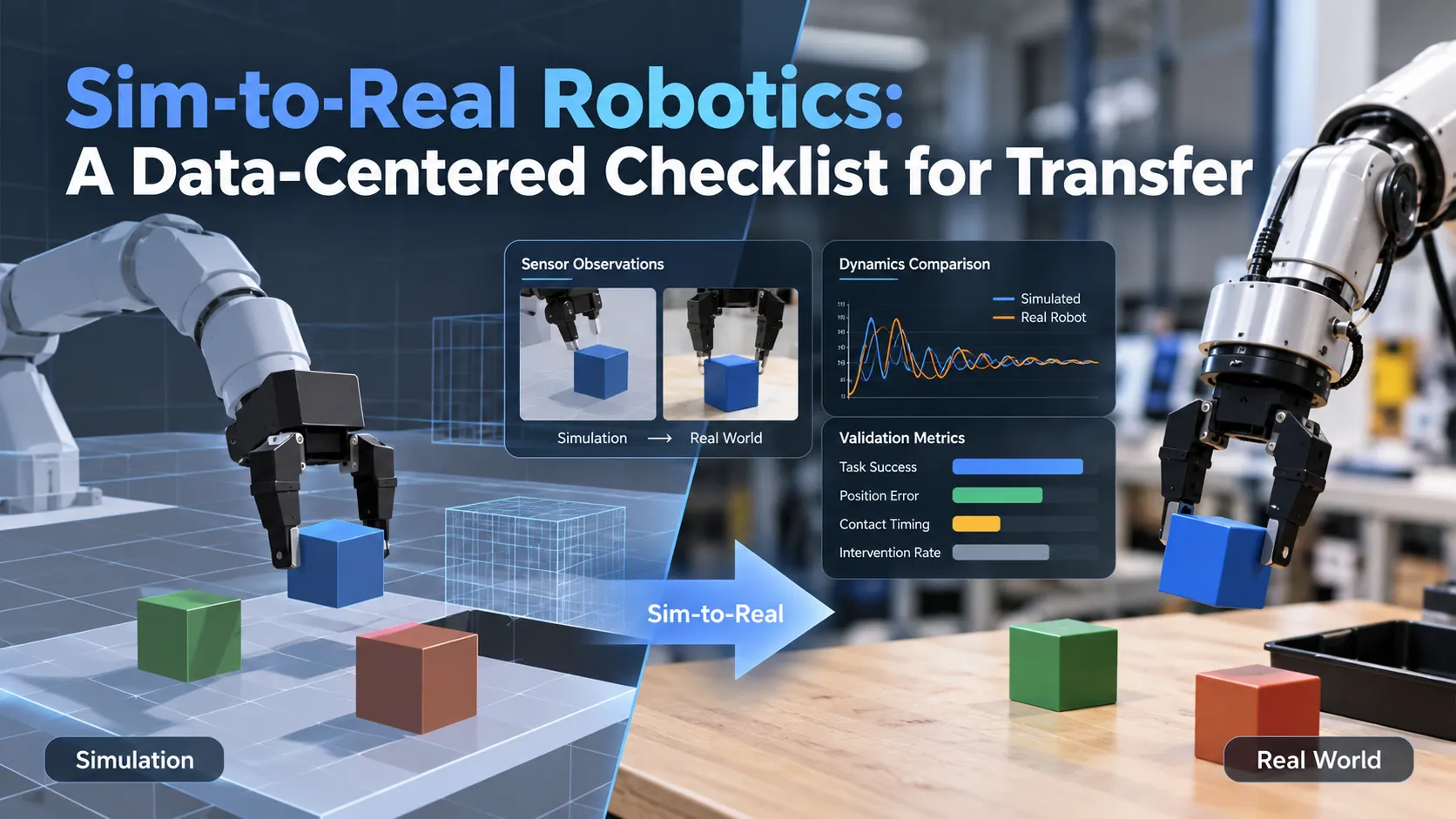
Simulation environments can generate variations in object placement, lighting, appearance, and scene configuration without physically resetting each real-world scenario.
NVIDIA's Isaac Sim, for example, provides tools for simulation and synthetic data generation. Its documentation describes domain randomization workflows that vary scene parameters and generate training data for perception models.
The relevant trade-off is that synthetic data requires its own preparation and validation.
Teams may need simulation-ready assets, calibrated sensor models, suitable physics parameters, scenario generation, compute resources, and real-world evaluation.
A simulation that produces large quantities of observations is not automatically generating useful robot-control demonstrations.
Perception labels, action trajectories, and physically valid contact behavior are different outputs with different validation needs.
Synthetic data may be particularly useful when teams need controlled scene variation or examples of conditions that are difficult to capture repeatedly.
Real-world collection remains valuable for grounding assumptions about sensing, object interactions, human behavior, and robot performance.
The procurement decision should therefore be based on the downstream training task, not simply whether simulated episodes appear cheaper to produce.
Questions to Resolve Before Approving a Dataset Purchase
Should we buy existing robotics data or commission new collection?
Existing data can be attractive when its tasks, sensors, licensing, and embodiment are compatible with the project.
Custom collection is more appropriate when the model requires unusual viewpoints, a specific robot platform, distinctive environmental conditions, or a specialized annotation format.
Before buying existing data, review representative episodes and confirm that the necessary metadata and rights are available.
A large inventory is not useful if it does not match the learning objective.
What is the best unit for comparing dataset costs?
Accepted hours can be appropriate for time-based demonstrations, but they are not universal.
Some projects are better measured in accepted episodes, successful task executions, labeled interactions, or validated trajectories.
For example, a manipulation task with highly variable execution duration may be easier to evaluate using accepted task episodes alongside their duration distribution.
The billing unit should correspond to something the buyer can inspect and use.
Should failure and recovery demonstrations cost the same as successful episodes?
Not necessarily.
Failure and recovery collection may require deliberate scenario design, repeated attempts, intervention records, and more detailed outcome labels.
These requirements can change the effort needed to obtain a usable episode.
If recovery behavior matters to the model, it is better to specify the desired failure categories and recovery sequences than to request an unspecified percentage of unsuccessful demonstrations.
The supplier can then explain how those requirements affect collection and pricing.
What belongs in a robotics data request for quotation?
A useful request describes the target behavior, robot or embodiment, observation and action requirements, environments, intended volume, and acceptance criteria.
It should also explain the expected delivery schema, annotation needs, permitted data uses, and project schedule.
Include the intended model interface where possible.
For example, stating that the data will train a policy consuming synchronized camera observations and end-effector actions is more informative than requesting general-purpose manipulation footage.
Suppliers can price a defined technical requirement more meaningfully than an ambiguous dataset category.
The Most Expensive Dataset Is Often the One You Cannot Use
Robotics teams face a difficult purchasing decision because dataset quality cannot be reduced to a single number.
A lower quoted rate may be entirely appropriate for straightforward visual demonstrations. The same rate may be irrelevant when a project requires synchronized robot states, specialized sensing, difficult manipulations, or extensive validation.
The right procurement process begins with the model's learning objective and works backward to the data specification.
Define what each accepted episode must contain. Establish how quality will be measured. Clarify rights and delivery requirements. Review a representative pilot before committing to larger volumes.
Only then does an hourly price become a useful comparison.
For robotics training data pricing, the goal is not to buy the greatest number of recorded hours at the lowest nominal rate. It is to purchase data whose signals, structure, and permitted use match the training problem closely enough that engineering teams can put it to work.























Sign in to leave a comment.