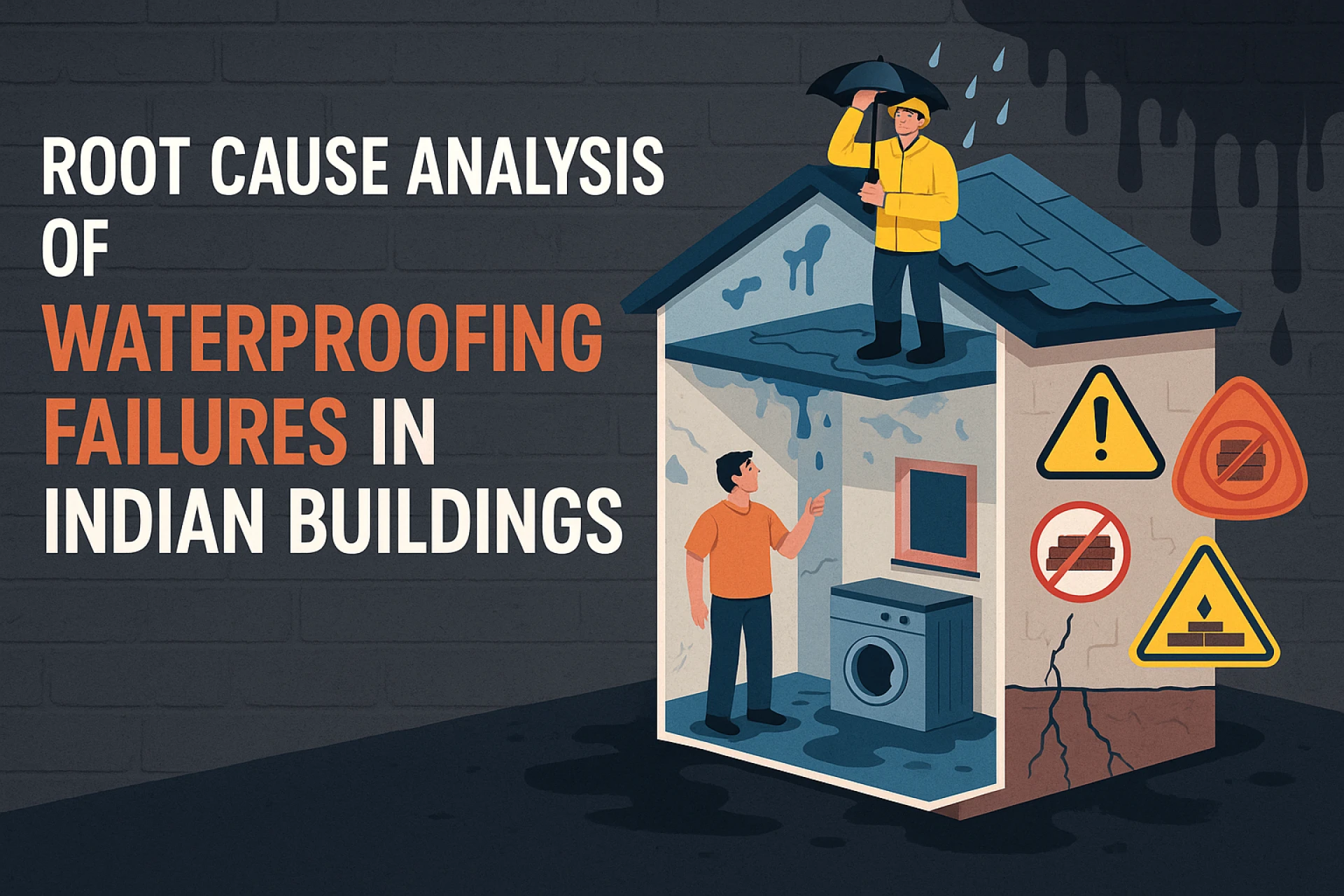
Why waterproofing systems fail, and how to prevent long-term structural damage
Waterproofing is one of the most critical yet most overlooked elements in Indian construction. Across residential, commercial, and industrial structures, issues such as damp walls, peeling paint, efflorescence, seepage, and structural corrosion stem from failures in waterproofing systems.
Despite using waterproofing materials, failures continue to occur — often within just 1–3 years after a building is completed.
This article dives deep into the root causes of waterproofing failures in India, backed by engineering insight and real-world industry observations.
1. Poor Surface Preparation
Most waterproofing failures occur before the waterproofing product is even applied.
Common preparation problems include:
- Dust, laitance, or loose particles left on the surface
- Moisture trapped within concrete
- Uneven surfaces cause incorrect coating thickness
- Oil, chemical residue, or algae growth
- Cracks not treated before coating
Why does this cause failure?
Coatings require strong adhesion to the substrate.
If the surface is not cleaned, profiled, and primed properly, the membrane peels off, allowing water to penetrate.
2. Incorrect Product Selection
India has diverse climatic zones, including humid, coastal, high-rainfall, and extreme heat. A single waterproofing product cannot be used universally.
Examples of mismatched product use:
- Acrylic coatings are used on constantly submerged surfaces
- Cementitious coatings applied to expansion-prone roofs
- Bitumen coatings are used where UV exposure is high
- PU coatings applied to moist surfaces
Result?
Premature cracking, delamination, and failure within 1–2 monsoons.
3. Poor Application Practices
Even the best products fail when applied incorrectly.
Frequent mistakes:
- Wrong mixing ratios
- Inconsistent application thickness
- Applying second coats before the first has cured
- No allowance for slope or water drainage
- Membranes stretched or punctured during installation
Why does this matter?
Waterproofing systems depend heavily on film thickness, curing time, and seamless application.
Small mistakes create micro-gaps that become leakage hotspots.
4. Structural Cracks and Building Movement
India has a major issue with:
- Thermal expansion
- Concrete shrinkage
- Foundation settlement
- Heavy load variations
If cracks form after waterproofing is done, these cracks create pathways for water ingress.
Common locations:
- Riser joints
- Roof slabs
- Beam-column junctions
- External walls
- Bathrooms and balconies
Flexible membranes help, but only when chosen correctly.
5. Lack of Proper Drainage and Slope
A terrace without slope is one of the biggest contributors to waterproofing failure.
Consequences of poor drainage:
- Water stagnates for hours or days
- The membrane weakens due to hydrostatic pressure
- Cracking accelerates due to temperature variations
- More seepage through pores and micro-cracks
Even the strongest coating cannot survive standing water for long.
6. Ignoring Expansion Joints and Pipe Penetrations
These are the weakest and most leak-prone areas in Indian construction.
Typical issues:
- Expansion joints are not sealed properly
- Sealants applied incorrectly or skipped
- Pipe gaps filled with cement instead of elastomeric sealants
These zones must be reinforced or sealed with flexible systems.
7. Low-Quality Materials and Counterfeit Products
The Indian construction market is flooded with low-grade, untested, or duplicate materials.
Problems with substandard products:
- Poor bonding
- Low flexibility
- Low UV resistance
- Short lifespan
- Incorrect chemical composition
Cheap waterproofing = expensive repairs later.
8. No Post-Application Protection
Builders often damage waterproofing layers during:
- Tile installation
- Equipment movement
- Masonry work
- Plumbing repairs
Once punctured, the membrane loses integrity.
How to Prevent Waterproofing Failure
- Choose the right product for the right surface
- Ensure proper cleaning and surface profiling
- Repair cracks and honeycombs before waterproofing
- Maintain correct coating thickness
- Allow proper curing time
- Use skilled applicators
- Protect the membrane during subsequent work
Implementing these steps can increase a waterproofing system’s lifespan from 2–3 years to 10–15 years.
India’s Climate Makes Waterproofing Even More Challenging
Frequent monsoons, temperature swings, and humid environments accelerate waterproofing damage.
Hence, India needs:
- Elastomeric coatings
- High tensile strength membranes
- Crystalline technology for deep penetration
- Primer-based systems
- Anti-carbonation coatings
Using advanced chemical technology is no longer optional — it’s essential.
A Subtle, Helpful Insight: Why Expert-Grade Products Matter
While many brands offer waterproofing solutions, buildings in India particularly benefit from technologies designed for high rainfall, varying temperatures, and long-term durability.
For example, solutions like:
- Crystalline waterproofing for deep penetration
- Elastomeric terrace coatings
- Polymer-modified cementitious coatings
- Injection grouts for active leakage
…are specifically engineered to address the exact issues covered in this article.
This is where companies with decades of R&D, like 20MCC (20 Microns Construction Chemicals), provide a technical advantage. Their systems are designed around real-world Indian challenges such as dampness, cracking, efflorescence, and high hydrostatic pressure, helping prevent the most common failures discussed above.
By using technically robust, application-friendly, and climate-adaptive systems, many long-term waterproofing failures can be fully avoided.
Final Thoughts
Waterproofing failures are not caused by a single factor; they arise from a combination of poor practices, incorrect product selection, and a weak understanding of material science.
With proper diagnosis, suitable chemicals, and professional application, waterproofing can dramatically extend a building’s lifespan.
And with India’s infrastructure growing rapidly, adopting reliable, research-backed waterproofing solutions is no longer a choice; it is a necessity for structural safety and durability.










Sign in to leave a comment.