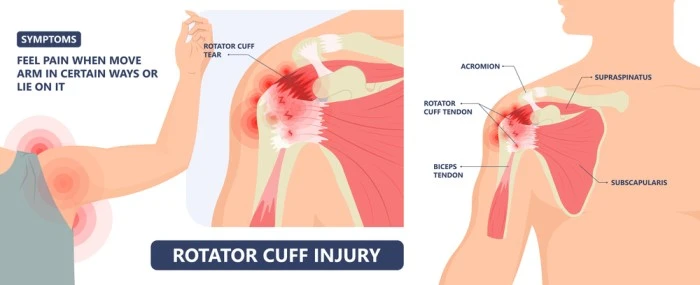

A rip that occurs in the group of four muscles and tendons responsible for helping you lift and rotate your arms and stabilizing your shoulder joint is called a rotator cuff tear. Rotator cuff tears are also called full-thickness tears or complete tears. This type of tear is fairly common, especially in jobs like cleaning windows or painting, sports like baseball, etc. It can happen due to normal wear and tear or if the same arm motion is repeated over and over or may even occur if your lift something heavy or fall on your arm.
Rotator Cuff Tear: Symptoms
It is not always that you will feel a torn rotator cuff but in some cases, you might, like:
- Having difficulty raising your arm
- Feeling pain while moving your arms when you lie on them or move in a certain way
- Have shoulder weakness
- Unable to lift things that you normally would
- Hearing popping or clicking sound when you move your arm
Rotator Cuff Tear: Causes and Risk Factors
The two most common ways in which you can injure your rotator cuff are your tendons wearing out over time and shoulder injury. A tear caused by a worn-down rotator cuff is called a degenerative tear. The following puts you at a risk for it:
> Occupation- Jobs like construction work, and painting raise your risk for rotator cuff tears.
> Lack of blood supply- Your rotator cuff area receives less blood as you get older. This can lead to larger tears as small tears become hard to repair
> Bone spurs- As you grow older, you may experience bone overgrowth in the shoulder. It can wear away the rotator cuff tissues and cause tears.
> Age – For individuals over 60, rotator cuffs are very common
> Family history- Genetics can also play a part in making certain categories of people more prone to rotator cuff tears.
> Athletics – Weightlifting, rowing, tennis, etc, puts you at risk of tears as it stresses your rotator cuff
When is Rotator Cuff Surgery Recommended?
If your pain does not improve with nonsurgical methods, doctors often recommend surgery as an option. The main indication for surgery is continued pain. If you are an active individual and tend to use your arms for overhead sports or work, your doctor may suggest surgery.
The other signs that may suggest you need surgery include:
- Symptoms that have lasted from a period of 6 to 12 months
- Presence of a large tear which is more than 3 cm and surrounding tendon tissue quality is good
- There is a significant loss of function and weakness in your shoulder
- The cause of your tear is a recent, active injury
Different Types of Rotator Cuff Surgery
1. Open Rotator Cuff Repair
In this surgical method, the repair is done by separating the shoulder muscle to get near the torn tendon. It also involves an open surgical incision that is several centimeters long over the shoulder. The surgery is recommended for people with complicated or large tears and people who need reconstruction procedures like tendon transfers. A tendon transfer is done in the case of severe rotator injuries where the damaged tendon cannot be reattached to the top of the humerus. In tendon transfer, typically the latissimus dorsi tendon in the back (or any other tendon from a different location in the body) is used to repair the rotator cuff. The surgeon may also remove bone spurs (osteophytes) during this procedure. Bone spurs are a sign of osteoarthritis which can result in shoulder pain.
2. Arthroscopic Rotator Cuff Repair
Often employed for patients with small to medium-sized tears (about 3 cm or smaller), the arthroscopic repair is the least invasive of the tree rotator cuff repair options and is an outpatient procedure. Arthroscopic surgery involves incisions of about a centimeter long each due to which patients experience lesser pain, faster recovery, and have a decreased risk of complications. The surgeon inserts a small camera and surgical instruments through the small incisions, during the surgery.
3. Mini-Open Rotator Cuff Repair
Mini-open repair is a combination of both open surgery and arthroscopic techniques. Arthroscopy is employed for the evaluation of the injury, removing the cartilage, and also trimming away bone spurs. To get direct visual access to repair the tear, a 1 to 5-inch incision is made. Open repair surgery involves the detachment of the shoulder muscle (deltoid), whereas mini-open and arthroscopic repair does not need it. For individuals who have more than one torn rotator cuff tendon, combined open surgery and arthroscopic technique may be recommended.
Conclusion
There are various shoulder surgery clinics in Dubai providing the best surgical and nonsurgical treatments for rotator cuff tears. Get connected with the leading clinics in Dubai to get the best should surgery in Dubai.











Sign in to leave a comment.