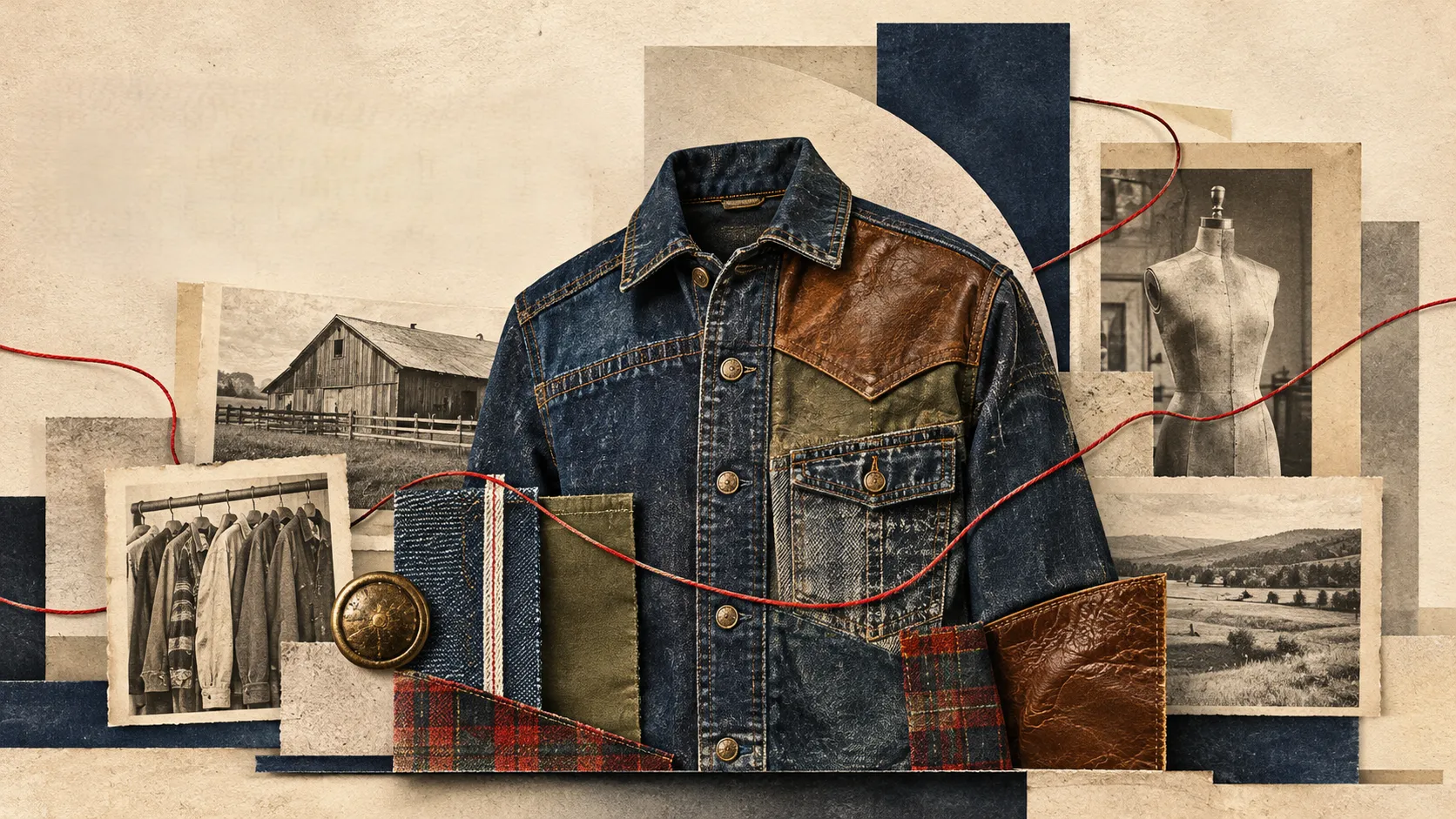

A clothing label can sell denim, leather jackets, work shirts, boots, and vintage-inspired accessories without developing a recognizable identity. These products have a long history, established visual codes, and an audience that appreciates their aesthetic. Yet the same ingredients can produce very different brands. The distinction becomes clearer when examining the RRL brand, the heritage-oriented label within Ralph Lauren's portfolio.
Founded in 1993, Double RL has built its identity around a particular interpretation of American heritage. Its products draw on Western clothing, workwear, military garments, denim history, and vintage Americana. However, its identity is not simply the result of collecting historical references. Product design, cultural storytelling, visual communication, vintage curation, and retail environments work together to express a consistent creative perspective.
Why does RRL feel like more than a collection of vintage-inspired clothes? And what allows its products, communication, and cultural references to feel connected? Its approach offers a useful case study in how a business can transform a meaningful source of inspiration into a coherent brand world.

What Is the RRL Brand? Understanding Double RL
RRL, commonly pronounced Double RL, is a distinct label within Ralph Lauren Corporation's broader lifestyle portfolio. It focuses on heritage-oriented clothing and accessories, with a creative direction rooted in vintage Americana and the functional garments associated with the American West. Its history provides a useful starting point for understanding how a personal interest can become the foundation of a recognizable commercial identity.
Double RL debuted in 1993. Its name comes from the Double RL Ranch in Colorado, which Ralph and Ricky Lauren purchased in 1982. According to Ralph Lauren's official timeline of Double RL's debut, the label embodies the authenticity and purpose-built style of the American West. Ralph Lauren also described the collection as an extension of his personal wardrobe, emphasizing practical clothing over fashion driven by trends.
The ranch is relevant because it gives the brand a documented connection to a real place and to the founder's interests. It is not necessary to imagine a fictional origin story to understand the label's direction. The landscape, Western culture, and historical objects associated with the American frontier offer a source of references that can be explored through contemporary product design.
RRL Is Not Simply a Vintage Clothing Store
There are several different ways a fashion brand can work with the past. Original vintage clothing consists of garments produced in an earlier period. Vintage-inspired clothing is newly manufactured but uses historical silhouettes, materials, or visual details. Historical reproductions attempt to recreate particular garments, while contemporary reinterpretations use historical references as the starting point for new designs.
Double RL works across this broader territory. Its collections include new garments informed by historical clothing, while its separate Vintage Curated by Double RL initiative presents original vintage garments and objects selected by the brand. These activities are related, but they are not interchangeable.
The distinction matters strategically. A reproduction demonstrates an interest in how a historical object was designed and constructed. A contemporary reinterpretation demonstrates how those ideas can be adapted to present-day use. Vintage curation, meanwhile, involves selecting original objects that fit the brand's cultural perspective.
This combination gives the label a relationship with history that extends beyond distressed finishes or old-fashioned styling. It can create new products while also presenting objects that already carry their own material histories.
The Relationship Between Ralph Lauren and Double RL
RRL operates within the larger Ralph Lauren brand portfolio, rather than as an independently disclosed fashion company. Ralph Lauren Corporation identifies Double RL among its apparel and accessories brands, alongside labels such as Polo Ralph Lauren, Ralph Lauren Collection, and Purple Label.
The different labels occupy distinct creative territories. Polo Ralph Lauren is broadly associated with American sportswear, preppy references, collegiate influences, and recognizable wardrobe staples. Double RL concentrates more heavily on Western clothing, vintage workwear, denim, and historical utility garments.
This distinction does not require a simple hierarchy of quality or prestige. The more useful interpretation is portfolio architecture: a company can serve different audiences and cultural interests through labels with separate creative identities while retaining a shared relationship with its broader brand philosophy.
The RRL Point of View: Selling a Way of Life, Not Just Clothes
Products become more meaningful when people can understand the ideas behind their design. Double RL's positioning connects clothing to a specific interpretation of the American West, rugged independence, practical workwear, and traditional craftsmanship. This gives its products a wider context than their immediate function.
A useful way to understand this process is through brand strategy and positioning. Positioning determines what a brand wants to represent, which audience it intends to serve, and why its offering should be understood differently from alternatives. In Double RL's case, the cultural territory provides a framework for making those decisions.
The Cultural Territory Behind the Brand
The label draws on several connected areas of American material culture: ranch clothing, early workwear, military uniforms, denim, vintage sportswear, and utility garments. These references share an emphasis on function, practical construction, and clothing designed for particular activities or environments.
A work shirt, for example, is not simply a shirt with an aged appearance. Its historical context is connected to practical use, repeated wear, and the requirements of physical work. Military-inspired chinos bring another recognizable reference into the product language, while selvedge denim connects the brand to the development of traditional denim production.
The American West acts as an organizing theme for these different references. It does not mean the label represents every part of American history or culture. Rather, it selects particular histories and symbols to build a focused creative territory.
That selectivity is essential. A recognizable brand does not need to represent everything. It needs a clear perspective on the territory it chooses to occupy.
Aesthetic Is Not the Same as a Point of View
Vintage typography, faded colors, rough textures, and historical photography can create an immediate impression of heritage. But these visual elements do not automatically explain why a brand exists or what its products represent.
Consider two hypothetical clothing labels. Both use faded denim, old-fashioned typography, and Western photography. The first selects these elements because they are fashionable. The second develops its collection around documented research into historical workwear, adapting selected functional details into garments designed for contemporary use.
They may look similar in an advertisement, but their underlying strategies are different. One depends on a visual trend; the other has a reason for making specific creative and product decisions.
RRL's stronger strategic proposition lies in the relationship between its cultural references and its offering. Its product categories are connected to the same historical territory that informs its wider identity. This makes the brand's visual language more than a decorative style.
Authenticity Needs More Than a Story
Authenticity is frequently used in heritage branding, but a claim of authenticity cannot establish itself. A brand needs evidence that its story is connected to its actual decisions.
For a clothing label, this evidence may involve historical research, recognizable construction references, material choices, functional details, and clear explanations of design influences. For another business, it may come from its founder's expertise, documented processes, or the origin of its products.
The distinction between research and manufactured nostalgia is particularly relevant. An old-looking label does not prove that a garment has a historical connection. A distressed finish does not establish that an item is durable. A Western-inspired photograph does not demonstrate an understanding of Western material culture.
RRL's strategic credibility depends on the extent to which its product language, cultural references, and storytelling reinforce one another. The story is more convincing when customers can examine its expression in the actual offering.
How RRL's Product Strategy Makes the Brand Recognizable
Products are among the strongest carriers of Double RL's identity. A brand may communicate an elaborate philosophy through photography and editorial content, but customers encounter its strategy most directly through what it makes and sells.
Ralph Lauren Corporation's fiscal 2026 Form 10-K identifies selvedge denim, military-grade chinos, tube-knit T-shirts, thermals, and flannels among the label's core wardrobe staples. The wider assortment also includes seasonal vintage-inspired collections, footwear, belts, bags, and leather goods. These categories provide a tangible foundation for its positioning.
Product Details as Brand Signals
Selvedge denim is a particularly recognizable part of the brand's product language. Its association with traditional denim production connects the label to the history of work clothing and the development of jeans as functional garments. The company's corporate description specifically identifies American-made selvedge denim jeans as part of the Double RL offering.
Workwear silhouettes provide another recognizable reference. Work shirts, practical jackets, and utility-oriented garments connect the collection to clothing historically designed around specific activities rather than short-lived fashion trends.
Military-inspired chinos bring the language of uniforms into everyday clothing. Their significance is not simply that they look different from conventional trousers. They contribute another recognizable historical reference to the wider product system.
Flannel shirts and tube-knit garments also support this vocabulary. They extend the range of everyday wardrobe staples while retaining associations with traditional American sportswear and work clothing.
Repeated details can eventually become brand codes. A brand code is a recurring visual or product element that helps people recognize a brand without needing to see its name or logo. For Double RL, the combined language of denim, utility silhouettes, Western references, and historical details creates a recognizable set of signals.
Historical Accuracy Versus Contemporary Wearability
Working with historical clothing involves a practical design problem. A garment that accurately reflects an earlier period may not necessarily suit contemporary expectations of fit, comfort, versatility, or everyday use.
A purely literal reproduction can feel more appropriate for a collection or specialist archive than for a modern wardrobe. On the other hand, adapting a historical reference too aggressively can remove the qualities that made it interesting in the first place.
The design challenge is to understand which elements matter and which can change. A designer might preserve the functional logic of a work shirt while adapting its proportions, fabric, or finishing details. This is not the same as reproducing an original garment. It is a process of translating historical knowledge into a contemporary product.
That distinction helps explain why heritage-oriented brands need research and design judgment, not just access to vintage references.
Consistency Across Product Categories
A coherent brand identity should remain recognizable even when the product assortment expands. Double RL applies its cultural territory across clothing, footwear, and accessories, allowing different products to contribute to the same overall perspective.
| Product Element | Observable Brand Reference | Strategic Contribution |
| Selvedge denim | Historical denim and workwear traditions | Provides a recognizable product anchor |
| Workwear silhouettes | Functional clothing associated with labor and utility | Connects the brand to its cultural territory |
| Military-inspired details | Uniforms and historical military garments | Adds recognizable design codes |
| Western references | Ranch clothing and American Western imagery | Reinforces its heritage language |
| Leather goods and accessories | Traditional materials and utility-oriented design | Extends the brand world beyond apparel |
None of these features is sufficient on its own to create a distinctive identity. Denim, chinos, and leather accessories are available from many brands. The strategic contribution comes from the way these categories work together and express a consistent creative direction.
RRL's Marketing Strategy: How the Brand Communicates Its World
Marketing is not limited to paid advertising or social media activity. For a lifestyle-oriented fashion label, the product itself, editorial imagery, retail environment, distribution, vintage curation, and cultural collaborations all contribute to how customers understand the brand.
Double RL's communication can therefore be examined through the different places where its identity becomes visible. The objective is not to assume that the label avoids conventional advertising, but to understand how its broader brand experience carries meaning.
Editorial Storytelling and the Visual Language of the Brand
Fashion imagery can communicate a cultural setting more efficiently than a conventional product description. A photograph of a garment against a carefully chosen landscape, for example, can establish historical and lifestyle associations before the viewer examines its construction.
For a brand drawing on Western and workwear traditions, styling, environment, clothing combinations, and the presence of historical objects can reinforce a recognizable visual atmosphere. The imagery does not need to explain every product feature. Its role is to establish context and help the audience interpret the collection.
Seasonal collections and editorial presentations can also introduce variation without abandoning the central identity. A new collection might emphasize Western references, while another explores military influences or vintage sportswear. The creative territory remains recognizable even when the specific references change.
The collaboration with Zefren-M provides a documented example of storytelling connected to a particular creative practice. Its presentation included material about the artist's background, work, and cultural references, rather than relying exclusively on photographs of the finished garments.
The Product as a Marketing Medium
A product can communicate the brand's position before any advertising message is read. Its silhouette, material, labels, hardware, stitching, and finishing details all contribute to the impression it creates.
However, it is useful to distinguish between visual signals and actual evidence. A shirt that looks like historical workwear communicates a reference. A shirt whose construction and functional details support that reference provides a stronger connection between the product and the brand's positioning.
This distinction becomes especially relevant when a brand emphasizes craftsmanship or historical knowledge. Such claims create expectations that the product must support.
Product storytelling is most convincing when it explains something specific: why a particular material was chosen, what historical garment informed the design, or how a construction detail affects the finished product. General statements about heritage offer less value than explanations customers can connect to an actual object.
Retail as a Physical Expression of Brand Identity
Retail environments translate a brand's abstract ideas into physical space. Architecture, furniture, materials, product arrangement, historical objects, lighting, and customer service can reinforce the same identity communicated through products and imagery.
Double RL's dedicated retail presence gives this approach room to develop. A store focused on the label can present its clothing alongside related objects and visual references, allowing customers to experience the brand as a more complete environment.
Some Ralph Lauren store listings identify services such as styling appointments, alterations and repairs, and access to antiques and vintage merchandise. These services are location-specific, so they should not be assumed to exist in every store. Their strategic relevance lies in the way they can extend the relationship beyond a simple purchase.
A store can therefore serve two purposes. It distributes products, but it also demonstrates how the brand wants its products to be understood. When the physical environment is consistent with the product language, the customer encounters a more coherent experience.
Selective Distribution and Brand Positioning
Ralph Lauren's corporate disclosures describe several distribution channels for Double RL: dedicated Double RL stores, selected Ralph Lauren stores, selected specialty retailers, and the company's digital commerce channels.
Distribution influences how a product is presented, which surrounding brands appear alongside it, and what type of shopping experience customers encounter. A dedicated store can provide more control over the environment than a product display inside a large multi-brand retailer.
This does not mean that limited availability automatically creates desirability. Nor does a controlled retail environment guarantee a strong brand. Distribution is one part of a wider system that includes product development, communication, pricing, and customer experience.
Its value is greatest when the chosen channels support the brand's positioning rather than contradict it.
Vintage Curation as a Form of Brand Storytelling
Vintage Curated by Double RL is an especially useful example of the relationship between brand identity and product curation. Through this initiative, Double RL presents original vintage garments and objects sourced and selected for the collection.
The distinction between manufacturing and curation is important. When a brand produces a new vintage-inspired jacket, it is interpreting a historical reference. When it selects an original vintage jacket, it is making a judgment about the value and relevance of an existing object.
Curation can therefore communicate a point of view about what deserves attention and preservation. A selection of historical garments is not simply a collection of old products. It reflects decisions about period, design, condition, material, and cultural relevance.
The initiative extends Double RL's relationship with history from the design of new clothing to the selection of objects that already possess a material past.
Cultural Collaboration and the Artist in Residence Program
In October 2024, Ralph Lauren announced the Double RL x Zefren-M capsule as part of its Artist in Residence program. Zefren-M is a Diné (Navajo) multidisciplinary artist whose work draws on weaving knowledge, traditional techniques, and the stories of Navajo people.
The capsule connected the artist's creative practice with Double RL's product vocabulary. It included workshirt silhouettes, a hand-knit shawl cardigan, soft accessories, and a floor rug. Its patterns and colors drew on the artist's background and the landscape of Navajo Nation. Zefren-M also designed stamped conchos featuring Spider Woman motifs connected to Navajo weaving tradition.
The collaboration included storytelling about the artist's background and creative practice. A percentage of the capsule's purchase price supported the Native-led Lyndon Foundation, which works to preserve heritage and craft and create opportunities for Indigenous youth pursuing careers in the arts.
Strategically, this represents a more participatory approach to cultural storytelling than simply borrowing a visual motif. The artist's knowledge and perspective contributed to the creative work, while attribution and community support were incorporated into the collaboration. It is a specific example, not evidence that every cultural reference across the brand follows the same process.
The Emotional Experience: What Does RRL Make Its Customers Feel?
The functional value of a garment is only one part of its appeal. Clothing also carries symbolic meaning. A customer may be attracted to a particular product because of its cultural references, the way it expresses personal taste, or its association with a lifestyle they appreciate.
These interpretations should not be confused with measured consumer research. They are possible emotional responses to the signals that Double RL makes available through its products and communication.
The Appeal of Authenticity and Craft
People interested in traditional clothing may value the historical references, materials, and construction details associated with heritage garments. For these customers, a product can offer an opportunity to engage with a particular design tradition rather than simply follow a seasonal trend.
Selvedge denim, utility-oriented silhouettes, and historical garment details provide concrete points of interest. They give knowledgeable customers something to examine beyond a logo or campaign image.
The distinction between perceived authenticity and proven product quality remains important. Historical references may make a product feel credible, but they do not automatically establish superior materials, construction, or longevity. Those qualities need to be evaluated independently.
Rugged Independence and Individual Expression
Western and workwear references carry symbolic associations with self-reliance, practicality, independence, and individualism. These associations form part of the cultural language that Double RL uses.
A customer who appreciates these ideas may use the brand's clothing as a way to express existing interests or aspects of personal taste. Another customer may simply prefer the silhouettes, materials, or styling.
The brand provides symbols through which people can express their identities and aspirations. Buying a jacket does not automatically make someone more independent or resilient. The value is in the meaning the customer chooses to associate with the product.
The Appeal of Age, Wear, and Patina
Faded fabrics, repaired details, weathered textures, and vintage-inspired finishes can communicate character and the passage of time. They contrast with the highly polished appearance of some contemporary fashion products.
For vintage enthusiasts, these details may create an impression of individuality. They can also suggest that a garment belongs to a longer design tradition rather than being created around a short-lived trend.
However, an aged appearance is not the same as genuine product longevity. A deliberately distressed finish does not prove that an item will last longer, and vintage-inspired styling should not automatically be described as sustainable.
Belonging to a Specific Taste Community
Double RL has a recognizable relationship with communities interested in heritage clothing, denim, vintage garments, workwear, and Americana. These audiences may have detailed knowledge of historical construction, material differences, garment eras, and specialist makers.
Meaningful recognition within such a community is different from broad brand awareness. A brand does not necessarily need universal appeal to become relevant to people who share a specific set of interests.
This is one reason a focused identity can be strategically valuable. When a brand understands its intended audience, it can make more precise product and communication decisions instead of diluting its offering to attract everyone.
Aspirational Identity Versus Everyday Utility
There is also a tension within heritage fashion between the original purpose of clothing and its contemporary lifestyle position. Workwear was developed to serve practical needs. Today, garments inspired by those traditions may be purchased for their appearance, cultural references, and perceived connection to a particular way of life.
RRL operates within this tension. Its customers do not need to work on a ranch or in an industrial setting to appreciate a work shirt or military-inspired trouser.
The brand translates functional historical references into an aspirational contemporary wardrobe. The interesting strategic point is not that the customer adopts the historical lifestyle, but that the product makes selected elements of its visual and cultural language accessible in everyday life.
Heritage, Culture, and the Risks of Borrowing From the Past
Cultural heritage provides a substantial creative resource, but it also creates responsibilities. Historical objects, techniques, patterns, and symbols have origins that deserve research and appropriate attribution. A brand cannot assume that every reference is available for unrestricted decorative use.
Inspiration Is Not the Same as Ownership
A business may draw inspiration from a historical period or cultural tradition without claiming to own its meaning. The challenge is understanding the difference between studying a reference and using it without context.
Before adopting a cultural element, brands should investigate its origin, historical significance, contemporary meaning, and relationship to the communities associated with it. They should also consider whether the reference is appropriate for the product and whether its use could misrepresent the people or traditions involved.
These principles apply well beyond fashion. Food brands, hospitality businesses, interior designers, and media companies all use cultural references in their storytelling. Research and attribution should precede visual execution.
From Cultural Inspiration to Meaningful Collaboration
The Double RL x Zefren-M collaboration offers a specific example of how cultural practitioners can participate in a brand's creative process. Rather than using Navajo weaving references as anonymous decoration, the project identified the artist and connected the collection to their background and practice.
Its significance includes creative agency, attribution, and support for a Native-led organization. These elements provide a more substantial basis for cultural storytelling than simply reproducing recognizable patterns.
Still, one collaboration does not resolve every question about representation or establish a universal standard for the brand. Each project needs to be considered on its own terms, including the distribution of creative control, compensation, and the way cultural meanings are communicated.
When Heritage Becomes Costume
Heritage becomes superficial when historical elements are used only because they make a product look distinctive. A business might use old-fashioned typography, imitation wear, or Western imagery without understanding the references behind them.
The problem is not that contemporary brands cannot use historical design. It is that visual imitation creates expectations that the business may have no reason to fulfil.
A research-based approach begins by understanding the original purpose of a garment, object, or visual reference. It then identifies which qualities are relevant to the current product and audience. The result may look less obviously historical, but it has a stronger strategic reason for existing.
Why RRL Has Developed Such a Distinctive and Enduring Appeal
Double RL's identity can be understood through the consistency of its decisions. Its relationship with vintage Americana, Western wear, workwear, and denim provides a recognizable cultural territory. Product categories make this territory tangible, while editorial storytelling, retail, curation, and collaboration extend it into other brand experiences.
Several factors help explain why this approach is less interchangeable with general vintage-inspired styling.
A Focused and Recognizable Cultural Territory
The label does not rely on an undefined interest in the past. Its creative direction concentrates on particular areas of American material culture. The ranch connection, workwear references, Western clothing, and denim traditions create a relatively coherent field of inspiration.
This focus gives the brand boundaries. A clear territory makes it easier to decide which products belong in a collection, which references are relevant, and which visual ideas would weaken the identity.
Consistency Between What the Brand Says and What It Makes
A brand narrative becomes more convincing when the product supports it. Double RL's core categories provide visible connections to its stated positioning. Its vintage curation and selected collaborations add further forms of evidence.
The important point is the relationship between the promise and the offering. A brand that speaks about utility should demonstrate utility in its product design. A brand that discusses traditional craft should provide specific information about the techniques or people involved.
Recognizable Codes Without Complete Repetition
A stable identity does not require an unchanging assortment. A brand can introduce new products, explore different references, and develop its visual language while retaining recognizable codes.
Double RL's seasonal vintage-inspired collections provide room for this kind of variation. Denim, workwear, military references, and Western influences can be interpreted differently across collections without requiring the brand to abandon its central territory.
A Brand World That Extends Beyond the Product
The different dimensions of Double RL's strategy reinforce one another:
| Driver of Brand Appeal | Observable RRL Example | Strategic Meaning |
| Clear Positioning | Vintage Americana, Western references, and workwear | Establishes a specific cultural territory |
| Product Language | Denim, workwear silhouettes, and historical details | Makes the brand's point of view tangible |
| Visual Consistency | Recurring styling and aesthetic codes | Supports recognition across collections |
| Cultural Storytelling | Ranch origins and vintage references | Gives products a wider narrative context |
| Retail Experience | Dedicated stores and curated environments | Extends the brand world into physical space |
| Vintage Curation | Vintage Curated by Double RL | Demonstrates a relationship with historical objects |
| Creative Collaboration | Double RL x Zefren-M | Creates an opportunity for cultural participation |
| Controlled Evolution | Seasonal collections and selected collaborations | Allows development without abandoning the core identity |
These factors are analytical interpretations of the brand's visible strategy, not independently measured contributors to sales. Ralph Lauren reports its business through geographic segments and does not disclose a separate Double RL revenue figure in its fiscal 2026 segment reporting. There is therefore no basis for assigning the parent company's financial performance to the label or quantifying the commercial contribution of any individual brand element.
How to Build a Brand With a Point of View: Seven Lessons From Double RL
The purpose of studying Double RL is not to help another business create a similar fashion label. Its more useful contribution is the strategic logic behind its development. The following seven lessons can be adapted to different industries, product categories, and business sizes.
Step 1: Find a Genuine Source of Inspiration
A distinctive brand should begin with a meaningful source of inspiration, not simply a visual trend. That source might be the founder's background, a local community, a craft, a technical discipline, a historical reference, or a problem the business understands particularly well.
Consider a small company producing outdoor furniture. Rather than automatically adopting rustic styling, it could begin with the founder's experience of designing furniture for compact urban gardens. That practical knowledge might inform its materials, modular construction, product dimensions, and communication.
The source of inspiration needs to be relevant to what the business actually does. Inventing a heritage story to create an impression of authenticity is a fragile foundation.
Step 2: Define a Precise Cultural and Market Territory
A brand needs to establish where it competes and what it wants to represent. This involves understanding its audience, category conventions, competitors, relevant cultural references, and the associations it can credibly build.
A company should be able to explain why its position makes sense for its products and customers. A focused strategy is more useful than a broad statement about being innovative, premium, or customer-focused.
For businesses developing this direction, Rexo's brand strategy services provide a relevant reference for thinking about positioning, differentiation, and strategic direction before investing heavily in visual execution.
The objective is to identify a position that is both meaningful to the audience and defensible through the business's actual capabilities.
Step 3: Turn the Brand's Point of View Into Product or Service Evidence
A positioning statement creates expectations. The offering must provide evidence that those expectations are reasonable.
For a product business, evidence might come from materials, construction, functionality, performance, packaging, repairability, or product lifecycle. For a service business, it may involve expertise, delivery standards, communication, reliability, or methodology.
Imagine a consulting firm that positions itself around transparent research. Its service should include clear methodologies, documented assumptions, understandable reporting, and evidence-based recommendations. A polished website cannot compensate for a service that fails to demonstrate the promised approach.
Step 4: Develop a Recognizable Identity System
A strategic point of view needs a consistent verbal and visual expression. This includes naming, logos, typography, color, photography, packaging, tone of voice, and recurring brand codes.
The purpose is not to create a collection of attractive design elements. It is to translate the brand's meaning into recognizable signals.
A useful next step is developing a distinctive verbal and visual identity system that connects positioning with repeated expressions across customer touchpoints.
For example, a specialist architecture studio focused on sustainable renovation might use material-led photography, precise technical language, restrained visual design, and case studies that explain how existing buildings were adapted. Each element would reinforce the same underlying position.
Step 5: Build a Consistent Brand World Across Touchpoints
A brand is experienced through more than its website or advertising. Customers encounter it through social media, sales conversations, packaging, content, customer support, delivery, retail environments, and collaborations.
Consider a small coffee company whose positioning is built around direct relationships with producers. Its website could explain sourcing decisions, packaging could identify the origin of individual coffees, educational content could introduce cultivation practices, and customer service could provide clear preparation advice.
These touchpoints do not need identical creative assets. They need to express the same strategic idea. Consistency comes from preserving a recognizable core while adapting the format to the context.
Step 6: Build Relationships Around the Brand's Point of View
A focused identity can attract people who share an interest in the problem, category, craft, or cultural territory associated with the business. Community-building should give those people reasons to participate beyond purchasing.
A specialist running store, for example, could organize educational sessions about footwear, host local running events, publish practical training material, and invite customers to share route recommendations. These activities create useful relationships around the store's expertise.
The brand becomes relevant through participation and shared interests rather than through repeated messages about belonging.
Step 7: Evolve Without Losing the Brand's Identity
A brand needs room to adapt. New products, audiences, technologies, markets, and communication formats may become necessary as the business develops.
The challenge is distinguishing strategic evolution from trend chasing. A company that changes its visual identity every year without a clear reason may weaken recognition. A company that refuses to adapt may become irrelevant.
Imagine the architecture studio expanding from residential renovation into commercial adaptive reuse. It could develop new service categories while preserving its focus on extending the useful life of existing buildings.
The specific offering changes, but the central point of view remains recognizable.
What Other Businesses Should Not Copy From RRL
Copying the visible aesthetic of a heritage brand is easier than understanding the decisions behind it. Businesses can reproduce old-fashioned typography, distressed surfaces, denim-inspired details, and nostalgic photography, but these elements will not automatically produce a credible identity.
Several mistakes are particularly common:
- Copying vintage aesthetics without a genuine source of inspiration. Businesses may choose a historical look because it appears distinctive. The result is an identity built around fashion rather than a meaningful connection to the product or founder. A more effective approach is to identify a relevant source of inspiration before defining the visual language.
- Using distressed textures and old-fashioned typography as substitutes for strategy. These elements can create an immediate impression, but they do not explain market positioning or differentiation. Design should express a strategic idea, not compensate for the absence of one.
- Claiming craftsmanship without providing evidence. A business may use language associated with traditional skills while offering no explanation of its materials, construction, expertise, or production methods. Customers need tangible reasons to believe such claims. Clear product information and verifiable processes are more useful than unsupported statements.
- Romanticizing historical lifestyles without understanding their context. Historical workwear and frontier clothing emerged from particular social and economic conditions. Presenting those periods as purely romantic settings can distort their history. Research and contextual understanding should guide the way historical references are used.
- Borrowing cultural symbols without research, attribution, or participation. Recognizable patterns and techniques may belong to traditions with specific meanings and communities. Treating them as decorative assets risks misrepresentation. Brands should investigate origins and involve relevant practitioners where appropriate.
- Treating scarcity and premium pricing as substitutes for differentiation. A limited product or expensive price point does not explain why a brand deserves attention. Without a relevant point of difference and a credible offering, scarcity is only a distribution decision.
- Building a narrow identity without allowing meaningful evolution. A brand that repeats the same references indefinitely can become predictable. The alternative is to preserve a clear strategic core while exploring relevant new products, experiences, and creative directions.
- Copying product categories without understanding the audience or market. Selling denim, work shirts, chinos, and leather accessories does not make a new business the equivalent of Double RL. Product selection should respond to the company's own capabilities, customers, and positioning.
- Assuming visual consistency guarantees a consistent customer experience. A brand may look coherent across its website and advertising while providing inconsistent service or product quality. Its operational decisions must support the identity expressed through design. This is where strategic creativity in branding becomes relevant: creative expression needs to emerge from a meaningful point of view rather than surface-level imitation.
The underlying problem with all nine mistakes is the same. They begin with the appearance of a distinctive brand instead of the reasoning that should produce one.
Does Your Brand Have a Coherent Point of View?
A brand's coherence cannot be evaluated by looking at its logo, color palette, or website in isolation. The more useful test is whether its strategy, offering, communication, and customer experience reinforce the same underlying meaning.
The following questions can help identify where a brand is coherent and where its decisions may be disconnected.
| Area | Diagnostic Question | What a Strong Answer Looks Like |
| Brand Positioning | Can people understand what the brand stands for and whom it serves? | A clear and relevant market position |
| Source of Inspiration | Does the brand have a genuine reason for its chosen references? | A defensible and relevant source of inspiration |
| Product or Service | Does the offering support the brand's claims? | Tangible evidence of promised value |
| Identity | Are verbal and visual signals recognizable? | A coherent system rather than unrelated design choices |
| Storytelling | Does the brand have a meaningful point of view? | Specific stories connected to its actual identity |
| Experience | Do customer interactions reinforce the same expectations? | A consistent and credible customer experience |
| Differentiation | Can the brand explain why it is not interchangeable with competitors? | A meaningful and defensible point of difference |
| Evolution | Can the brand adapt without losing its identity? | Controlled development within a recognizable strategic framework |
A strong answer in one area cannot compensate for weaknesses everywhere else. A distinctive logo cannot repair an undifferentiated product, and compelling storytelling cannot sustain expectations that the customer experience repeatedly contradicts.
The diagnostic value comes from examining the relationships among these areas. When the same point of view informs product decisions, design, communication, and behavior, the brand becomes easier to recognize and understand.
A Distinctive Brand Is Built Through Consistent Decisions
Double RL offers a useful case study because its identity is expressed through a connected set of decisions. Its ranch-related origins establish a historical starting point. Its cultural references define a recognizable territory. Its products translate that territory into tangible design choices, while storytelling, vintage curation, retail environments, and selected collaborations extend the experience beyond individual garments.
The lesson is not to become another RRL. A business cannot manufacture a credible heritage simply by adopting Western imagery, old-fashioned typography, or vintage-inspired products. It needs a source of inspiration that makes sense for its own history, capabilities, audience, and market.
A recognizable brand is not created by repeating a particular aesthetic. It is created when the decisions behind the offering, the identity, the story, and the customer experience consistently express the same point of view.



















Sign in to leave a comment.