

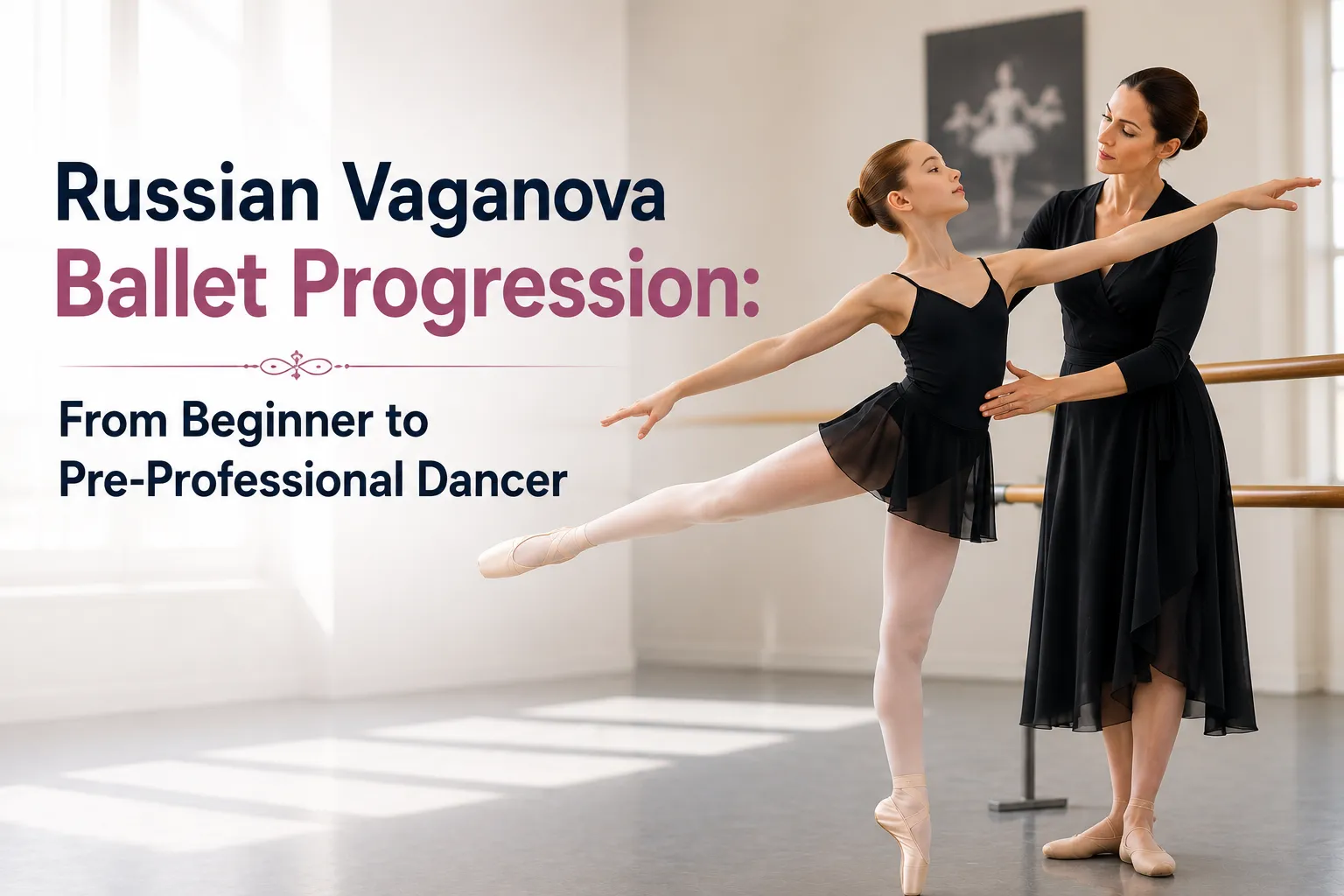
The Russian Vaganova ballet method is a structured, grade-based training system developed by Agrippina Vaganova in the early 20th century. It progresses students through clearly defined stages — from foundational posture and port de bras to advanced pointe work and allegro sequences — building technical precision, artistry, and physical conditioning in a logical, cumulative sequence.
If you are a serious student wondering what the full training journey looks like, this roadmap will walk you through every stage — what you learn, what your body develops, and what readiness for the next level actually means.
What Makes the Vaganova Method Different From Other Ballet Techniques?
Most ballet systems teach steps. The Vaganova method teaches the body how to move as a unified instrument. Every arm, head, back, and leg position is connected. Nothing works in isolation.
Agrippina Vaganova, a former Mariinsky ballerina, codified this system after years of observing what caused technical failure in dancers. Her answer was a curriculum built on muscle memory, anatomical logic, and artistic expression developed simultaneously — not as separate skills added on later.
Key distinctions of the Vaganova approach:
- The back is treated as the primary engine of movement, not just a support structure
- Port de bras is taught from the very first year, not introduced as an advanced concept
- Epaulement — the slight rotation of the shoulders and head — is embedded into every exercise from the beginning
- Each level builds directly on the technical vocabulary of the previous one
The Vaganova Training Stages: A Level-by-Level Roadmap

The Vaganova curriculum is typically structured across eight to nine years in professional school training. For students starting as adults or joining mid-stream, the progression is adapted but the core logic stays intact.
Stage 1 — Foundation (Years 1–2): Building the Body from Scratch
This stage is not about learning steps. It is about rewiring posture, alignment, and basic muscle engagement. Students work entirely at the barre before any centre work is introduced.
Key training focus at this stage:
- Correct turnout and its anatomical limits per individual student
- Plié and tendu mechanics — the foundation of every future step
- Basic port de bras and head positions
- Coordination of arms and legs moving together
A common mistake students and parents make is rushing this stage. The Vaganova system deliberately slows down here because errors embedded at foundation level compound over time. One misaligned tendu becomes a flawed pirouette three years later.
Stage 2 — Technical Development (Years 3–4): Vocabulary Expansion
Students begin centre work in earnest. Adagio combinations, petit allegro, and the early vocabulary of turns are introduced. The body should now have sufficient strength and muscle memory to execute steps without consciously thinking about alignment.
Key milestones at this stage:
- Introduction of pirouettes en dehors and en dedans
- Basic adagio with développés and arabesque balances
- Simple petit allegro — changements, échappés, assemblés
- First exposure to diagonal combinations across the floor
For students in ballet classes in Singapore, consistent attendance at this stage is especially critical. Missing classes during years three and four creates gaps that are difficult to recover without individualised correction work.
Stage 3 — Consolidation (Years 5–6): Strength, Artistry, and Pointe
This is where training becomes noticeably more demanding. Female students typically begin pointe work if their feet, ankles, and overall technique meet the required standard. Male students begin more advanced allegro and elevation work.
Training intensity increases significantly:
- Grand allegro combinations with multiple steps linked together
- Pointe barre and centre work for female students
- Fouettés and complex turn sequences
- Introduction of performance repertoire — excerpts from classical ballets
The Vaganova method places strong emphasis on musicality and artistic expression at this stage. Technical accuracy is assumed; the focus shifts toward how you move, not just whether you can execute the step.
Stage 4 — Pre-Professional (Years 7–9): Repertoire and Specialisation
Students at this level are training at near-professional volume. Class frequency, cross-training, and repertoire coaching become the dominant activities. Variation classes — learning and polishing specific solos from the classical canon — prepare students for auditions and performances.
What pre-professional training involves:
- Daily technique class plus rehearsal hours
- Classical variations from Sleeping Beauty, Swan Lake, Giselle, Don Quixote
- Character dance and historical dance as required by the full Vaganova curriculum
- Partnering work (pas de deux) for advanced students
Adults Ballet Class and the Vaganova Method: Is It Accessible?
Yes — and this is often misunderstood. The Vaganova method is not exclusive to students who began training at age four. A structured adults ballet class following Vaganova principles can deliver genuine technical development, even for students who start in their twenties or thirties.
The curriculum adapts the same logical progression: foundational alignment first, technical vocabulary second, artistry and performance third. Adult bodies respond differently — recovery takes longer, flexibility develops more slowly — but the systematic nature of the Vaganova approach actually suits adult learners well because every concept is explained, not just demonstrated.
Progress Benchmarks: How Do You Know You Are Ready for the Next Level?
| Stage | Technical Benchmark | Artistic Benchmark |
|---|---|---|
| Foundation | Clean plié and tendu without grip or collapse | Arms and head move with the exercise, not after it |
| Technical Development | Single pirouettes with consistent landing | Adagio held with stillness and control |
| Consolidation | Sustained pointe work, grand allegro fluency | Music shapes the movement, not the count |
| Pre-Professional | Variation readiness, full class at professional pace | Character and intention visible in performance |
What Serious Students Should Understand About Long-Term Progression
The Vaganova system rewards patience and penalises shortcuts. Students who rush through foundation work carry technical debt that surfaces under performance pressure. Students who develop slowly but correctly tend to plateau less and recover from injury faster.
Three principles that govern long-term success under this method:
- Consistency over intensity: Three well-executed classes per week produce more lasting development than six rushed ones
- Correction is the curriculum: A teacher stopping you mid-exercise to correct alignment is not interruption — it is the lesson
- The body has its own timeline: Hypermobility, proportions, and natural turnout all affect how quickly a student moves through stages
For students training in Singapore, the School of Russian Ballet Singapore offers structured Vaganova-based training across all levels — from introductory classes through to pre-professional preparation — with instruction grounded in the authentic Russian academic tradition.
FAQ
What age should a child start Russian Vaganova ballet training?
The majority of the Vaganova schools start taking in students between the ages of 4 and 6 for pre-ballet class, while training begins when students are about 7 or 8 years old. Early training helps the body build up turn out and flexibility, among others. However, late starters can also progress through all levels.
How long does it take to complete the Vaganova ballet curriculum?
The complete course of Vaganova technique runs for eight to nine years in a professional conservatory. This can vary for students enrolled in a recreational or semi-professional program. This depends more on class attendance, innate ability, and regular training, not necessarily age.
Can adults learn ballet using the Vaganova method?
Indeed. Adults may learn following a well-structured Vaganova method beginning with alignment and barre. Although adult bodies respond differently compared to children, the systemized structure of the technique in terms of technical vocabularies learned in layers fits very well with adults. In two to four years, many adults achieve an advanced intermediate level.
When does a student start pointe work in the Vaganova system?
A pointe class generally commences after three to four years of proper training, usually at an age of 11 to 12 years. The ability to commence pointe class is determined by the trainer, considering the strength of the ankle joints, positioning of the feet, and technical abilities.

























Sign in to leave a comment.