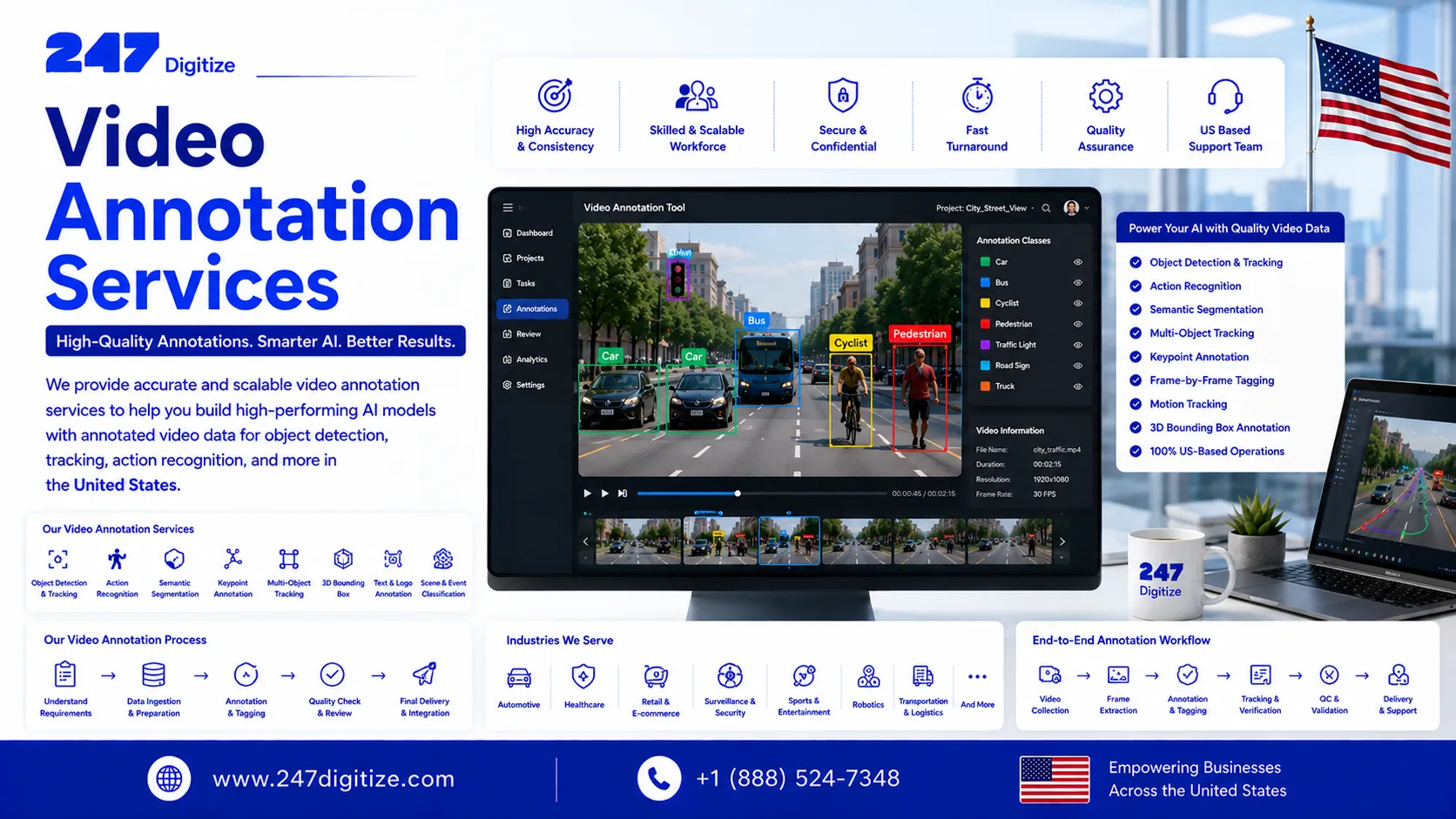
Developing an advanced artificial intelligence model requires a substantial amount of high-quality training data. In computer vision, transforming raw video frames into structured data that a machine can interpret is one of the most resource-intensive bottlenecks. AI models cannot inherently comprehend moving objects, contextual depth, or spatial boundaries on their own. They require frame-by-frame contextual tags to learn patterns, identify anomalies, and make precise real-time predictions.
For technology teams across the United States, managing this operational overhead internally can strain engineering resources. This is where professional video annotation services become an essential asset. By converting massive flows of unstructured footage into flawlessly tagged training datasets, expert labeling services empower AI developers to accelerate their deployment timelines and build models that perform reliably in the real world.
Why Video Modality Demands Expert Processing
Unlike static images, video introduces a temporal dimension. An object moving across a screen must be tracked continuously from frame to frame while preserving spatial consistency. This requires advanced labeling techniques, such as bounding boxes, 3D cuboids, semantic segmentation, and key-point tracking. If an annotator misplaces a single vector or fails to track an obscured object across a series of frames, the underlying algorithm receives flawed training inputs.
The massive scale of visual data production continues to drive substantial industry demand for external, specialized processing teams. A major market analysis report tracks the rapid financial trajectory of this space:
According to a comprehensive 2025 industry research report published by Grand View Research, the global AI annotation market was valued at USD 1.45 billion in 2024 and is projected to reach USD 13.11 billion by 2033, expanding at a compound annual growth rate (CAGR) of 27.2%. The report emphasizes that the image and video computer vision segment led the market, capturing over 41% of the total global revenue, fueled by escalating demands from autonomous vehicles, defense security, and specialized healthcare diagnostics.
Source: Grand View Research AI Annotation Market Report 2033
The Advantage of Outsourcing to 247Digitize
While automated labeling scripts have made progress, they frequently fail when encountering complex edge cases, overlapping objects, or low-resolution video footage. Human-in-the-loop validation remains the industry standard for delivering the precision required by enterprise-grade computer vision models.
Partnering with a dedicated service provider like 247Digitize ensures your raw datasets are managed securely and annotated to your exact technical specifications. Rather than leaving data quality to automated platforms, a managed team of data labeling specialists manually reviews, tags, and cross-checks every single frame. This specialized workflow eliminates label drift, corrects alignment errors, and guarantees that complex custom attributes—such as object velocity, directional change, or environmental hazards—are labeled with absolute precision.
Strategic Impact Across Key Industries
Outsourcing your labeling workflows directly optimizes operational overhead and improves machine learning accuracy across multiple sectors:
- Autonomous Driving and Mobility: Self-driving systems rely on radar, camera feeds, and LiDAR to navigate. High-precision video labeling ensures cars correctly identify pedestrians, traffic signs, and changing lane conditions across varying weather environments.
- Security and Intelligent Surveillance: Modern retail and municipal monitoring systems use computer vision to spot anomalies or optimize foot traffic. Accurately labeled security footage enables automated detection systems to operate with minimal false alarms.
- Medical Imaging and Healthcare: Surgical videos and diagnostic feeds require meticulous anatomical tagging. Expert annotators help build models that can assist physicians in identifying anomalies during live procedures.
- Retail and E-Commerce Automation: From frictionless checkout systems to smart inventory monitoring, specialized tracking across continuous video streams allows retail networks to automate complex back-end operations safely.
By shifting the burden of database management and frame-by-frame tracking to an external partner, your internal data scientists can step away from manual labeling chores. They can focus entirely on optimizing algorithm architecture, running tests, and scaling your core technology forward.
Frequently Asked Questions (FAQs)
1. What are video annotation services?
They are specialized data labeling services where human professionals use specialized software to tag, label, or track specific objects, actions, or boundaries within a video file. This structured visual metadata is then used as training data to teach machine learning and computer vision models how to perceive moving objects.
2. How does video labeling differ from image labeling?
Image labeling deals with single, isolated frames. Video labeling includes a temporal element, meaning annotators must track an object's continuity, velocity, and positioning across multiple consecutive frames, ensuring the data remains synchronous and connected over time.
3. Why is human-in-the-loop validation necessary for video data?
Automated tools often struggle with visual obstructions, changing light levels, and unusual edge cases. Human annotators provide the critical cognitive context needed to interpret ambiguous visuals correctly, keeping the dataset free of errors that could degrade model performance.
4. Is our proprietary video data secure when working with an external partner?
Data security is a foundational requirement. Established data annotation partners utilize secure data transmission protocols, restricted-access facility environments, and stringent non-disclosure agreements (NDAs) to protect your proprietary files throughout the entire project lifecycle.
5. What are the common types of annotation used for video analysis?
The most common types include 2D bounding boxes for basic detection, 3D cuboids for spatial depth estimation, semantic segmentation for pixel-level boundary mapping, polyline annotation for lane tracking, and key-point labeling for human pose and facial expression mapping.































Sign in to leave a comment.