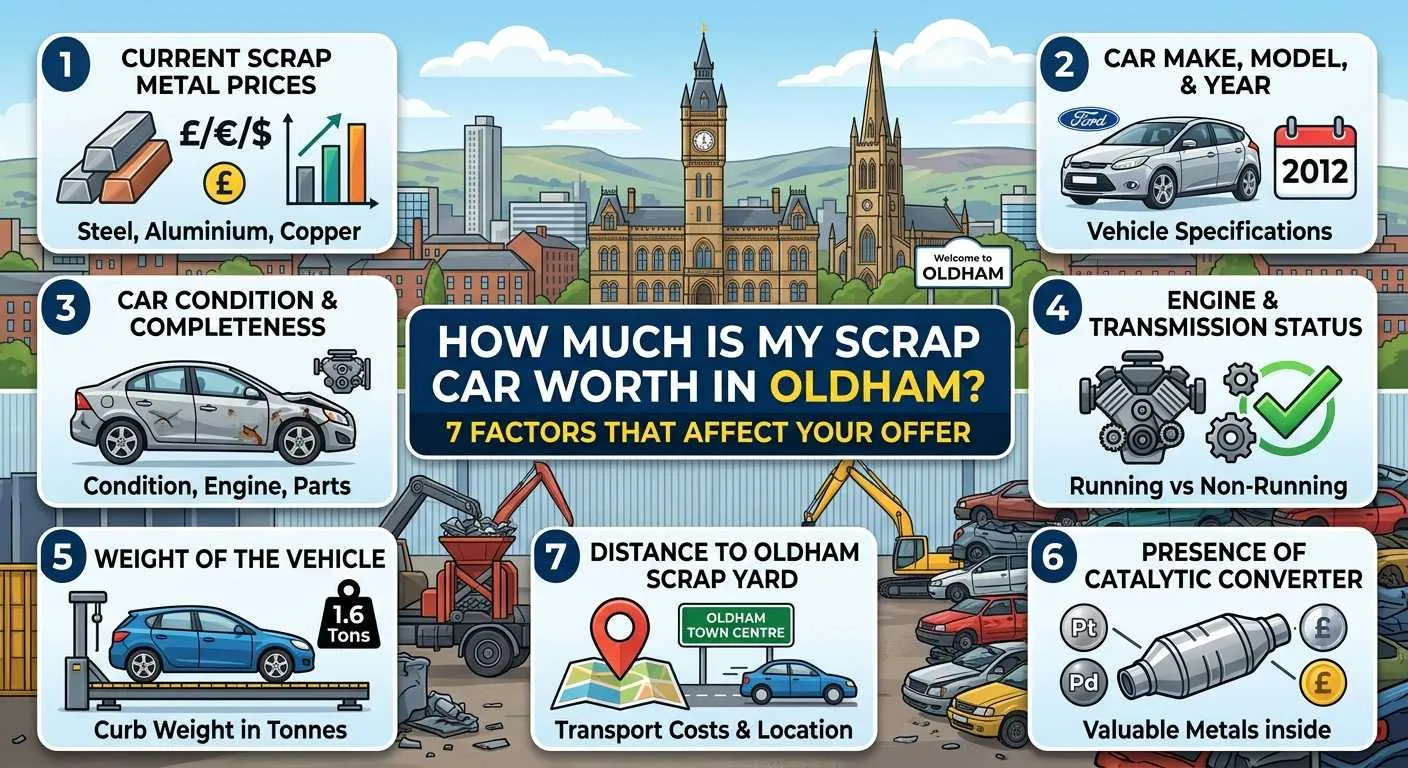

If you have an old car sitting on your driveway in Oldham, you have probably wondered whether it is still worth anything or whether it is time to let it go. Perhaps it has failed its MOT, developed an expensive engine problem or been parked up for months because you no longer use it. The good news is that a car does not have to be roadworthy to have scrap value. The amount you can receive depends on what the vehicle is made of, which parts can still be recovered, its condition and the current market. If you are considering scrapping your car in Oldham, understanding these factors will help you make sense of the offer rather than simply accepting the first figure you hear.
There is no single price that applies to every scrap car. Two vehicles of the same age can receive different offers, even if they look similar from the outside. One might have its engine, wheels and catalytic converter intact, while the other has been stripped of valuable components. Here are seven factors that help explain how scrap car valuations work and what you should consider before arranging collection.
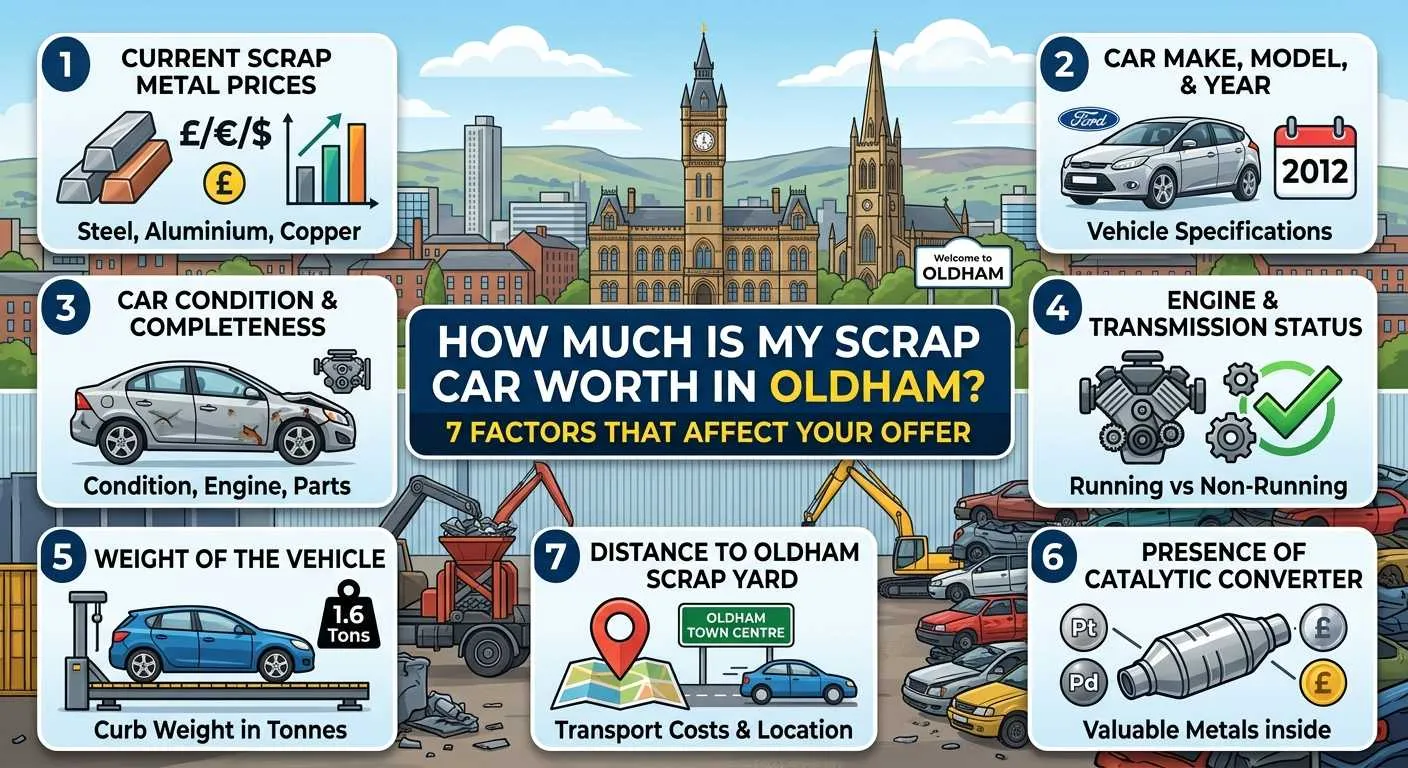
1. The Weight of Your Car
One of the biggest factors affecting scrap value is the amount of recoverable metal in your vehicle. Cars contain steel, aluminium and other materials that can be separated and recycled, so a heavier vehicle will often have a higher basic scrap value than a smaller one.
Think about the difference between a small city car and a large family SUV. A compact hatchback generally contains less metal than a substantial estate car or 4x4. Even if both vehicles are no longer roadworthy, their weights can lead to different starting valuations.
However, weight is not the whole story. A scrap buyer also needs to consider the vehicle's condition, missing components, processing requirements and whether any parts can be reused.
You should not try to increase your car's weight by filling it with unwanted metal or other items. That will not necessarily increase the offer, and the collection company may require the vehicle to be cleared of unrelated materials.
What this means for you: Do not judge your car's value by its size alone. Its weight provides a useful starting point, but the final quote depends on several factors working together.
2. Current Scrap Metal Prices
Scrap metal prices change over time, which means a valuation you received several months ago may not be the same as an offer available today.
Recyclers consider the value of the materials they can recover from end-of-life vehicles. When the market value of those materials changes, the amount a buyer can offer for a car may change too. Processing expenses, transport and local demand can also affect the final figure.
For example, imagine your old car has been sitting outside your home since last winter. You previously asked for a quote but decided to wait because you thought you might repair it. If you request another valuation now, the amount could be different—not necessarily because the car has deteriorated, but because market conditions or the buyer's costs have changed.
This is why broad online price estimates should be treated as a guide rather than a guaranteed offer. A useful quote should reflect your actual vehicle and the terms of collection.
What this means for you: Ask for a current valuation rather than relying on an old quote or a price you have seen advertised for a different vehicle. Check how long the offer remains valid and whether collection is included.
3. Your Car's Make, Model and Age
The make, model and age of your car can influence how much a buyer is prepared to offer, particularly if some components still have a resale value.
A relatively common model may have parts that other motorists and garages are still looking for. Components such as mirrors, doors, alternators, gearboxes and certain electronic parts may be reusable if they are in suitable condition. A rarer or older model may have less demand for its individual parts, although this is not always the case.
Age also needs to be considered in context. A 15-year-old vehicle with a working engine, intact body panels and undamaged components might offer more reuse potential than a newer car that has suffered severe fire damage.
The badge on the bonnet does not automatically determine the price, either. A premium vehicle may contain valuable components, but those components only add meaningful value if they can be recovered and there is demand for them.
What this means for you: When requesting a quote, provide the correct registration number, make, model and any relevant specification details. These help the buyer identify the vehicle and assess its likely value more accurately.
4. The Condition of Your Car and Its Missing Parts
A car does not have to be in perfect condition to have value, but what is damaged or missing can make a difference to the offer.
Consider two cars that have both failed their MOT. The first has a faulty exhaust and a few warning lights on the dashboard, but its engine, gearbox, wheels and other major components are still present. The second has suffered serious damage and has already had several components removed.
Although both vehicles may be destined for the scrapyard, the first could offer more opportunities for parts recovery. The second may be valued more heavily on its remaining materials, depending on its condition and what can be recovered.
Some of the parts that may influence a valuation include:
- Engine and gearbox: Working units may have value if they can be reused.
- Catalytic converter: The precious metals inside can make this a significant component, although its value varies by vehicle and market conditions.
- Alloy wheels and tyres: Their condition and suitability for reuse can affect their value.
- Body panels: Doors, bonnets and tailgates may be reusable if they are in good condition and there is demand for them.
- Battery and other components: Their condition and the type of vehicle determine whether they add value.
You do not need to repair every fault before requesting a scrap quote. In fact, spending hundreds of pounds fixing a car that is already at the end of its useful life may not make financial sense.
Be honest about any major damage or missing parts when asking for a valuation. A quote based on an accurate description is more useful than an attractive initial figure that changes when the vehicle is inspected.
What this means for you: Tell the buyer about significant damage and any components that have already been removed. You can still request a valuation for a damaged or incomplete vehicle, but its condition needs to be reflected in the offer.
5. Whether Your Car Runs, Has an MOT or Can Be Driven
A failed MOT can make a car difficult or expensive to keep, but it does not automatically mean the vehicle has no value.
The important question is what has caused the failure and whether the car has any realistic repair or resale potential.
A vehicle with worn tyres, suspension problems or an emissions issue may be in a very different position from one with a seized engine or serious structural damage. Even when neither car is suitable for continued use in its current condition, their remaining components may have different values.
Imagine your car has failed its MOT because several repairs are needed at once. The garage has provided an estimate, and the total is more than you are comfortable spending on a vehicle that is already getting old. You may be deciding between paying for the repairs, selling the car as it stands or arranging scrapping.
That is when it helps to compare the likely repair cost with the vehicle's realistic value after repairs. A repair is not automatically worthwhile just because the car could pass its MOT afterwards.
For more help weighing up that decision, read this guide to MOT failure in Oldham and whether you should repair your car.
It is also important to distinguish between a car that does not run and one that cannot be moved safely. A vehicle with a flat battery may simply need assistance to start, while a car with seized brakes, damaged wheels or a locked steering system may need specialist loading arrangements.
These practical details can affect collection costs and the final offer, depending on the provider's terms.
What this means for you: Explain whether the engine starts, whether the car moves and what faults you know about. You do not need to get it running just to request a quote, but accurate information helps the buyer assess the job.
6. The Distance to Your Vehicle and Collection Arrangements
Where your car is located can also influence the price you receive.
A buyer has to account for the time, staff and equipment needed to collect a vehicle. A car that is easy to reach near the collection team's usual operating area may cost less to recover than one requiring a longer journey or more complicated loading.
This does not mean living in one part of Oldham automatically guarantees a better price than living in another. The effect depends on the collection provider, its operating area and the circumstances of the vehicle.
For example, a car parked in an accessible driveway may be relatively straightforward to load. A non-runner squeezed into a narrow space, with flat tyres and another vehicle blocking the exit, could require additional time or equipment.
When you request a quote, provide the postcode and explain any access difficulties. If the car is in a garage, on private land or parked somewhere that requires special arrangements, mention that too.
Also, check what is included in the offer. A quote that appears higher at first may not represent better value if collection or recovery charges are added later.
What this means for you: Compare the actual amount you will receive, not just the headline valuation. Ask whether collection is included and whether any additional charges could apply to your vehicle.
7. Local Demand and the Value of Reusable Parts
The final factor is demand for your vehicle and the components it contains.
A scrap car is not always worth only the value of its metal. Depending on its condition, some parts may be suitable for reuse, while other vehicles may be more appropriate for straightforward recycling.
A common model with a working gearbox or undamaged body panels may appeal to a dismantler who supplies replacement parts. A severely damaged vehicle with few reusable components may have less value beyond the materials that can be recovered.
Demand can also change. A part that is easy to sell today may be less sought after in the future, and the value of metals and components can move independently.
This is why two buyers can sometimes offer different amounts for the same car. They may have different routes for recycling, different demand for components, different collection costs or different access to buyers for recovered parts.
You should not assume that the buyer offering the highest initial figure will necessarily pay that amount once the vehicle's condition and collection arrangements are confirmed. Ask how long the quote is valid and what could cause it to change.
What this means for you: Give the buyer the correct vehicle details and an honest description of its condition. Compare a couple of genuine offers if possible, and choose a provider that explains its terms clearly.
How to Get a Fair Offer for Your Scrap Car in Oldham
Once you understand what affects the valuation, there are a few simple steps you can take before agreeing to a collection.
Give accurate vehicle details. Provide the registration number, make, model and any known faults. If the car has been involved in an accident or is missing major components, mention that from the beginning.
Compare like-for-like quotes. Ask whether the price includes collection and whether any conditions could affect the amount you receive. A slightly lower offer with clear terms may be more reliable than a higher figure that comes with unexpected deductions.
Avoid removing valuable parts without doing the sums. Taking off the wheels, engine or catalytic converter may appear to be a way to earn extra money, but it can reduce the vehicle's value as a complete unit and make collection more complicated. GOV.UK also notes that an authorised treatment facility may charge for accepting a vehicle after essential parts have been removed.
Be cautious of unrealistic promises. No single scrap price applies to every vehicle, and a buyer should be able to explain the basis of its offer. Ask questions if the final amount differs from the original quotation.
Use the proper disposal route. If your vehicle is being scrapped as an end-of-life vehicle, it must go through an Authorised Treatment Facility (ATF). In England and Wales, payment for a vehicle that is scrapped must be made by bank transfer or cheque, not cash. The ATF should issue a Certificate of Destruction when the vehicle is completely scrapped.
These checks will not guarantee the highest possible price, but they can help you make a more informed decision and avoid unnecessary surprises.
Frequently Asked Questions
How much is a scrap car worth in Oldham?
There is no fixed price for every scrap car in Oldham. The amount depends on its weight, condition, make and model, missing parts, current scrap metal prices and collection arrangements. The most reliable way to find out what your particular car is worth is to request a current quote using its details.
Is a car worth anything if it has failed its MOT?
Yes, it can be. A failed MOT does not automatically make a vehicle worthless. Depending on the faults, the car may still have reusable components or recoverable materials. The severity of the damage and the cost of collecting and processing it will influence the offer.
Does a heavier car always get a better scrap price?
Not necessarily, although weight is an important factor. A heavier car generally contains more recoverable metal, but missing components, damage, processing costs and the value of reusable parts can change the final valuation.
Can I get my scrap car collected if it does not start?
A non-running car can often be collected, but the arrangements depend on its condition and location. Tell the collection company whether the car rolls, whether its wheels are intact and whether it can be accessed by recovery equipment.
Should I repair my car before scrapping it?
That depends on the cost of the repairs and the vehicle's likely value afterwards. If the repairs are expensive and the car is already ageing, scrapping it may be the more practical option. Compare the garage's estimate with the car's realistic value before making a decision.
Can I negotiate a scrap car offer?
You can ask how the offer was calculated and compare it with other genuine quotes. Providing accurate information and checking collection terms can help you make a fair comparison, although a buyer may not be able to increase its offer.
Final Thoughts
Finding out how much your scrap car is worth in Oldham does not have to be complicated. Start by looking at the vehicle's weight, condition and reusable parts, then consider current metal prices, collection arrangements and demand for the components it contains.
Remember that the oldest or most damaged car is not necessarily the least valuable. A vehicle that no longer makes financial sense to repair may still have useful parts or materials worth recovering. Equally, a newer car can receive a lower offer if important components are missing or it has suffered severe damage.
The best approach is to provide honest information, compare clear quotations and understand exactly what is included before agreeing to collection. That way, you can make a decision based on the value of your actual vehicle rather than a generic price estimate.
If you are ready to explore your options, visit Scrap Car Guys to find out more about the service and the next steps for scrapping your car.





















Sign in to leave a comment.