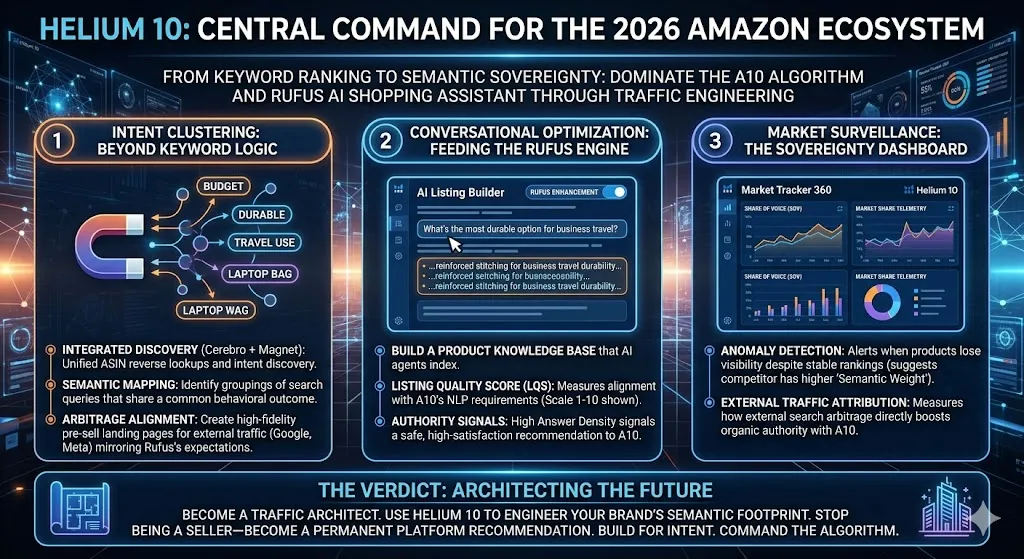

In the 2026 Amazon ecosystem, the traditional concept of "ranking" has been superseded by Semantic Sovereignty. With the full integration of the A10 algorithm and the Rufus AI shopping assistant, Amazon no longer merely matches keywords; it interprets buyer intent and conversational context. Success in this era isn't about being found—it’s about being the only logical answer to a customer's complex, natural-language query.
For the professional media buyer and high-volume operator, the game has shifted from simple arbitrage to Traffic Engineering. This requires a precision-tuned data stack that bridges the gap between external signals and internal authority. Here is how Helium 10 serves as the central command for this high-frequency environment.
1. Intent Clustering: Beyond Keyword Logic
By 2026, the vanity of raw search volume has faded. The new gold standard is Intent Density. Rufus AI prioritizes products that demonstrate a deep semantic fit for specific use-case clusters.
Integrated Discovery: As of early 2026, Magnet has been fully merged into Cerebro, creating a unified environment for ASIN-based reverse lookups and intent discovery.
Semantic Mapping: Using this integrated engine, elite sellers identify "Intent Clusters"—groups of search queries that share a common behavioral outcome.
Arbitrage Alignment: For media buyers running external traffic (Google/Meta), this data allows for the creation of high-fidelity "pre-sell" landing pages that mirror the exact semantic expectations Rufus has for the category.
2. Conversational Optimization: Feeding the Rufus Engine
The 2026 AI Listing Builder has evolved into an agentic marketing tool. It no longer just stuffs keywords; it builds a Product Knowledge Base that AI shopping assistants can index and recommend.
Rufus Enhancement Toggle: The AI Listing Builder now includes a specific "Optimize for Rufus" feature. By analyzing natural-language prompts like "What's the most durable option for business travel?", the tool helps you weave specific use-case answers directly into your bullets and A+ content.
Listing Quality Score (LQS): Every listing is assigned an objective Quality Score (1-10) that measures alignment with A10’s NLP requirements.
Authority Signals: A10 heavily weights Seller Authority and consistent conversion rates. The Listing Builder ensures your "Answer Density" is high enough to signal to the algorithm that your product is a safe, high-satisfaction recommendation.
3. Market Surveillance: The Sovereignty Dashboard
In a market moving at the speed of AI, reactive management is a liability. You need real-time Market Share Telemetry to defend your territory.
Market Tracker 360: This enterprise-level module allows you to monitor your Share of Voice (SOV) across entire categories.
Anomaly Detection: In 2026, sellers use performance anomaly alerts to detect when their products lose visibility despite stable rankings—often a sign that a competitor has achieved a higher "Semantic Weight" in the category.
External Traffic Attribution: Because A10 rewards listings that attract off-Amazon signals, Helium 10's Attribution tools are critical for measuring how your search arbitrage efforts are directly boosting your organic authority.
The Verdict: Architecting the Future
The 2026 Amazon landscape belongs to the Traffic Architects. By using Helium 10 to engineer your brand’s semantic footprint, you stop being a "seller" and become a permanent fixture of the platform's recommendation engine.
Build for intent. Command the algorithm.
Use code MADABOUTSKINOFFICIAL20 at checkout to secure your toolkit and start your Prime Day prep today.



























Sign in to leave a comment.