
Among the audio world, the Shure SM7B is still holding the title of being the most flexible microphone, which is often acclaimed for its characteristic warmness, clear sound, and its ability to be used in almost any recording situation. In any case, for a podcast, a stream, or recording vocals, an adequate SM7B setting is capable of lifting your sound to a level beyond imagination. This deep A/B comparison experiments with the best configurations for each situation, which enables you to adjust your mic to achieve a professional finish and, at the same time, make the maximum use of its construction and the legendary Shure M7B backplate switches.
Understanding the SM7B Sound Profile
It is necessary to know the basis of the SM7B before referencing the specific applications. It is a single-directional dynamic microphone that features a flat frequency response and a smooth presence boost. Thanks to its tightly controlled proximity effect and internal air suspension shock isolation, the device is able to provide a stable sound even in non-ideally treated rooms. But adjusting your SM7B recording settings to the minimum will still result in an optimal balance between clarity and character for any kind of application.
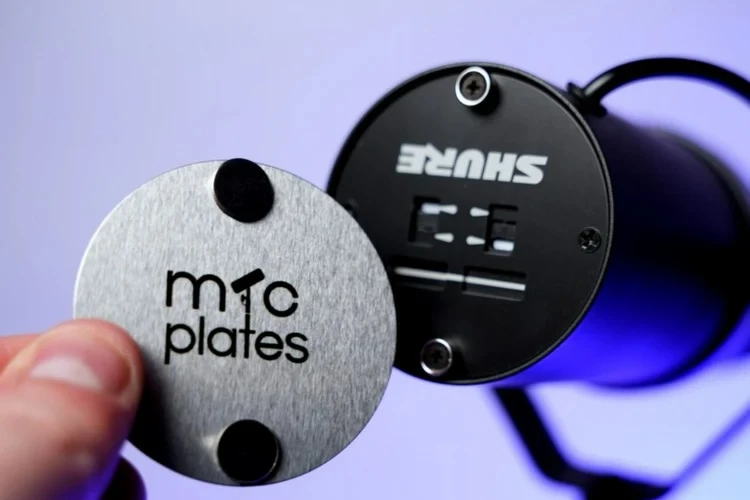
You can locate two very important switches on the shure sm7b back plate:
Bass Roll-Off (Low Cut)—Helps in getting rid of low-frequency rumbles and room noise.
Presence Boost – Makes the upper mids more clear, which is great for vocal clarity and brightness.
These switches decide the microphone’s tonal response in different scenarios; thus, they play a key role in your setup strategy.
A/B Comparison: SM7B Settings for Different Applications
A. SM7B Podcasting Settings—Clarity and Intimacy
In a podcast, the most important features of the sound are the articulation and the warmth of the voice. The listeners want to have the “radio” voice—clear, natural, and without any kind of a harsh high.
Recommended Setup:
- Distance: 2–4 inches from the microphone with a pop filter or foam windscreen.
- EQ Profile: Either a flat curve or a low-cut if the proximity effect adds too much bass.
- Presence Boost: Affected only if your voice is too mellow or dull and then you switch the presence boost ON.
- Preamp Gain: 55–60 dB. If necessary, a clean preamp or inline booster like a Cloudlifter can be used.
- Compression: Small ratio (2:1 to 3:1) and a very slight reduction of the threshold to level the peaks.
- De-esser: Very gentle, only if your sibilants are exaggerated.
Why It Works:
The setup increases the speech side of the sounds, while the rich and smooth tone, which is the characteristic of the SM7B, is still kept. Using the low cut engaged, it removes the hum coming from a desk or an HVAC, but still, the vocal body is not taken away.
A/B Comparison Result:
Flat vs. Presence Boost ON: The flat curve is less bright and thus gives more warmth, which is great for storytelling or low-frequency voices. The presence boost makes the sound more crisp and clear, which is just right for the interview or the fast-paced, energetic style of the speech.
B. SM7B Streaming Settings—Balanced and Controlled
Streamer environments are full of different problems—noise coming from the room, sudden voice peaks, and a feeling of tiredness during long streams. A consistent, broadcast-quality tone is what is needed here to be heard through live environments.
Recommended Setup:
- Distance: 4–6 inches with the pop filter on. A little more distance helps deal with plosives in long spoken sessions.
- EQ Profile: Both bass roll-off and presence boost should be turned on for a bright, modern sound.
- Noise Gate: Use the light gating on the background hum, the typing sounds, and the clicks to filter.
- Compression: Medium (3:1 ratio), with a fast attack and a medium release.
- Limiter: Place the safety threshold at about –3 dB to keep the signal from clipping when the reactive moments occur.
Why It Works:
The setup clarifies the sound and keeps the speech understandable, which is very important when the sound is heavily compressed, as it is in the case of streaming platforms such as Twitch or YouTube Live. The SM7B’s heavy diaphragm is a natural filter for noise that comes off-axis; however, gating and the low-cut filter help even more with isolation.
A/B Comparison Result:
Bass Roll-Off OFF vs. ON: Turning off the roll-off gives a more rounded tone, but it can also bring about the problem of low rumbles becoming too loud. Leaving it on provides more polished control for live broadcasts.
C. SM7B Vocal Recording—Dynamic and Expressive
The SM7B is a source of happiness for singers, as it is capable of a wide dynamic range and aggressive performances without any kind of distortion; hence, it is a favorite of recording studios.
Suggested Setup:
- Distance: 6–12 inches depending on vocal strength. Change for proximity warmth.
- EQ Profile: Use flat as a starting point and then switch on presence boost to get more detail and midrange sparkle.
- Bass Roll-Off: Leave it OFF most of the time. Use it only if the vocals are muddy or a lot of instruments are cluttering the mix.
- Preamp Gain: Around 60–65 dB in order to have some headroom left while the singing is expressive.
- Compression: Moderate ratio (3:1–4:1) and relatively slower release so that the vocal movement is not sacrificed.
- Reverb/FX: Use only a small amount of room or plate reverb for the effect of natural depth.
Why It Is Effective:
With this configuration, emotional nuances of the performance can be recorded by the SM7B while it also helps with sibilance and breath noise that are quiet. The set is great for pop, rock, or R&B vocals that want to sound dense but without the harshness of digital.
A/B Comparison Result:
Presence Boost OFF vs. ON: Boost ON gives the vocal the articulation, which makes it able to cut through dense instrumentation. OFF provides a warmer, vintage tone that is more suitable for soul or jazz styles.
Fine-Tuning SM7B Vocal Settings for Any Environment
Whatever the scenario is, there are hallmark universal principles for the SM7B vocal settings, which are:
- Try to keep the distance between the microphone and the source as consistent as possible in order to control the proximity effect.
- Do your best to minimize reflection in the room, especially for speech or singing.
- Employ a top-notch interface with at least +60 dB gain.
- Try out a subtle post-recording EQ to locate the natural resonance frequencies.
- Use a light mastering compression to give the final polish and not to crush the dynamics.
In case you have multiple audio recording types, make preset settings in your DAW (like Reaper, Logic Pro, or OBS for streaming) for various SM7B recording settings with labels for podcast, vocal, or live modes. Thus, you will be able to switch your working mode without interrupting the flow.
Final Verdict: Flexibility Meets Precision
One of the main reasons that the Shure SM7B is referred to as the "legend" of the mics is its adaptability besides the sound quality. No matter what activity you are doing—podcasting, streaming, or singing—the mic can be perfect with just a small adjustment of its back plate and front-end EQ.






















Sign in to leave a comment.