

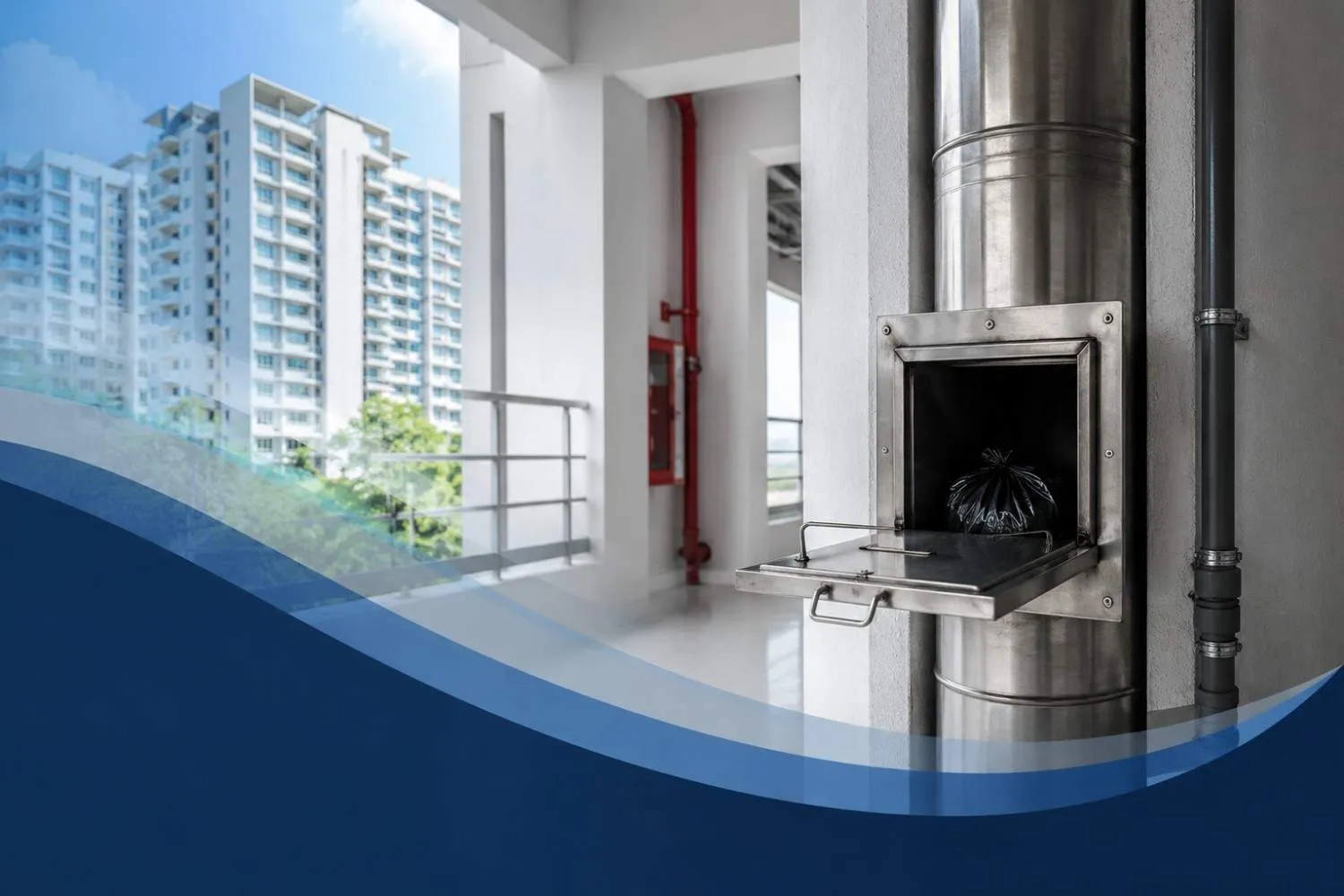
Condo rubbish chute replacement is required when recurring faults, structural deterioration or persistent hygiene failures are no longer remedied by maintenance or patching. Key indicators are chronic blockages, visible corrosion, persistent odours even after cleaning, non-compliant components and fire safety deficiencies. Early awareness of these signs allows MCST committees to prevent costly reactive expenditure and exposure to liability.
This diagnostic checklist will help the MCST committees and facility managers make an informed, defensible decision — replace or repair — before the next management council meeting.
Why the Replace-or-Repair Decision Matters More Than You Think
Most rubbish chute failures are not accompanied by a big announcement. They gather. A little smell complaint turns into a pest infestation report. A tiny crack in the hopper is not noticed until water begins to run down the neighbouring walls. When the problem becomes visible to residents, the underlying deterioration has often been underway for months.
For MCST committees, this creates two risks: financial (emergency replacements are much more costly than planned ones) and legal (not acting on known defects may expose management to liability under the Building Maintenance and Strata Management Act). The purpose of this checklist is to develop the core competency of distinguishing a repairable fault from a replacement-grade condition.
The Diagnostic Checklist: 8 Signs That Point to Replacement
Work through each item below. If you check three or more, a full condo rubbish chute replacement assessment — not another repair — is the appropriate next step.
1. Blockages Are Recurring Despite Multiple Clearing Interventions
A chute that blocks once after an unusual deposit is a maintenance issue. A chute that blocks repeatedly — even after professional rodding and jetting — signals structural deformation, internal surface degradation, or incorrect gradient alignment. Temporary fixes on a geometrically compromised chute will keep failing.
- Ask: Has this chute been cleared more than twice in the past 12 months?
- Ask: Are blockages occurring at the same point each time?
If yes to both, the chute's internal profile is likely compromised beyond repair.
2. Visible Corrosion, Cracks, or Structural Deformation
In Singapore's humid climate, galvanised and mild steel chute sections are particularly vulnerable to corrosion over time. Surface rust that has breached the chute wall, visible cracks at joints, or sections that have shifted out of alignment are all structural failure indicators. Patching corroded sections provides a short-term seal — it does not restore structural integrity or fire resistance.
Stainless steel chutes in older developments may also develop weld-line fatigue, especially in high-rise blocks where vibration and thermal expansion cycles accumulate over decades.
3. Persistent Odour That Survives Professional Deep Cleaning
Odour is one of the most common complaints filed with MCST offices, and it's also one of the most misdiagnosed. Cleaning crews typically address surface biofilm, but if odour persists after a certified deep clean, it indicates one of two replacement-grade conditions:
- Chute wall porosity — degraded surface coating allowing organic matter to permeate the material itself
- Compromised joints or cracks that trap decomposing waste and cannot be sanitised effectively
Neither condition is resolved by more frequent cleaning. The source of retention needs to be eliminated.
4. Fire Damper or Hopper Door Non-Compliance
Under the Singapore Civil Defence Force (SCDF) fire safety requirements, rubbish chutes of residential buildings must be fire-rated compartmentalised. If fire dampers do not close fully, if hopper doors do not close automatically or if the fire rating of chute sections is breached, that is not just a maintenance issue — it is a violation of regulations.
When a SCDF inspection or internal fire safety audit has identified a deficiency related to a chute, component-level repair is rarely sufficient. In most cases the audit finding and the regulatory standard will require complete replacement with compliant and certified components.
5. Evidence of Pest Ingress Through the Chute System
Cockroach, rat, or fly activity traced back to the chute shaft is a serious hygiene and structural signal. Pests enter through gaps at joints, deteriorated hopper seals, or cracks in the chute body. If pest control treatments are providing only short-term relief and the infestation recurs, the chute itself is the entry pathway — and it cannot be sealed adequately through pest control alone.
Facility managers should cross-reference pest control logs against chute complaint records. Correlation between the two is a clear replacement indicator.
6. Water Leakage or Moisture Damage in the Chute Shaft
Condensation and minor moisture are normal. Active water ingress — evidenced by water stains on shaft walls, efflorescence at chute joints, or damp patches appearing on adjacent residential walls — is not. Leaking chute joints allow moisture to migrate into the building fabric, accelerating concrete spalling and creating secondary mould risks.
This type of damage has a compounding cost profile: the longer replacement is deferred, the more remediation work the surrounding structure will require.
7. The System Is More Than 20–25 Years Old With No Major Overhaul
Most rubbish chute systems installed during Singapore's 1990s and early 2000s condominium development boom are now approaching or exceeding their effective service life. If the system has had no major component replacement in that period, the risk of multiple simultaneous failures increases sharply.
Age alone is not a replacement trigger — but age combined with any two other items on this checklist is a strong one. It is also a useful framing for budget planning at AGMs, where MCST committees can present replacement as lifecycle-based capital expenditure rather than reactive emergency spending.
8. Repair Costs Are Approaching or Exceeding Replacement Value
This is the financial test. Track cumulative repair invoices over a 24-month period. If the total approaches 40–50% of a full replacement quote, continued repair is economically irrational. You are funding deterioration, not extending service life.
A structured condo rubbish chute replacement, planned and tendered properly, also resets the maintenance clock — giving the development another 20+ years of reliable service with significantly lower ongoing maintenance costs.
Repair Is Still the Right Call in These Scenarios
Not every fault demands full replacement. Repairs are appropriate when:
- The fault is isolated to a single hopper door or floor-level component
- The chute is under 10 years old and the issue is a first-time, localised blockage
- Corrosion is surface-level only and the structural wall remains intact
- The fire damper issue is limited to a single unit and the component is readily replaceable
The key discipline is documentation. Every repair should be logged with the date, nature of fault, cost, and outcome. That record is what allows you to identify the pattern that moves a fault from "repair" to "replace."
How to Present the Replacement Case to Your Management Council
MCST committees often face internal pushback when proposing capital expenditure. The most effective approach is a documented fault history combined with a lifecycle cost comparison. Present cumulative repair spend alongside a replacement quote, project the 5-year cost trajectory of continued repairs, and reference any regulatory compliance gaps as non-optional drivers.
Framing replacement as risk management — not spending — changes the conversation at the council table.
Taking the Next Step
If this checklist has surfaced three or more indicators in your development, the responsible next step is a professional condition assessment, not another round of patching. Heng Plumbing specialises in rubbish chute replacement for condominiums and HDB developments across Singapore, offering structured assessments that give MCST committees the documented evidence they need to make a well-supported, budget-defensible decision.
Frequently Asked Questions
What is the typical lifespan of a condo rubbish chute in Singapore?
Most residential rubbish chutes in Singapore have an effective service life of 20 to 25 years, depending on material type, usage frequency, and maintenance history. Developments built during the 1990s and early 2000s condominium boom should conduct a formal condition assessment if no major overhaul has been carried out, as multiple components may be approaching simultaneous end-of-life.
What is the difference between HDB rubbish chute repair and full replacement?
HDB rubbish chute repair addresses isolated faults — a blocked section, a faulty hopper door, or a minor joint seal failure. Full replacement involves removing the entire chute system and installing compliant new components. Replacement is warranted when faults are recurring, structural deterioration is widespread, or fire safety compliance cannot be achieved through component-level repairs alone.
Who is responsible for rubbish chute maintenance in a condo — the MCST or individual unit owners?
Under the Building Maintenance and Strata Management Act in Singapore, the MCST is responsible for maintaining common property, which includes the rubbish chute system. Individual unit owners are responsible for correct usage but not for system-level repairs or replacement. MCST committees should ensure chute maintenance and replacement costs are captured in the sinking fund or management fund appropriately.
How much does a condo rubbish chute replacement typically cost in Singapore?
Costs vary based on building height, number of chutes, material specification, and scope of associated civil works. For mid-rise developments in Singapore, full replacement projects typically range from several thousand to tens of thousands of dollars. MCST committees should obtain at least two or three competitive quotations and ensure specifications reference current SCDF fire safety and NEA hygiene requirements.
Can rubbish chute odour ever be permanently resolved without replacement?
Persistent odour that survives professional deep cleaning is rarely resolved without addressing the root cause. If the chute's internal surface coating has degraded or joints are cracked and retaining organic matter, no cleaning protocol eliminates the source. In these cases, replacement of affected sections — or the full chute — is the only durable solution. Regular cleaning maintains a serviceable chute; it cannot restore a structurally compromised one.
What should an MCST include in a rubbish chute replacement tender?
A well-structured tender should specify material type and fire rating, compliance with current SCDF requirements, scope of civil and reinstatement works, warranty terms, disruption management during installation, and post-installation maintenance obligations. Including a clear performance specification rather than a prescriptive method specification gives contractors flexibility while holding them accountable to measurable outcomes.





























Sign in to leave a comment.