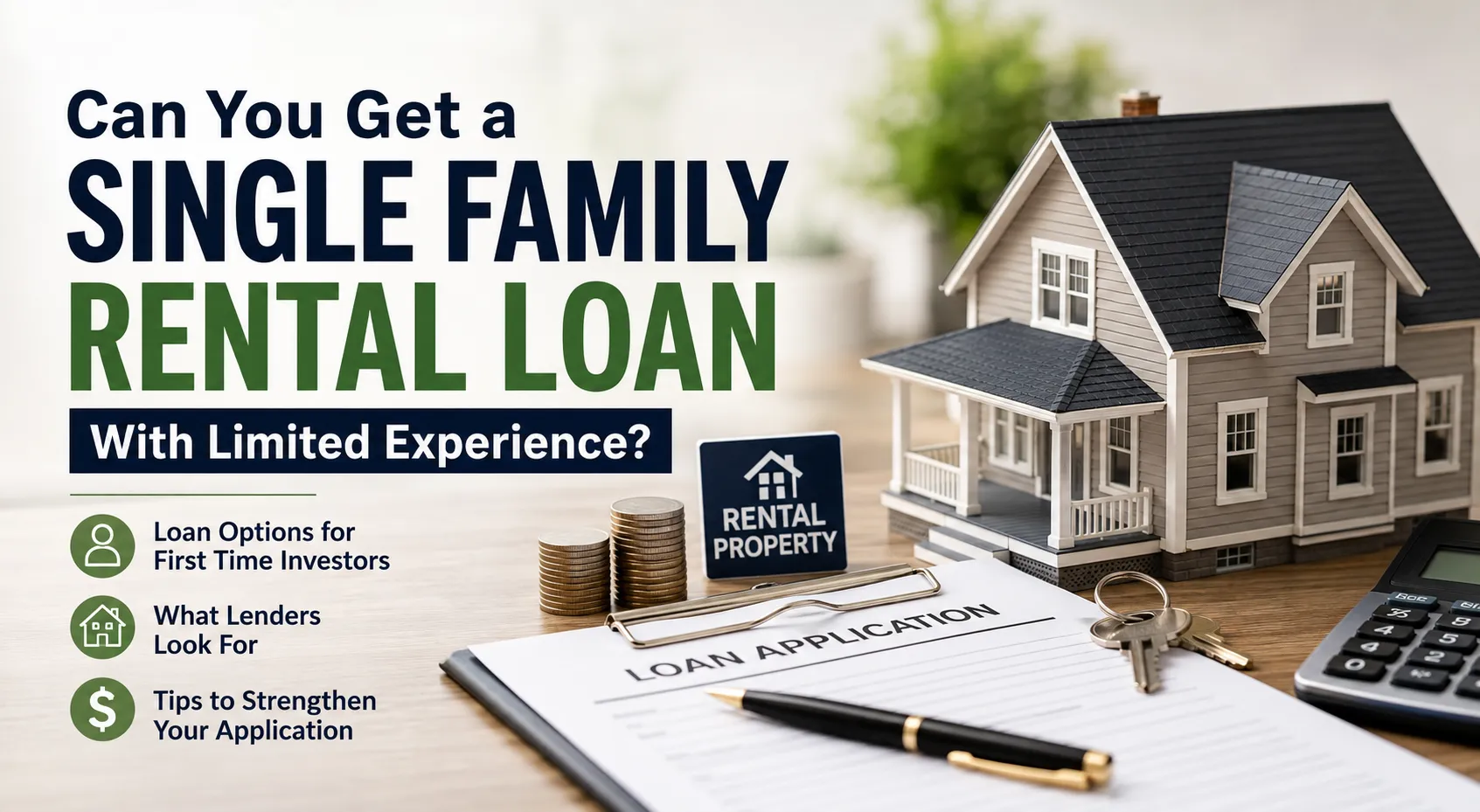
Buying your first rental property can feel like a catch 22. You need a property to gain experience, but you may worry that lenders want experience before they will finance that property.
The good news is that limited real estate experience does not automatically prevent you from getting single family rental loans. Many investor focused loan programs evaluate the property, its expected rental income, your credit profile, available cash, and the overall strength of the deal. Some lenders may also have specific requirements for first time investors, so the exact guidelines can vary.
This guide explains what first time investors should know about getting rental property financing, what lenders look for, how to strengthen an application, and how to choose the right financing option.
Quick Answer
Yes, you may be able to get a single family rental loan with limited or no previous investment property experience. Some investor focused loan programs, particularly certain DSCR loan programs, do not require borrowers to have an established rental property portfolio. Instead, the lender may place significant emphasis on the property's rental income, debt service coverage, credit, down payment, reserves, and overall financial strength.
However, having limited experience does not mean that every lender will approve you or offer the same terms. Some programs may have additional requirements for first time investors.
The most important thing is to find a lender whose program matches your situation and to present a property with realistic numbers.
Does Real Estate Experience Matter for a Rental Property Loan?
It can, but not always in the way new investors expect.
Traditional investment property mortgages can involve detailed review of the borrower's income, debts, credit history, assets, and rental income. Other investor focused programs can take a different approach.
For example, DSCR financing generally focuses heavily on whether the property can generate enough rental income to support its debt obligations.
That distinction matters.
A lender may not expect you to have managed ten rental properties if you are applying for a loan designed around the property's cash flow. But the lender still wants to see evidence that you understand the transaction and have the financial ability to complete it.
In other words, lack of experience may be manageable, but lack of preparation can be a problem.
How Single Family Rental Loans Can Help First Time Investors
A single family rental loan is financing used to purchase or refinance a single family property that will be held as an investment and rented to tenants.
Unlike a mortgage for your primary residence, the property is being purchased as an income producing asset.
That means the lender may examine several things at the same time:
- The property's expected rental income
- The monthly mortgage payment
- Property taxes
- Insurance
- Homeowners association expenses when applicable
- Your credit history
- Your down payment
- Your cash reserves
- The property's condition
- Your overall financial profile
Investor focused financing can sometimes provide a different qualification path.
This is one reason beginners should not assume that being new to real estate means they cannot obtain financing.
What Are Single Family Rental Lenders Looking For?
Different single family rental lenders have different underwriting guidelines. Still, there are several areas that commonly receive attention.
1. Credit
Your credit history gives a lender an indication of how you have handled debt in the past.
A higher credit score can make your application stronger and may provide access to better loan terms, depending on the program.
There is no universal credit score requirement for every single family rental loan. Some lenders may accept lower scores with compensating factors, while others may establish higher minimums.
Do not wait until you find a property to check your credit.
Review your credit early so you know where you stand.
2. Down Payment
Investment properties usually require more money upfront than an owner occupied home.
Depending on the loan program, property type, credit profile, and other factors, you may need a substantial down payment.
For example, suppose you are considering a $300,000 rental property.
A 25 percent down payment would be $75,000.
But that is not necessarily the full amount you need.
You may also need money for closing costs, prepaid expenses, repairs, and reserves.
3. Cash Reserves
Cash reserves are especially important for new investors.
Why?
Because rental properties do not always perform exactly as planned.
A tenant could move out. A water heater could fail. An insurance premium could increase. A property could remain vacant longer than expected.
Reserves give you a financial cushion when something unexpected happens.
Your lender may require you to show that you have enough liquid assets remaining after closing.
4. The Property's Rental Income
This is one of the most important factors for many investor focused loans.
A lender wants to know whether the property can reasonably generate enough income to support its debt.
This is where the debt service coverage ratio, commonly called DSCR, can become important.
A simple version of the calculation is:
DSCR = qualifying rental income ÷ property debt obligations
For example, suppose a property generates $2,500 in monthly qualifying rent and its monthly property related debt obligation is $2,000.
The DSCR would be:
$2,500 ÷ $2,000 = 1.25
A DSCR of 1.25 means the property's qualifying rental income is 25 percent higher than the monthly debt obligation used in the calculation.
The exact calculation and required ratio vary between lenders and loan programs.
Can a First Time Investor Qualify for DSCR Financing?
Yes, potentially.
This is one of the most important developments for people entering rental real estate.
Some investor focused loan programs specifically allow first time investors to qualify for DSCR financing without previous rental property experience.
The common structure is that the property itself plays a major role in qualification rather than relying entirely on the borrower's personal employment income.
However, do not interpret this as meaning that your finances no longer matter.
Credit, assets, reserves, down payment, property value, property condition, and the projected rental income can still affect the approval and terms.
Think of DSCR financing as a different way of evaluating an investment property, not as a loan with no requirements.
What If You Have No Landlord Experience?
Having no landlord experience does not necessarily mean you cannot qualify.
Instead, you need to demonstrate that you are approaching the investment responsibly.
For example, you can strengthen your application by:
- Working with an experienced real estate agent
- Using a professional property manager
- Researching comparable rental properties
- Reviewing local vacancy conditions
- Building a realistic property budget
- Maintaining adequate reserves
- Understanding your loan terms
- Having a clear plan for managing the property
- Getting insurance quotes before closing
- Reviewing the property inspection carefully
Hiring a property manager can be particularly useful for a first time investor.
It does not replace financial qualifications, but it can help demonstrate that you have a practical plan for handling leasing, maintenance, tenant communication, and other responsibilities.
Does Using a Property Manager Help With Limited Experience?
It can help make your investment plan more credible, although it does not guarantee loan approval.
Suppose you are buying your first rental property from another state.
You have never managed tenants before.
Instead of saying you will figure everything out after closing, you can research reputable property management companies in the area, compare their fees, understand their services, and obtain a management proposal.
That shows preparation.
It also helps you build a more realistic financial model.
For example, if a property manager charges 8 percent of collected rent, that cost should be considered when estimating your expected cash flow.
The goal is not to make the numbers look better.
The goal is to understand the numbers before you borrow money.
Conventional Financing vs Investor Focused Financing
A first time investor should understand that there is more than one possible financing route.
Conventional Investment Property Financing
Conventional financing can be attractive when a borrower has strong personal income, good credit, sufficient assets, and a straightforward financial profile.
This type of financing generally involves a detailed review of the borrower's personal financial situation, credit, assets, debts, and rental income.
DSCR Financing
DSCR financing generally evaluates the property's ability to support the debt.
This can be useful for investors whose personal income documentation does not fit neatly into traditional underwriting or for borrowers looking for an investor focused qualification approach.
DSCR financing can be particularly attractive to investors who are just beginning to build a rental portfolio.
Private Financing
Private lenders may evaluate a rental transaction based on their own underwriting standards.
This can provide flexibility in some situations, but private financing can also have different pricing, fees, loan structures, and repayment terms.
The right option depends on the property and your financial situation.
What Documents Should a First Time Investor Prepare?
Preparation can make the financing process much easier.
Although documentation varies by lender, you may be asked for items such as:
- Government issued identification
- Personal financial information
- Bank statements
- Proof of available funds
- Credit information
- Purchase contract
- Property information
- Insurance information
- Lease information if the property is already rented
- Rental market information
- Entity documents if purchasing through an LLC
- Information about other real estate you own
Your lender will tell you exactly what is required for your particular loan.
Having these documents ready before applying can help reduce unnecessary delays.
How Much Experience Do You Need?
There is no universal answer.
Some lenders may accept a borrower with no investment property history.
Others may offer different terms depending on whether you have previous rental experience.
Still others may impose additional requirements on first time investors.
This is why it is important to ask a lender directly:
Do you offer single family rental loans to first time investors, and if so, what additional requirements apply?
That question can save you considerable time.
If a lender requires previous investment property experience, there is little value in spending weeks preparing an application only to discover that the program does not fit.
How to Strengthen Your Application With Limited Experience
If you are new to rental real estate, focus on the factors you can control.
Choose a Property With Understandable Numbers
Do not choose a property simply because it looks inexpensive.
Study the expected rent, taxes, insurance, maintenance, vacancy, management costs, and financing costs.
Keep Additional Cash Available
Do not use every dollar you have for the down payment.
A rental property is a business investment. Unexpected expenses are part of ownership.
Build a Realistic Rent Estimate
Do not assume you can charge the highest rent in the neighborhood.
Look at comparable properties with similar size, condition, location, and amenities.
Improve Your Credit Before Applying
Paying down revolving debt, correcting inaccurate information, and avoiding unnecessary new credit applications can help you present a stronger financial profile.
Learn the Local Rental Market
Understand who rents in the area.
Are tenants primarily families, professionals, students, or retirees?
What are comparable homes renting for?
How long do properties typically remain available?
A strong understanding of the market can help you avoid buying a property based on unrealistic assumptions.
Have an Exit Plan
Even if your plan is to hold the property for ten years, you should understand what you would do if circumstances change.
Your strategy could involve holding, refinancing, selling, or adjusting the property management approach.
Common Mistakes First Time Rental Investors Make
Limited experience is not necessarily the biggest problem.
Poor preparation is.
Here are some mistakes to avoid.
1. Looking at the Property Before Understanding Financing
You do not want to fall in love with a property that does not fit your financing capacity.
2. Using Optimistic Rent Estimates
Your investment should make sense using realistic rental assumptions.
3. Forgetting Taxes and Insurance
A property can appear profitable until these expenses are included.
4. Spending All Available Cash at Closing
Reserves matter.
5. Ignoring Maintenance
Every property needs ongoing maintenance eventually.
6. Choosing a Lender Based Only on the Advertised Rate
Compare the complete loan structure, including fees, leverage, reserves, prepayment terms, and other conditions.
7. Assuming Every Lender Has the Same Requirements
They do not.
The differences between single family rental lenders can be significant.
A Simple Example for a First Time Investor
Imagine you find a single family home priced at $300,000.
You estimate that it can rent for $2,500 per month.
You then estimate the following monthly expenses:
Mortgage principal and interest: $1,650
Property taxes: $350
Insurance: $150
HOA: $100
That gives you total property related debt and housing expenses of approximately $2,250 per month.
Your basic DSCR calculation would be:
$2,500 ÷ $2,250 = 1.11
That is only an example. A lender may calculate qualifying rent and property expenses differently.
The lesson is more important than the number.
You should understand the property's financial performance before submitting your loan application.
If the deal only works when you assume unusually high rent and zero vacancy, it may not be a strong first investment.
How to Choose the Right Single Family Rental Lender
The lender you choose matters, especially when you have limited experience.
Look for a lender that regularly works with real estate investors and understands the type of property you want to purchase.
Ask questions such as:
- Do you work with first time rental investors?
- Is previous landlord experience required?
- How is rental income calculated?
- What DSCR does the program require?
- What credit score is needed?
- How much down payment is required?
- How much cash reserves are required?
- Can the property be purchased through an LLC?
- Are there prepayment penalties?
- What property types are eligible?
- What are the expected closing costs?
- What could cause the loan to be declined?
Do not hesitate to ask for clarification.
A good lending conversation should leave you with a clear understanding of what you need to qualify.
Why Beginners Should Focus on the Deal, Not Just the Loan
It is easy to become focused on finding financing.
But financing is only one part of a successful rental investment.
A loan cannot turn a poor property into a good investment.
Before moving forward, analyze:
- Purchase price
- Expected rent
- Property taxes
- Insurance
- Maintenance
- Vacancy
- Property management
- HOA costs
- Financing costs
- Potential repairs
- Local rental demand
- Long term appreciation potential
The property should make sense based on reasonable assumptions.
That is particularly important for a first time investor because your first rental can establish the foundation for everything you do afterward.
Can Limited Experience Affect Loan Terms?
Yes, it can.
Even when a lender accepts first time investors, experience may be one factor considered when determining leverage, pricing, reserves, or other conditions.
This is why you should compare actual loan offers rather than assuming that all single family rental financing programs work the same way.
A slightly higher down payment may sometimes make a transaction easier to approve.
Similarly, stronger credit, additional reserves, or a property with better cash flow can help strengthen the overall application.
Why First Time Investors Should Start With a Manageable Property
Your first rental does not need to be the biggest deal you can afford.
In fact, a simpler property may be a better learning experience.
A straightforward single family home in an area with established rental demand can allow you to learn about:
- Tenant screening
- Leasing
- Maintenance
- Property management
- Rental income
- Insurance
- Taxes
- Financing
- Cash flow
You can then use that experience when evaluating your next property.
The goal is to build a sustainable investment strategy rather than simply closing one transaction.
Final Thoughts
Getting a single family rental loan with limited experience is possible, but preparation matters.
You do not necessarily need a large portfolio or years of landlord experience. Certain investor focused financing programs, including some DSCR programs, may be available to first time investors.
At the same time, you should not assume that every lender will treat a first time investor the same way.
Your credit, down payment, reserves, property cash flow, rental assumptions, property condition, and overall financial position can all influence the transaction.
If you are new to rental investing, start by understanding your finances and identifying properties that make sense on realistic numbers. Then speak with experienced single family rental lenders about the financing options available for your situation.
For investors considering single family rental financing, the right first step is not simply asking, "Can I get approved?"
A better question is:
"Does this property make sense, and which financing structure fits the deal?"
That mindset can help you make a more informed first investment and create a stronger foundation for future rental properties.
Frequently Asked Questions
Can I get a single family rental loan with no rental property experience?
Yes. Some investor focused loan programs accept first time investors with no previous rental property experience. DSCR programs can be particularly relevant because qualification may focus heavily on the property's rental income. Requirements vary by lender.
What is the easiest rental property loan for a first time investor?
There is no single loan that is easiest for everyone. Some first time investors find DSCR financing attractive because qualification can focus on the property's rental income. Conventional investment property loans may also be appropriate for borrowers with strong personal income, credit, and assets.
Do I need landlord experience to qualify for a DSCR loan?
Not necessarily. Some DSCR programs accept first time investors without previous landlord experience. However, each lender sets its own requirements for credit, down payment, reserves, property cash flow, and other factors.
What credit score do I need for a single family rental loan?
There is no universal minimum credit score for all single family rental loans. Requirements vary by lender and loan program. A stronger credit profile can generally improve your financing options.
How much should I put down on my first rental property?
The required down payment depends on the loan program, property, credit profile, and lender. Many investor focused programs may require a down payment of around 20 percent to 25 percent, but actual requirements can vary.
Do I need cash reserves for a single family rental loan?
Often, yes. Investment property financing may require reserves after closing. The exact amount depends on the loan program, lender, property, and borrower profile.
Can I buy my first rental property through an LLC?
Some investor loan programs allow rental properties to be purchased or held through an LLC, but the rules vary by lender and loan structure. Ask your lender about entity eligibility before submitting an offer.
What is DSCR on a rental property?
DSCR stands for Debt Service Coverage Ratio. It compares the property's qualifying rental income with its debt obligations. A higher DSCR generally indicates that the property has more income available relative to its debt.
Can I qualify for rental financing if I do not have W2 income?
Possibly. Certain investor focused programs, particularly DSCR financing, may place greater emphasis on property cash flow than traditional employment income. However, lenders can still require credit, asset, reserve, and other financial qualifications.
Does a first time investor pay more for rental property financing?
Not necessarily, but limited experience can affect the terms offered by some lenders. Pricing and leverage can depend on credit, DSCR, down payment, reserves, property type, location, loan structure, and lender guidelines.
Can I use projected rent to qualify for my first rental property?
Some loan programs may allow projected or market rent to be considered, subject to specific documentation and underwriting requirements. Your lender can explain how qualifying rental income will be calculated for your specific property.
What should I do before applying for my first rental property loan?
Check your credit, calculate your available down payment, maintain sufficient reserves, review your monthly budget, research rental values, estimate property expenses, and speak with lenders before making an offer. Getting financing guidance early can help you focus on properties that fit your actual borrowing capacity.





























Sign in to leave a comment.