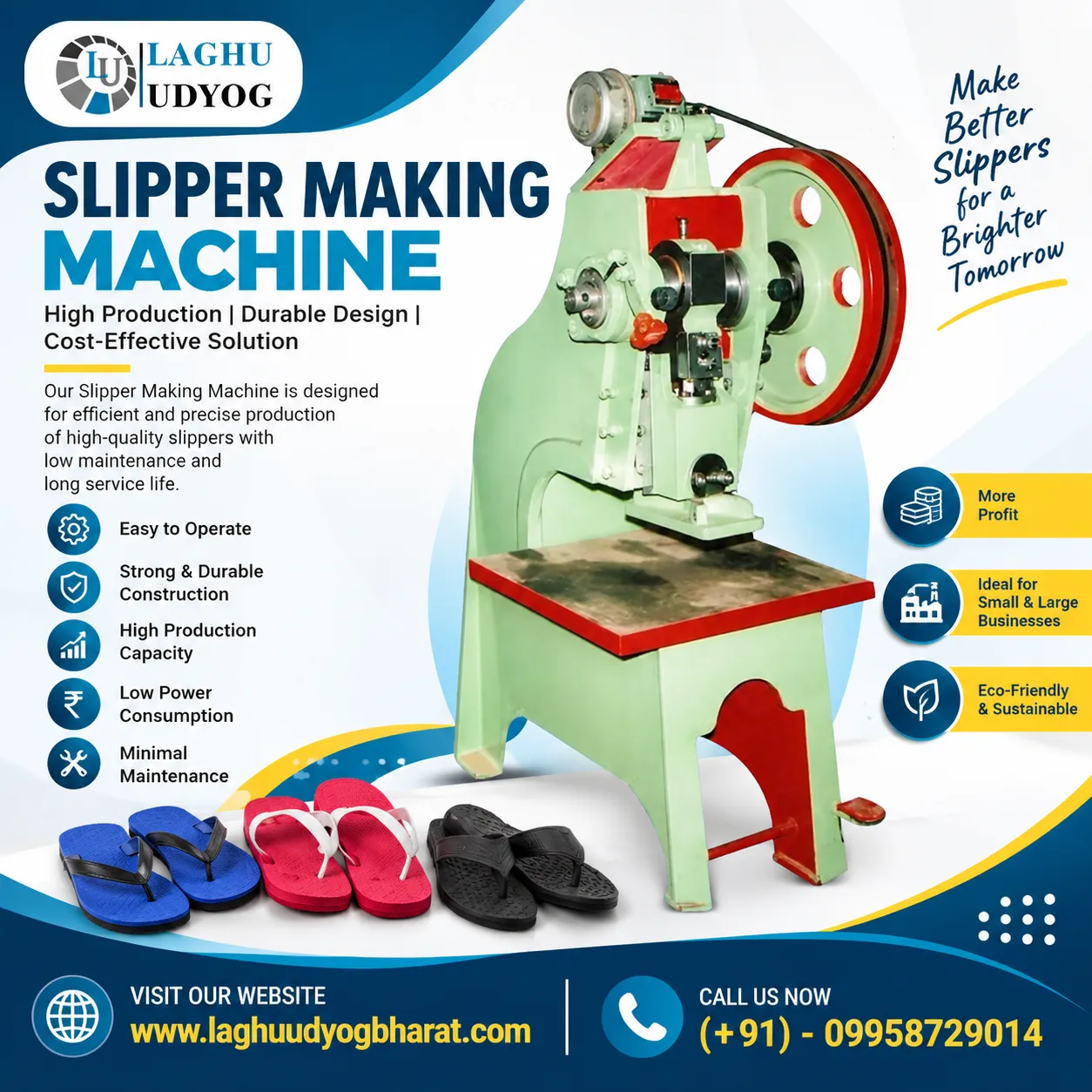

The manufacture of slippers may appear straightforward, but producing pairs with consistent dimensions, comfortable shaping, secure straps, and a clean finish requires coordination across several production stages. Machinery plays an important role in organizing these operations, particularly when a manufacturer needs repeatable output for regular orders.
A Slipper Making Machine is production equipment used to perform one or more processes involved in manufacturing slippers, depending on its design and configuration. Different machines may support operations such as sole cutting, shaping, moulding, drilling, strap-related work, or finishing. The appropriate setup depends on the slipper material, design, production volume, and level of automation required.
For a new manufacturing unit, understanding how these stages connect is often more useful than selecting equipment based only on a machine's headline features. A well-planned production line should match the characteristics of the raw material with the capabilities of each machine involved.
Understanding the Role of a Slipper Making Machine
A slipper manufacturing machine converts prepared footwear materials into components or finished products through controlled mechanical processes. The exact operation varies according to the machine type.
Some equipment is designed for specific stages, while integrated or specialized systems can handle multiple production requirements. For example, a production setup may use machinery to cut sole sheets into defined shapes, create required holes, form or process components, and complete finishing operations.
The machine does not replace the importance of material preparation or quality inspection. Instead, it provides controlled and repeatable processing within the overall manufacturing workflow.
How Does Slipper Manufacturing Work?
Slipper production generally involves a sequence of material preparation, forming, assembly, and finishing activities. The exact sequence can change according to the product design and manufacturing method.
1. Raw Material Preparation
The process begins with suitable materials selected according to the intended slipper. EVA, rubber, PVC, and other compatible materials can have different physical characteristics, so processing requirements may vary.
Material thickness, flexibility, density, surface characteristics, and intended product design should be considered before production begins.
2. Sole Cutting and Shaping
Prepared material is cut into the required sole profile. Cutting equipment helps establish the basic length and width of the slipper.
The accuracy of this stage affects later operations because inconsistent sole dimensions can create difficulties during assembly and finishing.
3. Forming or Moulding
Depending on the manufacturing method, the sole or footwear component may undergo shaping or moulding. This stage establishes the desired physical form of the product.
Different materials and designs can require different processing methods, which is why machinery should be selected according to the actual material and product specification rather than a general machine category alone.
4. Hole Formation and Strap Fitting
Many slipper designs require holes or specific attachment points for straps. These operations need to correspond correctly with the footwear pattern.
Strap components can then be fitted using an appropriate production method. Consistent positioning is important because uneven placement can affect both appearance and usability.
5. Finishing and Inspection
After the primary manufacturing operations, slippers can undergo trimming, edge cleaning, surface inspection, and other finishing activities.
Quality checking should examine dimensions, surface condition, strap placement, visible defects, and overall pair consistency before products move toward packaging.

What Materials Can Be Used?
Material selection has a direct relationship with machine requirements. Common footwear materials include EVA, rubber, and PVC, although the suitability of a particular material depends on the intended product and manufacturing process.
EVA is widely associated with lightweight footwear and may be processed using equipment designed for cutting, shaping, or forming compatible EVA material.
Rubber can have different processing characteristics from EVA, meaning that equipment settings and production methods may need to be evaluated accordingly.
PVC is another material used in footwear applications and may require machinery suited to its particular forming or processing method.
A manufacturer should therefore confirm material compatibility before purchasing a Slipper Production Machine. Assuming that one machine configuration will work identically with every material can lead to unsuitable equipment selection.
Automatic vs Semi-Automatic Slipper Machinery
Automation level is another important consideration when planning a footwear manufacturing setup.
| Consideration | Automatic System | Semi-Automatic System |
|---|---|---|
| Operator involvement | Generally lower for automated stages | Greater operator participation |
| Process control | More automated functions | Combination of machine and manual operations |
| Suitable use | Structured, repetitive production | Flexible or smaller-scale operations |
| Setup requirements | May require more planning | Can offer simpler process arrangements |
| Selection priority | Automation and workflow requirements | Flexibility and operational control |
Neither category is automatically suitable for every manufacturer. An Automatic Slipper Making Machine may be appropriate where a production process benefits from greater automation, while a semi-automatic arrangement can be considered where operators need more direct involvement in individual stages.
The decision should be based on production requirements rather than automation level alone.
Important Factors When Choosing a Machine
A machine purchase should begin with the product and production process, not simply with the machine name.
Product Design
Different sole shapes, thicknesses, strap arrangements, and decorative requirements can influence the equipment needed. Manufacturers producing several designs should determine whether one configuration can accommodate their product range.
Material Compatibility
The machine should be suitable for the material being processed. EVA, rubber, and PVC may behave differently during cutting, forming, or other operations.
Production Requirement
Expected production volume helps determine the appropriate machine arrangement. A small manufacturing unit may have different requirements from a facility handling continuous commercial production.
Available Workspace
Machine dimensions, material movement, operator access, electrical requirements, and supporting equipment should be considered when planning the production floor.
Maintenance and Service
Routine maintenance affects long-term machine usability. Buyers should understand cleaning requirements, wear components, lubrication needs where applicable, troubleshooting procedures, and the availability of technical assistance.
Operator Requirements
Even automated equipment requires appropriate setup, monitoring, and routine checks. Operators should understand machine controls, safety procedures, material handling, and basic inspection requirements.
Why Production Consistency Matters
Consistency is particularly important in footwear manufacturing because slippers are generally produced in pairs and often across multiple sizes. Differences in sole dimensions, hole positioning, strap placement, or finishing can become noticeable during inspection.
A suitable Slipper Manufacturing Machine can provide controlled processing at specific stages, but consistency also depends on material quality, machine setup, tooling condition, operator practices, and inspection procedures.
Manufacturers should establish basic checks throughout production rather than relying entirely on final inspection. Early identification of cutting or forming irregularities can help prevent a larger quantity of defective components from moving further through the process.
Maintenance Should Be Part of Machine Planning
Maintenance is not simply a post-purchase activity. It should be considered when comparing machinery.
Regular cleaning can help prevent material residue from interfering with operations. Cutting tools and other wear components should be inspected according to the manufacturer's recommendations. Loose connections, unusual sounds, inconsistent movement, and changes in processing quality should also receive attention.
A maintenance schedule can include routine cleaning, inspection of working components, checking machine settings, and planned replacement of consumable or wear-related parts where required.
Following the machine manufacturer's operating and maintenance instructions is important because servicing requirements differ between machine designs.
What Does Slipper Making Machine Price Depend On?
There is no single price applicable to every slipper manufacturing machine. Slipper Making Machine Price can vary according to machine type, automation level, configuration, production requirements, material compatibility, tooling, and included features.
A buyer comparing prices should therefore compare complete machine suitability rather than focusing only on the initial purchase amount. Installation requirements, operator needs, maintenance arrangements, supporting equipment, and after-sales service may also influence the overall investment involved in establishing a production setup.
The right question is not simply “Which machine costs less?” but “Which machine configuration matches the intended production process?”
Building a Practical Manufacturing Setup
A slipper manufacturing unit works best when individual production stages are planned as a connected workflow. Raw materials need to move logically from preparation through cutting, forming, assembly, finishing, inspection, and packaging.
Manufacturers should identify production bottlenecks before finalizing machinery. For example, increasing the speed of one operation may not improve overall output if another stage cannot process the resulting volume.
This makes workflow planning an important part of machinery selection. Equipment capacity, operator movement, material handling, inspection points, and finished-product storage should be considered together.
Final Considerations
A Slipper Making Machine should be viewed as one part of a broader footwear manufacturing process. Its suitability depends on the material, slipper design, production volume, required automation, workspace, operating method, and maintenance plan.
Manufacturers can make better equipment decisions by first mapping their production requirements and then comparing machines against those requirements. Attention to material compatibility, processing consistency, operator needs, and maintenance can help create a more practical manufacturing arrangement.
For businesses entering or expanding slipper production, careful machine selection is ultimately about creating a dependable workflow—from raw material preparation to finished, inspected footwear—rather than choosing equipment based on a single specification.
For More Information: www.laghuudyogbharat.com



















Sign in to leave a comment.