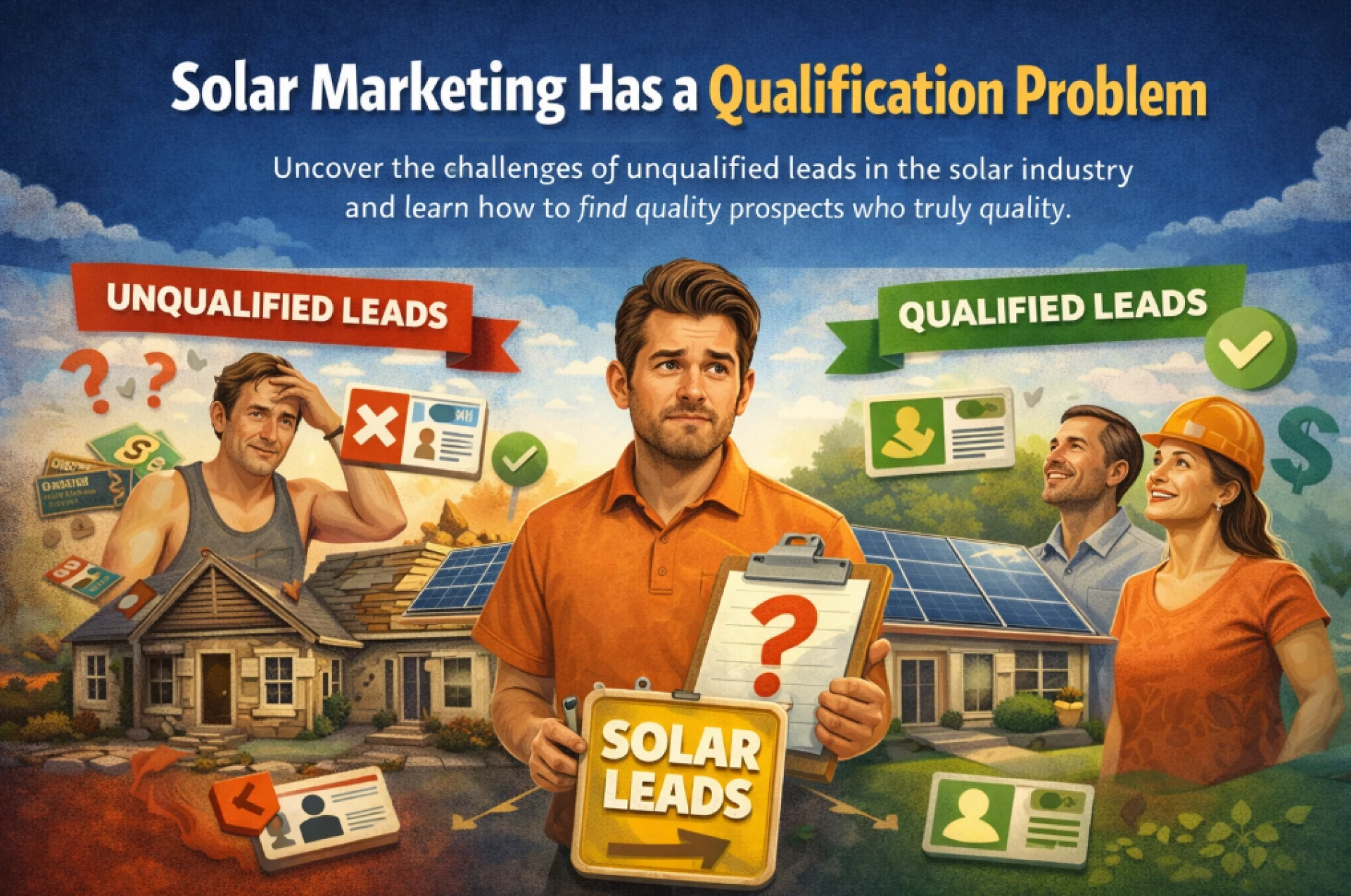

Solar companies are drowning in leads and starving for sales.
The ads are running. The form fills are coming in. The phone is ringing. But when your sales team actually talks to these people, half of them are renters, a quarter are just browsing, and the rest want a ballpark price for a roof that cannot support panels.
This is not a volume problem. This is a qualification problem. And it is costing solar companies thousands in wasted ad spend and hundreds of hours chasing contacts that were never going to convert.
If your solar lead generation campaigns are bringing in 100 leads but only booking 15 appointments, the issue is not your marketing. It is what you are calling a lead in the first place.
Why Solar Attracts Unqualified Leads at Scale
Solar is a high-ticket, high-consideration purchase. People research for months before they buy. They compare quotes from five different companies. They get hung up on financing terms, roof condition, HOA approval, and whether their neighbor actually saved money.
That long decision cycle creates a problem: every piece of content you publish, every ad you run, attracts people at wildly different stages of readiness.
Some are ready to sign. Most are not.
Your solar lead generation funnel pulls in curious homeowners who saw a headline about tax credits, renters who do not understand they cannot install panels, and people whose roofs need replacing before solar is even an option. None of these people should be eating up sales time, but without a proper lead qualification process, they do.
The math breaks fast. If your cost per lead is $50 and only 20% of leads are actually qualified, your real cost per qualified lead is $250. That is the number that matters, and most solar companies are not tracking it.
Where Solar Lead Quality Falls Apart
No Pre-Qualification at Intake
Most solar forms ask for name, email, phone number, and maybe zip code. That is it. No questions about homeownership. No questions about roof age or shading. No questions about budget or timeline.
You get the contact. You have no idea if they are worth calling.
A simple intake form that asks three qualifying questions can filter out 40% of junk leads before they ever hit your CRM. Homeowner status. Roof condition. Timeline to install. If someone is renting or says "just browsing," you do not waste a sales rep's time on a call that is going nowhere.
Lead qualification is not about being picky. It is about protecting your team's capacity for the leads that can actually close.
Slow Follow-Up Kills Solar Deals
Solar buyers are talking to multiple companies. Whoever responds first has a massive advantage. Whoever responds three hours later is already out of the running.
Speed to contact matters in every industry, but in solar it is brutal. A homeowner submits a form at 10am. By noon, they have gotten callbacks from two competitors, talked through pricing, and mentally moved on. When your team finally calls at 2pm, the lead is already cold.
If your solar appointment setting process relies on manual outreach with no automation, you are losing winnable deals to companies that just picked up the phone faster.
Generic Sales Pitches That Ignore Lead Context
Not every solar lead wants the same thing. Some care about savings. Some care about energy independence. Some just want the tax credit before it expires.
But most solar sales teams use the same pitch for everyone. They talk through system size, panel specs, and financing options without ever asking what the homeowner actually cares about.
That mismatch kills solar sales efficiency. You spend 30 minutes explaining ROI to someone who only wanted to know if their HOA allows installs. You lose deals because you never addressed the actual objection.
Sales readiness means knowing what the lead responded to, what their concerns are, and what message is most likely to move them forward before the first call happens.
What Good Solar Appointment Setting Looks Like
Solar appointment setting is not just about getting someone on the calendar. It is about getting the right someone on the calendar at the right time with the right expectations.
Here is what that system looks like:
Immediate response. Automated SMS confirmation within 60 seconds of form submission. First phone call within five minutes. If no answer, triggered follow-up sequence across phone, email, and text over the next three days.
Pre-call qualification. Before the appointment is confirmed, a quick screening call or automated questionnaire verifies homeownership, roof condition, and timeline. Leads that do not qualify get moved to a nurture sequence instead of a sales calendar.
Clear appointment expectations. The lead knows what the consultation will cover, how long it will take, and what information they need ready. That clarity reduces no-shows and improves consultation quality because both sides come prepared.
Automated reminders. Confirmations 24 hours out and two hours before the appointment. No-show rates drop by half when reminders are consistent and multi-channel.
When these pieces are in place, your appointment rate climbs, your show rate improves, and your sales team only talks to people who can actually buy.
The Metrics That Actually Matter
Most solar companies track leads generated and cost per lead. Those numbers are useless if the leads are garbage.
Track these instead:
- Lead-to-appointment rate by source. If Facebook is generating 100 leads but only 8 appointments while Google is generating 30 leads and 18 appointments, reallocate budget to Google.
- Appointment show rate. If half your booked consultations are no-shows, your qualification or reminder process is broken.
- Close rate per appointment. This tells you if the people showing up are actually qualified and sales-ready.
Solar sales efficiency is not about working more leads. It is about working better ones.
Final Thought
More leads will not fix a qualification problem. Better systems will.
The solar companies scaling profitably right now are not the ones generating the most form fills. They are the ones converting the highest percentage of the contacts they generate into booked, qualified consultations that actually close.
That starts with smarter solar lead generation, tighter intake qualification, and appointment systems that filter for readiness instead of just volume.
Struggling with lead quality or low conversion rates? 7th Growth helps solar companies build lead generation and appointment systems that attract qualified homeowners and turn them into booked consultations. Learn more at 7thgrowth.com





















Sign in to leave a comment.