

A supplier sample can pass every initial check and still create questions once a botanical powder reaches commercial production. With amla, the differences may appear as changes in color, acidity, moisture, particle size, flow, or processing behavior. None of these necessarily means the ingredient is unacceptable, but they can create extra work for formulation and quality teams. For buyers sourcing Organic Amla Powder bulk, the real challenge is controlling these variations before they become production issues.
Look at the Fruit Before Looking at the Price
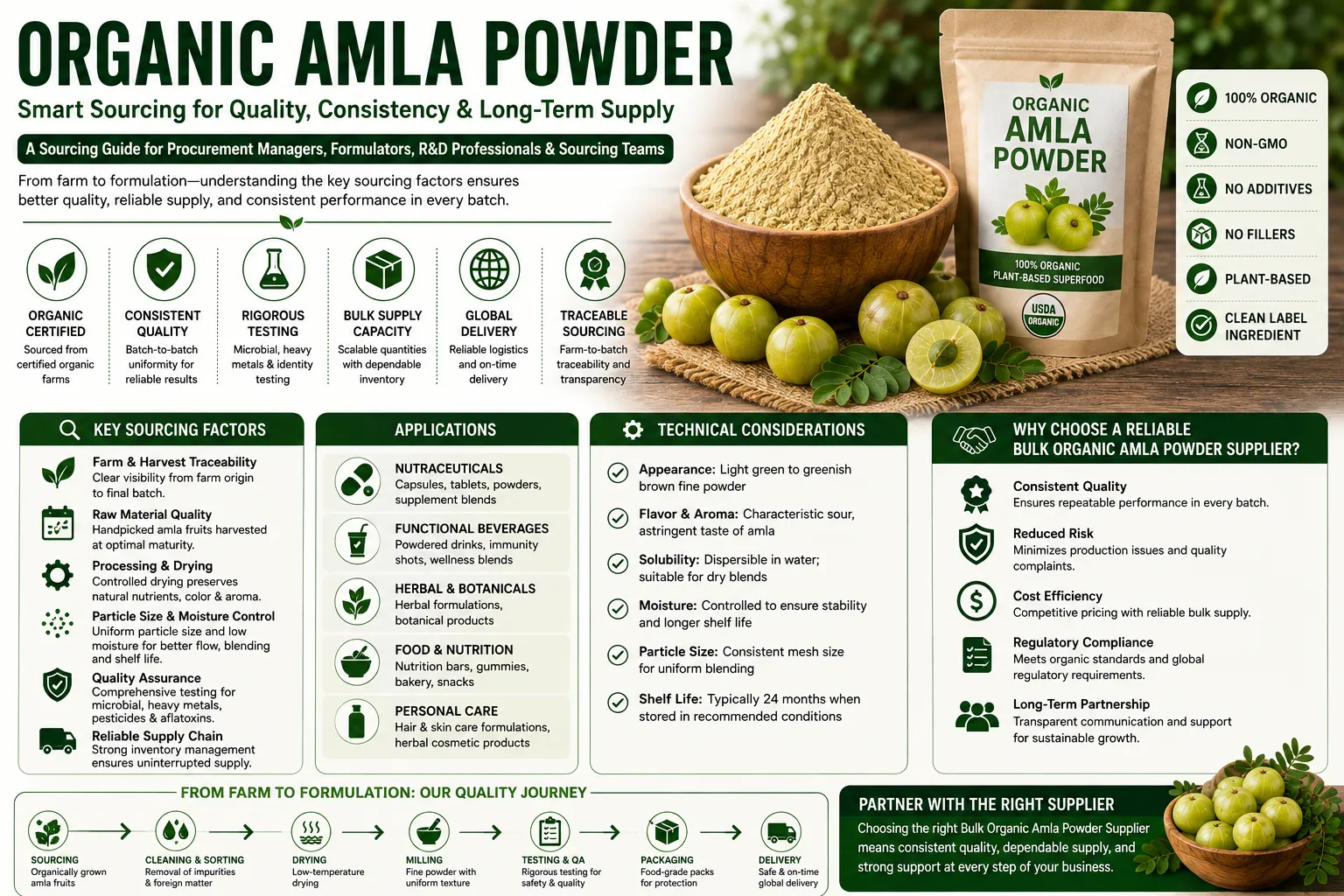
Amla, or Indian gooseberry, is the fruit of Phyllanthus emblica. Commercial amla powder is generally produced by cleaning, drying, milling, and screening the fruit. Each stage can influence the characteristics of the finished ingredient.
Fruit maturity, growing conditions, harvest timing, drying parameters, milling equipment, and storage can contribute to differences between lots. For procurement teams, this makes raw-material traceability an important part of supplier evaluation.
When reviewing Organic Amla Powder, buyers should establish the botanical identity, origin, processing location, and basic production controls. These details can become particularly useful when investigating why a new lot looks or performs differently from the approved sample.
The Finished Application Should Define the Specification
Amla powder is used in powdered beverages, functional food formulations, nutritional products, dietary supplements, and dry blends. Each application creates different technical requirements.
In beverage powders, natural acidity, particle size, dispersion, and interactions with other ingredients can influence processing and finished-product uniformity. Formulators may need to evaluate how the powder interacts with sweeteners, minerals, proteins, flavors, and other acidic ingredients.
Dry formulations present different considerations. Moisture, bulk density, flowability, and particle-size distribution can affect blending, dosing, and material handling.
This creates an important sourcing decision: do not approve the ingredient based only on a successful laboratory trial. Testing under production-relevant conditions can reveal differences in mixing, flow, dispersion, and handling that are not obvious at bench scale.
A COA Is the Starting Point, Not the Finish
For companies purchasing Organic Amla Powder bulk, a certificate of analysis should establish the analytical baseline. The actual specification may include botanical identity, moisture, particle size, bulk density, microbiological limits, heavy metals, pesticide residues, and foreign-matter requirements.
Depending on the market and finished-product specification, procurement may also request:
- Organic certification
- Country-of-origin documentation
- Traceability records
- Allergen declarations
- GMO status
- Shelf-life information
- Storage and packaging requirements
Organic certification should be verified for the actual ingredient and relevant processing operation. It is also useful to confirm whether the material is whole-fruit powder or an extract, particularly when a formulation has specific compositional requirements.
Watch for Variability That Standard Testing Can Miss
One recurring sourcing observation is that two lots can meet the same broad specification while still behaving differently.
Amla powder can vary in shade and aroma depending on raw material and processing. Drying conditions may influence its final characteristics, while milling and screening can alter particle-size distribution and flow. Exposure to moisture during transport or storage can increase caking and create handling problems.
A retained reference sample provides a practical benchmark. Quality teams can compare incoming lots for appearance, odor, flow, particle characteristics, and other agreed attributes in addition to laboratory testing.
For formulations where consistency is critical, testing several lots during supplier qualification is often more informative than approving a supplier from one sample.
Bulk Buying Requires Supply Planning
Procurement decisions should consider more than the quoted price per kilogram. Minimum order quantities, lead times, packaging configurations, production capacity, seasonal availability, transportation conditions, and warehouse requirements can all affect the actual cost of sourcing.
A low-cost ingredient may become expensive if lot variability leads to additional testing, production adjustments, rework, or rejected material. Conversely, excessive inventory can create shelf-life and storage concerns.
For organic ingredients, certification continuity should also be part of the supply assessment. The supplier needs to maintain appropriate certification and traceability across future lots, not only during initial qualification.
The Sourcing Benchmark That Matters
The strongest approach to Organic Amla Powder combines procurement, quality, and R&D requirements from the beginning. Origin, botanical identity, certification, analytical parameters, physical characteristics, and application performance should all contribute to supplier approval.
For manufacturers sourcing Organic Amla Powder bulk, the real test is repeatability. A sample can demonstrate that an ingredient works under controlled conditions, but multiple consistent commercial lots demonstrate that the supply can support ongoing manufacturing.
That is ultimately the difference between approving an ingredient and building a dependable sourcing program: the material needs to remain predictable from receiving and storage through blending, processing, and finished-product production.


























Sign in to leave a comment.