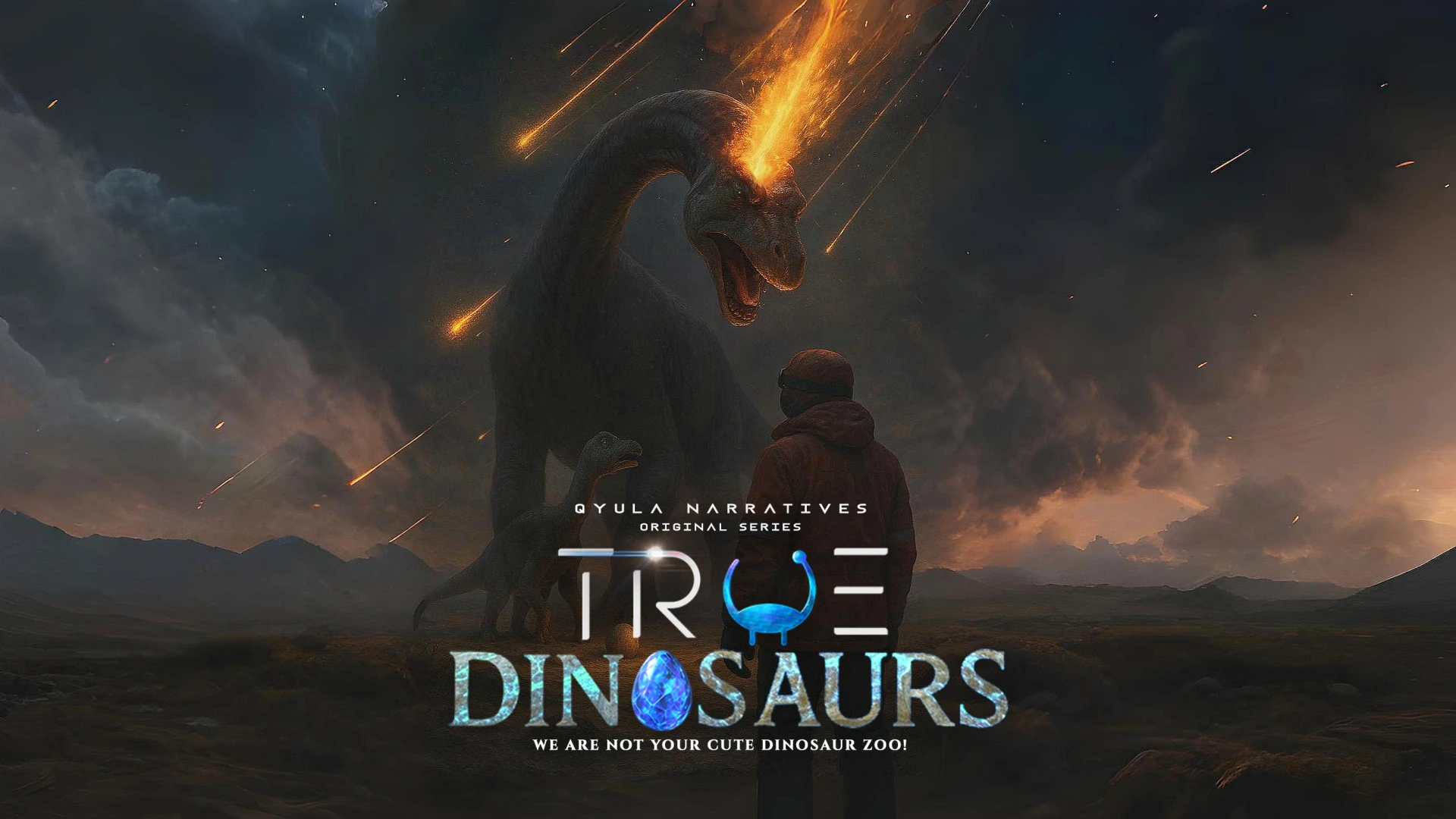

The landscape of modern documentary filmmaking is saturated with explorations of the prehistoric. From cinematic reenactments to CGI spectacles, dinosaurs remain a perennial subject that bridges science, imagination, and spectacle. Among the many entries into this realm, one stands out for its artistic ambition and narrative scope: the True Dinosaurs series. Beginning with True Dinosaurs Season 1: Revelation, the franchise quickly distinguished itself not only as a showcase of scientific accuracy and cutting-edge visuals but also as a bold attempt to weave story into scale—the scale of life, extinction, and time itself. Unlike many other productions that merely dramatize dinosaurs as monsters of an ancient stage, True Dinosaurs approaches them as characters in a grand ecological drama, telling stories through scales—both literally, in terms of skin and anatomy, and metaphorically, through the scales of time and existence.
This essay will explore how the series employs storytelling to transform paleontological knowledge into deeply human narratives, how visual design and music complement its themes, how the companion True Dinosaurs Book expands its world, and why this project represents a high point in the fusion of science and art.
A Different Approach to Dinosaur Storytelling
Most productions about dinosaurs aim to “show” the creatures as they lived. What distinguishes True Dinosaurs is that it strives not only to show but to tell. It asks questions: What did survival mean in the Triassic swamps? How does evolution feel when seen from the perspective of a species enduring endless change? What stories can we infer not from fossils alone but from the gaps between them?
The series is structured less like a museum exhibit and more like a collection of myths—myths, however, built upon scientific foundations. Each episode becomes a chapter in a saga, with species introduced almost like protagonists. For instance, a young Coelophysis is not merely depicted as a small predator but as a fragile survivor, navigating droughts and larger rivals. The camera lingers on its eye, conveying thought, fear, and determination. These choices transform what could be dry re-creations into narrative beats that resonate with viewers.
True Dinosaurs Season 1: Revelation was groundbreaking in this respect. The word “Revelation” captures both its unveiling of new discoveries and its revelation in the spiritual sense: it treated the history of dinosaurs not just as data, but as a kind of epic scripture of the Earth. Instead of framing dinosaurs as alien oddities, it grounded them as real animals whose fates were tied to climates, migrations, and catastrophes that echo human struggles.
The Art of Scale: Literal and Metaphorical
When discussing “storytelling through scales,” the phrase works on multiple levels:
- Biological scales – the details of skin, feathers, and textures, painstakingly rendered to reflect scientific speculation. These give individuality to species and help audiences connect emotionally.
- Temporal scales – time as a character in itself. Dinosaurs lived not for a few centuries but across epochs lasting millions of years. The series often dramatizes this vastness by fading one ecosystem into another, showing how dominance is temporary and survival is fleeting.
- Narrative scales – the shifts between intimate, close-up stories (a hatchling’s first breath) and grand planetary spectacles (asteroid impacts, continental drift). This interplay keeps the viewer emotionally invested while never losing sight of the cosmic immensity of prehistory.
By working simultaneously on these scales, True Dinosaurs achieves something rare: it allows viewers to feel both the heartbeat of an individual creature and the slow pulse of geological time. This is storytelling at its most ambitious.
Visual and Musical Storytelling
The artistry of True Dinosaurs lies not only in narrative but in craft. The production design treats every scale on a dinosaur’s hide as part of the visual storytelling. Light ripples across the armor of an Ankylosaurus, making it feel both majestic and vulnerable. The feathers of raptors are rendered not as flamboyant decoration but as evolutionary tools, tied into the tension of hunts and escapes.
The cinematography echoes modern wildlife documentaries, grounding the prehistoric in the familiar. Low-angle shots of herbivores grazing mimic the way we film elephants on the savannah. Aerial sweeps over volcanic landscapes resemble drone footage of present-day wastelands. These choices remove the sense of “fantasy” and root the visuals in documentary realism, reinforcing the idea that this is not mythology but history.
Music also plays a central role. Instead of bombastic orchestral cues, much of the soundtrack favors atmospheric tones—pulses, echoes, and chants that emphasize rhythm over melody. These soundscapes suggest both ancient rituals and natural cycles, reinforcing the notion that dinosaurs were not monsters of chaos but participants in a rhythmic Earth. In certain moments, the music even mirrors heartbeat patterns, aligning audience empathy with the inner world of creatures we can never truly know.
Characterization Without Words
Another artful decision is the absence of anthropomorphic dialogue. Dinosaurs do not “speak” or think aloud; instead, character is conveyed through movement, gaze, and interaction. A mother Maiasaura defending her nest communicates more through posture and sound than words ever could. Predators are shown not as villains but as hungry survivors, their violence framed as part of life’s cycle rather than moral conflict.
This approach respects scientific credibility while still giving viewers characters to care about. It recalls the techniques of silent cinema, where emotion emerged from gesture and rhythm rather than speech. By refusing to humanize dinosaurs with narration-heavy scripting, True Dinosaurs trusts the audience to invest emotionally through visual cues.
Expanding the Universe: The True Dinosaurs Book
Midway through the franchise’s rise, the release of the True Dinosaurs Book provided an essential expansion of its vision. Whereas the series is constrained by screen time and cinematic pacing, the book allows deeper dives into both science and story. It blends paleoart, essays by paleontologists, and fictionalized diary entries “from the age of dinosaurs.”
This multi-genre approach mirrors the show’s ambition. The book does not simply rehash episodes; instead, it functions as a kind of companion mythology. A chapter may include a richly painted double-page spread of a sauropod herd, followed by scientific context, and then a short narrative imagining the perspective of a juvenile within that herd. Readers move between art, fact, and fiction seamlessly, reinforcing the idea that dinosaurs cannot be contained by one lens alone.
Moreover, the True Dinosaurs Book emphasizes the cultural resonance of dinosaurs. Essays explore how different societies—from Victorian fossil hunters to modern filmmakers—have reimagined these creatures. By contextualizing dinosaurs as both scientific subjects and cultural icons, the book mirrors the dual storytelling scales of the series: literal and symbolic.
Themes of Survival and Extinction
At its heart, True Dinosaurs is not only about dinosaurs but about the fragility of existence. The series consistently returns to themes of survival and extinction. Each episode builds tension not through human conflict but through ecological uncertainty: droughts, volcanic winters, asteroid impacts. Viewers are reminded that dominance is temporary, whether for a predator at the top of its food chain or an entire clade of animals.
In this way, the storytelling resonates with contemporary audiences facing climate crises and biodiversity loss. The parallels are never forced, but they are unavoidable. Watching an ecosystem collapse around dinosaurs inevitably prompts reflection on our own precarious place in Earth’s history. Thus, the scales of storytelling extend beyond prehistory into allegory for the present.
Scientific Responsibility and Creative License
Balancing science with art is always a challenge in paleontological storytelling. True Dinosaurs succeeds by acknowledging uncertainty rather than hiding it. When evidence is incomplete, the series presents speculative reconstructions while highlighting the scientific reasoning behind them. For example, feathered dinosaurs are not presented as definitive fact for all species but as informed possibilities.
This honesty enhances credibility. It also mirrors the very process of science—constantly revising, questioning, and reimagining. Storytelling, in this context, becomes an act of scientific humility as much as artistic creation. The scales of knowledge are tipped toward transparency, inviting audiences into the process of discovery rather than pretending at omniscience.
Cultural Impact and Audience Reception
Since its debut, True Dinosaurs has achieved critical acclaim for blending spectacle with substance. Viewers have praised its emotional resonance, noting how it makes them care about creatures long extinct. Paleontologists, while sometimes debating individual reconstructions, have generally applauded its respect for science and refusal to indulge in outdated tropes.
Importantly, the series has influenced younger audiences. Teachers report students citing the show in classroom discussions, while paleoartists acknowledge it as inspiration for new artwork. By treating dinosaurs as subjects of narrative depth, the series expands the cultural perception of prehistoric life from “scary reptiles” to complex participants in Earth’s saga.
Storytelling Beyond the Screen
The artistry of True Dinosaurs lies not only in what is shown but in how it lingers afterward. Viewers finish an episode not merely having learned about a species but feeling as though they have witnessed a story that echoes their own. The struggle for food, the need for shelter, the inevitability of death—these universal themes transcend extinction and resonate across time.
By telling stories through scales, the series affirms that every detail matters: a claw mark on a tree, a feather shimmering in volcanic ash, a fossilized footprint that captures a moment of motion from millions of years ago. These fragments become narratives, and narratives become connections.
The Artistry of Absence
Equally powerful is what the series chooses not to show. At times, the camera lingers on empty landscapes—seas without swimmers, forests without footsteps—after extinction events. Silence becomes a character, absence a form of storytelling. These moments remind viewers that history is not only about what lived but also about what was lost.
Such restraint gives weight to the presence of dinosaurs when they do appear. Every roar, every stampede, every wingbeat is heightened against the awareness of eventual silence. Storytelling through scales is, in this sense, storytelling through contrast: abundance and absence, life and loss.
Conclusion: The Legacy of Storytelling Through Scales
The True Dinosaurs series, from True Dinosaurs Season 1: Revelation through the expansion of the True Dinosaurs Book, represents a landmark in the fusion of science and art. By embracing multiple scales—biological, temporal, and narrative—it transforms paleontology into an epic of life itself. Through meticulous visuals, atmospheric sound, and restrained yet powerful storytelling, it elevates dinosaurs from spectacle to subject, from monsters to metaphors.
Its greatest achievement lies in how it reminds us that storytelling is not limited to humans. Every fossil is a fragment of a story waiting to be told. Every scale, every feather, every footprint is a chapter in the ongoing narrative of Earth. By telling these stories with reverence and creativity, True Dinosaurs ensures that dinosaurs are not only remembered but reimagined in ways that enrich our understanding of life, past and present.
In a world facing its own revelations—of climate change, extinction, and survival—the series is more than entertainment. It is a mirror, reflecting our own fragility through the lens of creatures that once ruled the Earth. Storytelling through scales, then, is not just about dinosaurs. It is about us, about how we perceive time, survival, and the stories we leave behind.









Sign in to leave a comment.