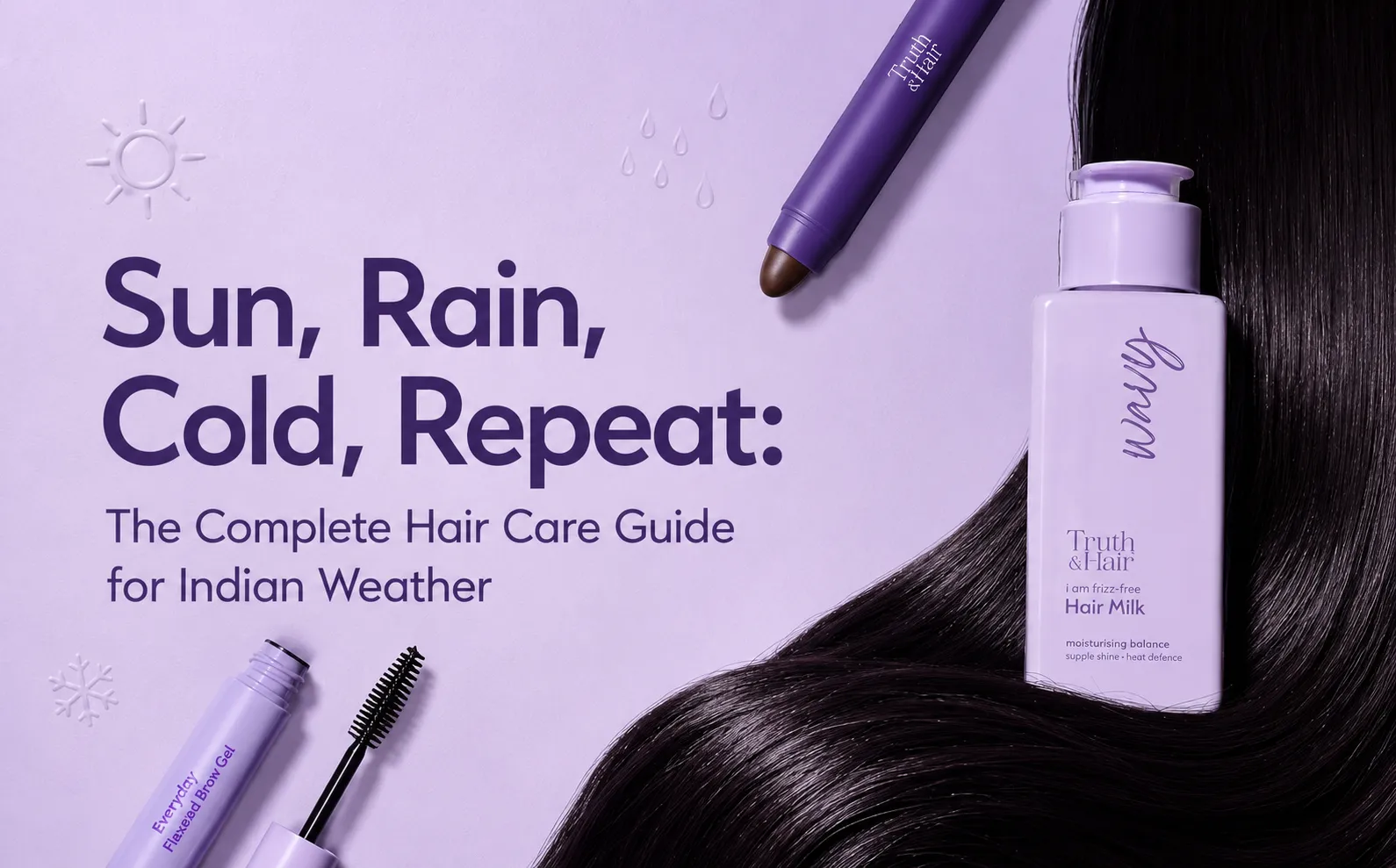

India does not have one kind of weather. It has extremes — searing summer heat, monsoon humidity that feels like a second skin, and dry winters that pull every last drop of moisture from your hair. And unlike many parts of the world where seasons shift gradually, India moves between these states with little warning and even less mercy.
Your hair feels every transition. What worked in April stops working in July. What saved your hair in the monsoon creates buildup by October. And by the time winter sets in, you are dealing with a completely different set of problems all over again.
The solution is not a single product or a single routine. It is a seasonal approach — one that adapts as the weather does.
Why Indian Weather Demands a Different Hair Care Strategy
Most global hair care advice is built for temperate climates with moderate humidity and predictable seasonal shifts. India is none of those things.
The UV index in Indian summers regularly reaches extreme levels. Monsoon humidity in coastal and inland cities alike can sit at 80–90% for weeks at a time. Northern winters bring dry, cold air that strips moisture as efficiently as any harsh chemical. And in many parts of the country, these transitions happen rapidly — sometimes within days.
Good hair care tips for Indian weather must account for this volatility. They cannot be built on a one-size routine that ignores what the sky is doing outside your window.
Summer: Heat, UV, and the Scalp You Are Ignoring
Indian summer is the season that does the most visible hair damage — and the most of that damage happens at the scalp level, not the strand level.
UV radiation breaks down the proteins in your hair shaft, leading to dryness, colour fading, and increased brittleness. The scalp overproduces sebum in response to heat and sweat, creating buildup that clogs follicles and slows healthy growth. And frequent washing to manage that oiliness strips the natural oils your hair needs to stay protected.
What your hair needs in summer:
Use a gentle, sulphate-free shampoo two to three times a week — enough to keep the scalp clean without over-stripping. Follow with a lightweight conditioner from mid-lengths to ends only. Apply a UV-protective serum or leave-in conditioner before stepping outside. When possible, cover your hair with a scarf or hat during peak sun hours.
Avoid heat styling entirely during summer if you can — your hair is already under thermal stress from the environment. If you must use heat, always apply a heat protectant first and keep the temperature as low as possible.
Switch to a hair care products routine built specifically for your texture — straight, wavy, or curly hair each responds to summer heat differently and benefits from texture-specific formulas rather than generic solutions.
Monsoon: Humidity, Frizz, and the Moisture Paradox
The monsoon is the season most Indian women dread most for their hair — and for good reason. Humidity causes the hair cuticle to swell and lift, which leads to frizz, loss of definition, and a texture that seems to change by the hour.
The paradox of monsoon hair care is that your hair is simultaneously surrounded by moisture and internally dry. External humidity causes surface frizz; the lack of adequate internal hydration means the strand is still thirsty underneath. This is why simply avoiding moisture does not work — the goal is to fill the strand from within so external humidity has nowhere to enter.
A well-structured seasonal hair care routine for monsoon looks like this: clarify once a week to remove the buildup that humidity accelerates. Deep condition after every clarifying session to restore internal moisture. Apply an anti-frizz serum or cream on damp hair immediately after washing to seal the cuticle before the air can interfere.
For wavy hair, monsoon is particularly challenging. The texture is porous enough to absorb humidity rapidly but not structured enough to stay defined under that moisture load. Texture-specific wavy hair care products — lightweight milks, anti-frizz serums, and defining creams — make a measurable difference in how waves hold their shape through humid days.
For curly hair, the approach needs to be even more deliberate. Deep conditioning weekly, sealing with a curl cream or gel after washing, and switching to a sulphate-free cleanser keeps curls defined and moisturised through the season. Explore Truth & Hair's range of curly hair care products built specifically for Indian curl patterns and the moisture challenges they face during monsoon.
Post-Monsoon Transition: The Season Most People Miss
October and November represent one of the most overlooked phases in Indian hair care. The humidity drops. The air becomes drier. And hair that spent months adapting to excess moisture suddenly finds itself in a very different environment.
This transition period often brings increased shedding, dullness, and a sudden loss of the definition or smoothness your hair had during the wetter months. Many people blame their products — but the products have not changed. The weather has.
What to do during transition:
Reduce the frequency of clarifying and shift to a more nourishing shampoo. Add a protein treatment once a month to rebuild any bonds weakened during the monsoon. Reintroduce a light hair oil for scalp massage — something you likely avoided during the humidity of the monsoon months. And gradually layer in richer conditioners as the air gets drier.
This is the season to rebuild, not maintain.
Winter: Dryness, Static, and Scalp Sensitivity
Winter hair care in India varies significantly by geography. Mumbai winters are mild and manageable. Delhi winters are dry, cold, and genuinely harsh on hair. Hill stations and northern regions go further still — cold air holds almost no moisture, and the contrast between heated indoor air and cold outdoor air creates a cycle of constant moisture loss.
What your hair needs in winter:
Weekly oil massages return to the routine as a genuine priority. Natural oils — not heavy mineral oils — nourish the scalp, improve circulation, and create a protective layer against dry air. A rich, creamy conditioner replaces lightweight summer formulas. Deep conditioning every two weeks maintains elasticity and prevents the brittleness that leads to winter breakage.
Avoid washing hair with hot water — it strips the scalp of natural oils more aggressively than any other single habit. Lukewarm water is enough to cleanse effectively and far kinder to both scalp and strand.
Static electricity — that winter phenomenon where your hair seems to repel itself — is addressed by moisture. A leave-in conditioner applied to dry ends, or a few drops of hair oil smoothed over the surface, reduces static without weighing the hair down.
The Principles That Apply All Year
While the specifics of your routine should shift with the season, a few principles hold across all of them.
Texture-first thinking. The best seasonal hair care tips recommended by experts consistently point to texture-specific care over generic routines. Straight hair, wavy hair, and curly hair respond to India's seasonal shifts differently. Your routine should reflect your texture, not just your season.
Hydration from within, protection from without. Every season asks you to maintain internal moisture in the strand while creating a surface barrier against whatever the environment is doing. The tools change — lighter in summer, richer in winter — but the principle does not.
Scalp first, always. Healthy hair grows from a healthy scalp. Before worrying about your ends or your texture, ask whether your scalp is clean, balanced, and nourished. Every season's routine should begin there.
End Note
India's weather does not stay still — and neither should your hair care routine.
Understanding what each season asks of your hair, and adapting accordingly, is the difference between hair that survives the year and hair that thrives through it.
Are you ready to build a routine that moves with the weather?
Explore Truth & Hair's complete range of texture-specific, scalp-safe hair care products — clean formulations designed for Indian hair types, through every Indian season.



















Sign in to leave a comment.