
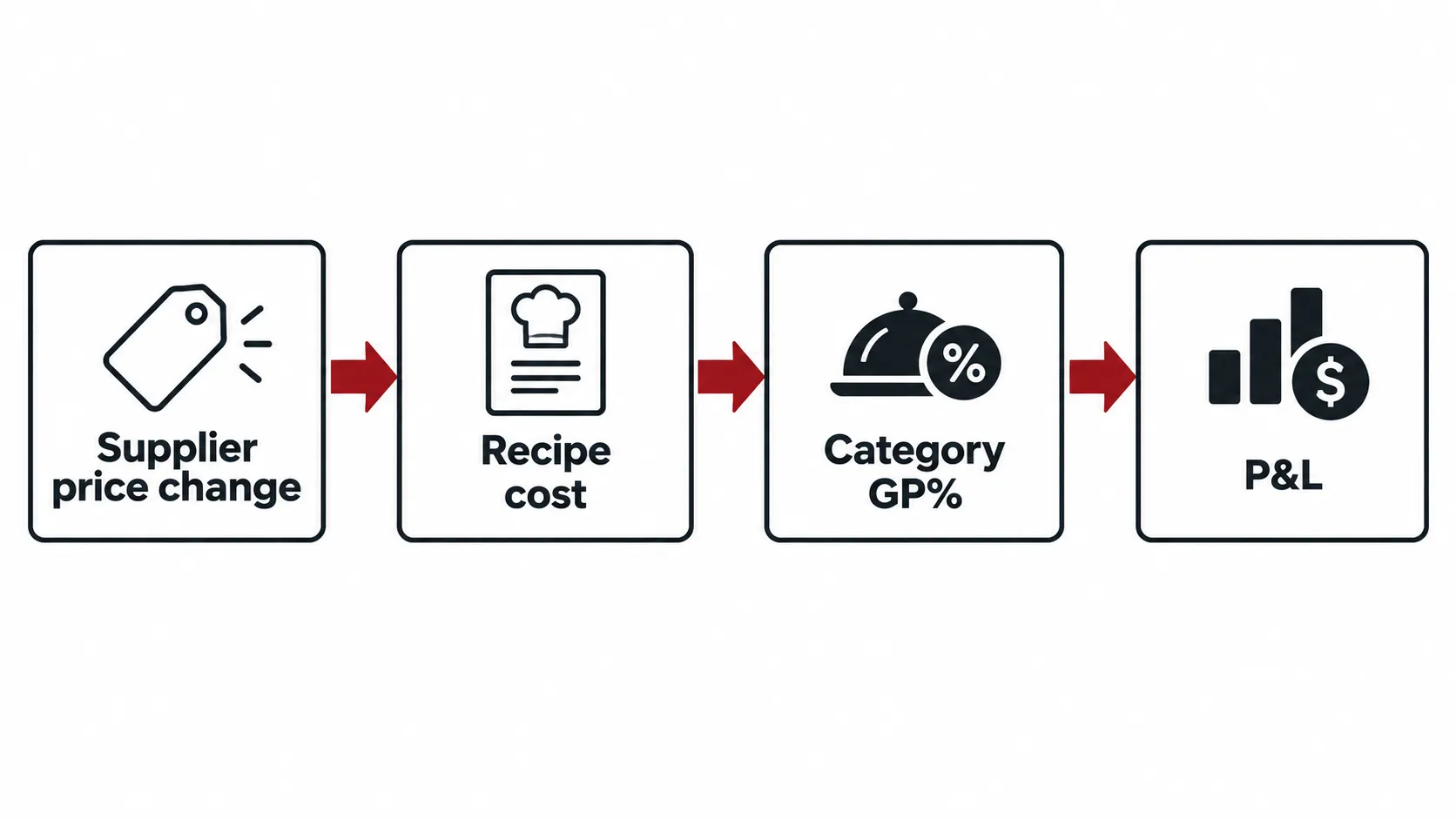
When a supplier raises a price, the person who feels it first is usually in purchasing: an invoice lands, a unit cost ticks up, an order gets flagged. But the person who owns the consequence is finance. A one-line cost increase on a core ingredient does not stay contained to that line. It moves through the recipe, into the plate cost, into the category gross profit percentage, and eventually into the numbers a CFO has to explain at month end. By the time that chain is visible in a P&L, the increase has usually been live for weeks.
The gap between a price change and a margin decision
Most independent and multi-site operators track supplier prices the way they track most operational detail: reactively, at the point an invoice or delivery note surfaces it. That works for spotting a change. It does not work for deciding what to do about it, because the decision that matters is not "did the price move" but "what does this do to gross profit on every dish that uses this ingredient, across every site."
That question sits with finance and operations, not with the person placing the order. A purchasing team can renegotiate, switch supplier, or absorb a short-term increase, but none of those choices should be made blind to the margin math. Recipe costing, not just purchase price, is what turns a supplier's price list into a business decision.
Why headline food inflation understates the operator-level problem
According to the ONS (August 2026 release, 12 months to July 2026), UK food and non-alcoholic beverage inflation had eased to roughly 1.3%, well down from the sharper increases seen earlier in the year. A calm headline number like that can read as reassuring. It is also close to useless for a kitchen, because it is an average across an entire national basket.
Individual inputs move in opposite directions underneath that average, sometimes sharply. A protein line can rise close to double digits year on year while a commodity like flour falls at the same time. An operator using a national inflation figure as a proxy for their own cost base is, in effect, cancelling out the exact volatility that is squeezing their specific menu. The average hides the margin problem instead of revealing it.
What margin ownership actually looks like
Three things separate operators who catch a price increase early from those who find it in a variance report three months later.
First, cost visibility has to sit at the recipe level, not the invoice level. A price change on a single ingredient should immediately show its effect on every dish, every menu section and every location that uses it, not just the line item on one supplier statement.
Second, the review cadence has to be frequent enough to matter. Waiting for a monthly close to notice a cost creep means a full month of margin erosion has already happened before anyone acts on it.
Third, the response has to be shared between finance and operations, not owned by purchasing alone. Whether the right move is a menu price adjustment, a portion change, a supplier conversation or simply accepting a thinner margin on one line is a commercial decision, not a sourcing one.
Group operators face a sharper version of the same problem: the same supplier increase can land differently across sites depending on local contracts, delivery frequency and menu mix, which means a single national reaction is often the wrong one. Multi-location visibility, not a single average, is what lets a head office see where the pressure is actually landing.
Building the habit, not just the tool
None of this requires exotic technology. A free food cost calculator is enough to test how a single ingredient price move flows through to a specific recipe's margin, and it is a reasonable starting point for a finance team that wants to see the mechanics before investing in anything more. The habit that matters is checking that math routinely, at the point a price changes, rather than only at month end.
For operators managing multiple suppliers and locations, the same logic scales into supplier and procurement management software that flags a price change against every affected recipe automatically, rather than relying on someone in purchasing to remember to raise it. The tool is not the point. The point is making margin protection a routine, not a discovery.
Supplier prices will keep moving, in both directions and at uneven rates across categories. The operators who protect margin are not the ones with the sharpest negotiators. They are the ones who see the effect of a price change on gross profit the same day it happens, and treat that as a finance conversation from the outset, not a purchasing problem that finance finds out about later.




















Sign in to leave a comment.