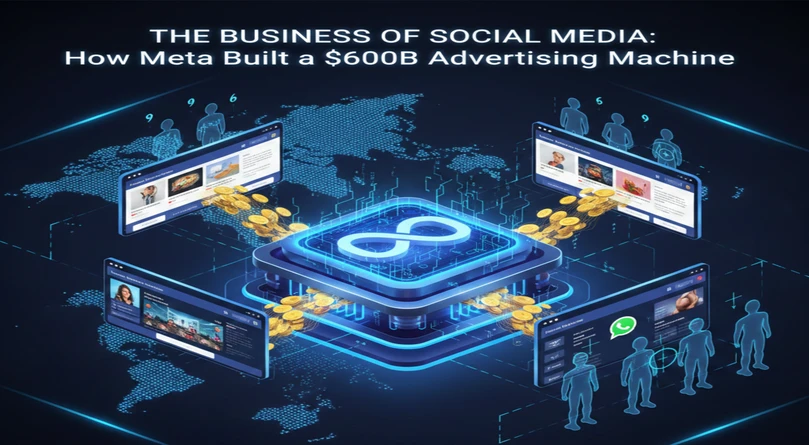

Social media feels casual. You open an app, scroll for a few minutes, like a post, reply to a message, maybe share a reel, and move on. No payment. No invoice. No visible cost.
But make no mistake: social media is not free. Behind every scroll sits one of the most efficient advertising machines ever built. And at the center of it stands Meta.
Meta doesn’t just operate social platforms. It operates an attention economy, one where human behavior is measured, optimized, and sold at a global scale. While users think they’re consuming content, Meta is quietly converting time into data and data into revenue.
This is the real business of social media, and understanding it is essential for marketers, creators, and investors alike.
It Was Never About Social. It Was About Attention.
Meta’s success isn’t built on creativity or community alone. It’s built on one simple idea:
The longer users stay, the more valuable they become to advertisers.
Every like, comment, share, pause, or swipe improves Meta’s ability to:
- Predict interests
- Target ads precisely
- Increase conversion probability
- Charge higher advertising rates
From a business perspective, Meta doesn’t optimize for happiness or well-being. It optimizes for time spent. And it has done so better than anyone else.
How It All Began: Building the Foundation of an Empire
Facebook (2004): Real Identity Changed Everything
Facebook started in a Harvard dorm room, but its real innovation wasn’t technical—it was psychological.
At a time when platforms like Orkut and MySpace allowed anonymity and heavy customization, Facebook enforced:
- Real names
- Real photos
- Real social connections
This created trust, authenticity, and social pressure. People didn’t just browse Facebook; they represented themselves on it.
That single decision made Facebook:
- Stickier
- More credible to advertisers
- Harder to leave as networks grew
Network effects kicked in fast. Once everyone you knew was on Facebook, not being there became the exception.
Instagram (2010): Mobile, Emotion, and Visual Habit
Instagram launched at the perfect moment when smartphones became extensions of daily life. Instagram was Mobile-first, Visual, Emotion-driven, and Effortless to use
It grew to 30 million users in just two years. Meta didn’t try to compete it bought Instagram in 2012 for $1 billion. In hindsight, that acquisition defined the next decade of social media.
Under Meta, Instagram evolved into:
- A major ad platform
- A creator economy engine
- A direct competitor to Snapchat and TikTok
When rivals innovated, Instagram copied Stories and then Reels fast and aggressively. Originality mattered less than execution at scale. read more









Sign in to leave a comment.