
Picture this. A training company starts small. One trainer, one classroom, a handful of clients who trust them to get the job done. Scheduling is simple: a phone call here, a quick note in a notebook there. Life is good.
Fast forward two years. Now there are twelve trainers, five cities, and a client list that's tripled. Someone is still trying to run the whole operation from a spreadsheet with seventeen tabs, half of them named "FINAL_v2" and "FINAL_v2_ACTUAL."
Sound familiar?
If you work anywhere near corporate training, you've probably heard the rumor by now: instructor-led training (ILT) is dying. AI is taking over. Nobody wants classrooms anymore. Everything's going digital.
Except… It's not actually happening. Not even close.
The Numbers Tell a Different Story
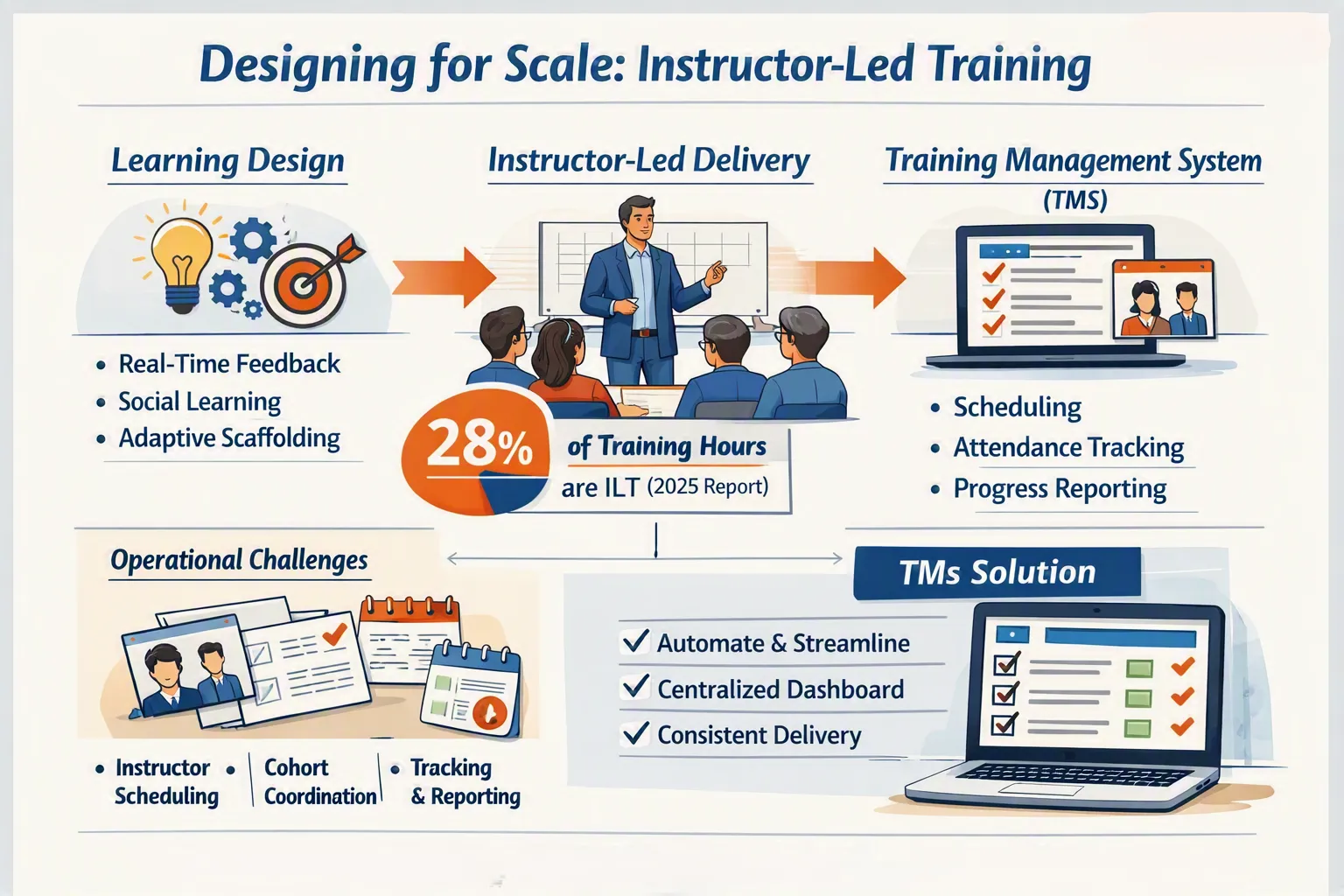
Here's something that might surprise you. According to the Training Industry Report, U.S. training expenditure hit a massive $102.8 billion in 2025, and instructor-led classrooms still accounted for 28% of all training hours delivered that year, making ILT one of the top two training delivery methods used by organizations, right behind virtual classrooms.
Let that sink in for a second. In an era obsessed with automation, AI tutors, and bite-sized video content, companies are still investing heavily in real, live, human-led training. Why? Because some skills just can't be learned from a screen. Try teaching someone to handle an angry customer, perform a delicate technical procedure, or make a split-second compliance decision — purely through pre-recorded video. It doesn't work the same way.
So if live training is still this important, what's actually going wrong for the companies struggling with it?
It's Not the Classroom. It's the Chaos Behind It.
Here's the honest answer: most training programs don't fail because the training itself is bad. They fail because nobody built a system that could handle growth.
Think about what happens as a training program scales:
- Two trainers become twelve, and now nobody knows who's free on Thursday
- One location becomes five, and each one starts doing things its own way
- Manual attendance sheets turn into a nightmare during audit season
- Invoices get sent late, or worse, get sent wrong
- Nobody can actually say which programs are making money and which ones are quietly draining resources
None of this has anything to do with the quality of the instructor or the value of the course. It's pure operational overload — the kind that creeps up slowly until one day, everything feels like it's on fire.
There's a quote from Bill Gates that fits this situation almost perfectly:
"The first rule of any technology used in a business is that automation applied to an efficient operation will magnify the efficiency. The second is that automation applied to an inefficient operation will magnify the inefficiency."
That's exactly the trap a lot of training teams fall into. They add a fancy new tool — a flashy LMS, a slick Zoom integration — hoping it'll fix the chaos. But if the process underneath was already broken, the new tool just makes the mess move faster. It doesn't fix anything.
A Fresh Development Worth Knowing About
Here's something interesting happening in the training world right now, in 2026: the industry just launched its first-ever global benchmark study built specifically for instructor-led training providers. The research is pulling in real data on pricing, delivery formats, and technology usage from training providers across North America, the UK, and APAC, with guidance from a panel of respected voices in learning and development.
Think about what that actually means. Nobody spends time and money building an industry benchmark for something that's fading away. Benchmark studies happen when an industry is growing fast enough that everyone suddenly wants real numbers to compare themselves against. That alone tells you something about where ILT is really headed.
At the same time, several well-known workplace learning experts have pointed out a renewed appreciation for classroom-style training in 2025 and 2026 — not as a replacement for digital learning, but as the format organizations turn to when they need faster, higher-impact skill-building than passive video content can deliver.
Where Blended Learning Fits In
This is where blended learning becomes such a useful idea. Nobody's saying every training session needs a live instructor standing in the room. Blended learning, mixing instructor-led sessions with self-paced digital content, lets teams use live training for what it does best (real conversations, hands-on practice, complex problem-solving) while letting technology handle the simpler, repeatable material.
The mistake a lot of companies make is treating "blended" as two separate systems bolted together — an LMS running one lane, a messy spreadsheet running the other. That's not blended learning. That's just double the paperwork, dressed up with a nicer name.
So, What Actually Fixes This?
This is exactly where a proper training management system (TMS) earns its keep. It's not just "scheduling software." Done right, it becomes the operational backbone that lets a growing training company function like a well-oiled machine instead of a controlled crisis:
- Matching the right trainer to the right session, based on real availability and skill — not guesswork
- Coordinating multiple locations so ten centers act like one connected system, not ten separate islands
- Automatically tracking attendance, certifications, and audit trails
- Handling billing and invoicing without someone manually chasing numbers every month
- Giving leadership real visibility into which programs are actually profitable
Once the operational side is solid, instructor-led training stops being the source of stress. It becomes the thing that actually sets a company apart from competitors who are still stuck untangling spreadsheets.
A Quick Reality Check
Ask yourself honestly — do any of these sound a little too familiar?
- You have more trainers than one person can realistically track in their head
- Scheduling a single session takes hours instead of minutes
- Every audit season feels like a mild panic attack
- Nobody can confidently say which training programs are actually profitable
- Your LMS and your scheduling process don't talk to each other at all
If you nodded along to two or more of these, here's the good news: this isn't a training problem. It's a systems problem. And systems problems, unlike people problems, actually have clear solutions.
The Real Takeaway
Instructor-led training isn't dying. Not even close. Billions in ongoing training investment, renewed interest from L&D leaders, and the industry's very first dedicated benchmark study all point in the same direction — live training is holding strong, and in many cases, growing.
The companies that struggle aren't the ones doing "too much" live training. They're the ones trying to run it using tools that were never designed to handle real growth. Fix the operational backbone behind the classroom, and instructor-led training stops feeling like a constant headache — and starts becoming one of the strongest tools in the entire learning strategy.
FAQs
Is instructor-led training becoming obsolete because of AI and e-learning?
Not according to the data. ILT remained one of the top two training delivery methods in 2025, making up 28% of all U.S. training hours, per the Training Industry Report.
What's the biggest challenge when scaling instructor-led training?
It's rarely the training content itself. The real struggle is operational — scheduling, multi-location coordination, compliance tracking, and billing, all of which get harder as a program grows.
What exactly is a training management system (TMS)?
It's software built specifically to handle the operational side of live training — scheduling, trainer allocation, attendance, invoicing, and reporting — distinct from an LMS, which mainly focuses on delivering content.
How is blended learning different from just using an LMS and a TMS separately?
True blended learning connects instructor-led sessions and self-paced content through the same schedule, same learner data, and same reporting system — not two disconnected tools running independently.
Can smaller training teams actually benefit from a TMS, or is it only useful for big enterprises?
Smaller teams often feel scaling pain earlier than expected — sometimes with just a handful of trainers or a second city. Getting the right system in early helps growth stay smooth instead of chaotic.
What's the latest trend happening in the ILT space right now?
In 2026, the industry launched its first-ever global benchmark report focused entirely on instructor-led training providers — a clear signal that the market is maturing and scaling, not shrinking.























Sign in to leave a comment.