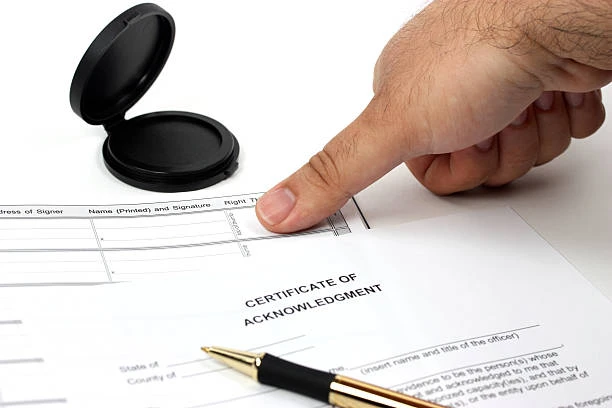

An acknowledgment statement notarization is one of the most common types of notarial acts, required for various legal, financial, and real estate documents. Unlike sworn oaths or affidavits, an acknowledgment simply confirms that the signer appeared before a notary, was properly identified, and voluntarily signed the document.
This guide explains everything you need to know about acknowledgment notarizations—what they are, when they’re required, how the process works, and common mistakes to avoid.
What Is an Acknowledgment Notarization?
An acknowledgment is a notarial act where a signer confirms:
✔ They signed the document willingly (without coercion)
✔ They understand what they’re signing
✔ Their identity was verified by the notary
Unlike a jurat (used for affidavits), an acknowledgment does not require the signer to swear an oath. It simply certifies that the signature is genuine.
When Is an Acknowledgment Required?
Common documents needing acknowledgment notarization include:
✅ Real estate deeds & mortgages
✅ Power of attorney forms
✅ Business contracts
✅ Loan agreements
✅ Trust documents
✅ Some court filings
How Does the Acknowledgment Process Work?
Step 1: Prepare the Document
Before visiting a notary:
- The document must be fully filled out (except for signatures).
- The signer must not sign beforehand—they must do so in the notary’s presence.
- The document should include a pre-printed notarial certificate (or the notary will attach one).
Step 2: Bring Proper Identification
The signer must present a valid, government-issued ID, such as:
- Driver’s license
- Passport
- State ID card
- Military ID
Expired or damaged IDs are not accepted.
Step 3: Appear Before the Notary
The notary will:
- Verify the signer’s identity (checking the ID).
- Confirm the signer understands the document (without giving legal advice).
- Witness the signature (the signer must sign in front of the notary).
- Complete the notarial certificate (with stamp, signature, and commission details).
Step 4: The Notary Seals the Document
The notary will:
- Affix their official stamp/seal
- Sign and date the acknowledgment certificate
- Record the notarization in their journal (if required by state law)
Common Mistakes to Avoid
❌ Signing Before Meeting the Notary
Some states allow pre-signing for acknowledgments, but many require the signature to be made in the notary’s presence. Always check your state’s rules.
❌ Using an Expired or Invalid ID
Notaries cannot accept:
- Expired driver’s licenses
- Damaged IDs
- Social Security cards (not valid for notarization)
❌ Missing Notarial Wording
If the document lacks an acknowledgment certificate, the notary must attach one. An improper certificate can invalidate the notarization.
❌ Notary Doesn’t Keep Records
Many states require notaries to log acknowledgments in a journal. If they don’t, it could cause legal issues later.
Remote Online Notarization (RON) for Acknowledgments
Many states now allow remote notarizations, where the signer appears via video call. The process is similar, but:
- The signer must prove identity through knowledge-based authentication (KBA) or credential analysis.
- The notary uses digital seals and electronic journals.
- The document is signed electronically (with an e-signature).
Check if your state permits RON for acknowledgments.
Why Choose a Professional Notary Service?
For hassle-free acknowledgment notarizations, consider:
✔ Mobile notaries (they come to you)
✔ Certified signing agents (experienced with legal docs)
✔ Same-day services (for urgent documents)
Dallas Best Mobile Notary Services specializes in fast, accurate acknowledgment notarizations for real estate, legal, and business documents.
Frequently Asked Questions (FAQs)
Q: Can an acknowledgment be notarized if the document is already signed?
A: It depends on the state. Some allow it if the signer confirms they signed it, while others require the signature to be made in the notary’s presence.
Q: Does an acknowledgment expire?
A: No, but some institutions (like banks) may reject older notarizations (usually after 6-12 months).
Q: Can a family member notarize an acknowledgment for me?
A: No. Notaries cannot notarize for relatives (in most states) due to conflict of interest.
Final Thoughts
Acknowledgment notarizations are essential for verifying signatures on important documents. By following the correct steps—proper ID, in-person signing, and accurate notarial wording—you ensure your paperwork is legally binding.
Need a reliable notary for acknowledgments? Dallas Best Mobile Notary Services provides professional, efficient notarizations at your convenience.










Sign in to leave a comment.