
Introduction
In today\'s world, efficient and reliable water storage solutions are crucial for ensuring a consistent water supply across various sectors, including residential, commercial, and industrial applications. Among the myriad of options available, GRP (Glass Reinforced Plastic) panel water tanks have emerged as a preferred choice due to their remarkable durability, lightweight nature, and exceptional resistance to corrosion and environmental factors. Solico Tanks, a leading manufacturer in the water storage industry, has been at the forefront of developing innovative GRP panel water tanks that meet diverse needs and stringent quality standards.
This article delves into the world of Solico Tanks\' GRP panel water tanks, exploring their unique features, construction, and advantages. We will examine the key components that make up these tanks, including the GRP panels, fasteners, sealants, support structures, and accessories. By understanding the intricacies of these elements, readers will gain insight into why Solico Tanks\' GRP panel water tanks stand out as a reliable and efficient solution for water storage.
Join us as we explore the engineering excellence and technological advancements behind Solico Tanks\' GRP panel water tanks, and discover how these tanks are setting new benchmarks in water storage solutions worldwide.
GRP Panels: The Core Components
GRP panels serve as the fundamental components of GRP panel water tanks. Crafted through the SMC (Sheet Molding Compound) process, these panels are a blend of glass fibers, polyester resin, and fillers, compressed under high pressure and temperature. This manufacturing method yields a composite material with exceptional properties.
A key feature of GRP panels is their lightweight nature, facilitating easy transport and installation. Despite being light, these panels are remarkably strong, making them ideal for water storage applications where durability is crucial. The strength of GRP panels stems from the embedded glass fibers within the polyester resin matrix, which provide reinforcement and enhance mechanical properties.
Additionally, GRP panels are highly resistant to corrosion, UV rays, and bacterial growth. The polyester resin acts as a protective barrier, preventing water and other corrosive substances from compromising the tank\'s integrity. The smooth, non-porous surface of GRP panels also inhibits bacterial and algae growth, ensuring stored water remains clean and safe.
Available in various sizes, such as 1m x 1m, 1m x 0.5m, or 0.5m x 0.5m, GRP panels offer flexibility in tank design and capacity. This modularity allows for custom-built water tanks tailored to specific requirements, suitable for residential, commercial, or industrial use. Customization of tank sizes and configurations is a significant advantage of GRP panel water tanks over other storage solutions.
The thickness of GRP panels varies based on the tank\'s height, with thicker panels at the base to withstand increased water pressure. This design ensures the tank can safely hold the required water volume without compromising structural integrity. The thicker base panels also help distribute the water weight evenly, reducing the risk of leaks or failures.
In conclusion, GRP panels are the backbone of GRP panel water tanks, offering a unique combination of strength, durability, corrosion resistance, and customizability. These features make them an excellent choice for water storage across various industries and settings.
Fasteners: Securing the Structure
Bolts, nuts, and washers are crucial in assembling GRP panels into a robust water tank. These fasteners are selected to endure the tank\'s internal pressure and external environmental conditions, ensuring a long-lasting, watertight seal.
Corrosion resistance is vital for these fasteners. Stainless steel grades 316 and 304 are popular for their excellent corrosion resistance, even in harsh environments. Hot-dipped galvanized steel is another cost-effective option with good corrosion resistance.
The bolts and nuts work together to securely connect the GRP panels, forming a unified structure. Bolts pass through pre-drilled holes in the panels, with nuts tightened on the other side for a snug fit. Washers under the bolt heads and nuts distribute the load evenly across the panel surface, preventing damage to the GRP material.
Proper bolt tightening is essential to ensure a watertight seal and maintain the tank\'s structural integrity. The correct torque, as specified by the manufacturer, must be applied using a torque wrench. Over-tightening can damage GRP panels, while under-tightening may lead to leaks or structural weakness.
Fastener spacing and placement are also critical. Fasteners should be evenly distributed along panel edges to create a uniform seal and prevent stress concentrations. Additional sealants or gaskets may be used with the fasteners to enhance water-tightness.
Regular inspection and maintenance of bolts, nuts, and washers are necessary to ensure the tank\'s long-term performance. Fasteners should be checked for corrosion, damage, or loosening and replaced if needed. By using high-quality, corrosion-resistant fasteners and following proper installation and maintenance procedures, the bolts, nuts, and washers will securely hold the GRP panels together, ensuring a reliable water storage solution.
Sealants and Gaskets: Ensuring Leak Prevention
Sealants and gaskets are essential for ensuring the watertightness of GRP panel water tanks. These components are strategically placed between GRP panels to prevent leaks and maintain the tank\'s structural integrity. The sealants used are formulated to withstand internal water pressure and external environmental conditions, such as temperature changes and UV exposure.
The most common sealant in GRP panel water tanks is non-toxic rubber foam, designed for use with GRP products. This sealant maintains its softness and adhesive properties even at low temperatures, ensuring a long-lasting, watertight seal. The rubber foam is compressed between the GRP panels during assembly, creating a tight seal that prevents water from escaping through the joints.
Other sealants may be used depending on the tank\'s specific requirements and environmental conditions. For instance, silicone sealants resist UV radiation and withstand extreme temperatures, while polyurethane sealants offer exceptional strength and durability, suitable for tanks exposed to high stress or movement.
Gaskets, placed between the flanges of GRP panels, create seals preventing water leakage. Typically made from rubber, neoprene, or silicone, gaskets compress and conform to flange surfaces, ensuring a reliable seal.
Proper selection and installation of sealants and gaskets are critical for the long-term performance of GRP panel water tanks. Manufacturers and installers must follow strict guidelines and use high-quality, compatible materials to ensure the tank remains watertight. Regular inspections and maintenance are also necessary to identify and address potential issues before they cause leaks or damage.
In summary, sealants and gaskets are vital for maintaining the watertightness of GRP panel water tanks. Specialized materials like non-toxic rubber foam sealants and flexible gaskets are designed to withstand internal and external pressures, creating a durable seal between GRP panels. Proper selection, installation, and maintenance of these components are essential for the tank\'s overall performance and longevity.
Support Structures: Strengthening the Tank
Support structures are crucial for reinforcing GRP panel water tanks, ensuring their structural integrity and longevity. Depending on the tank\'s size and height, support structures can be external or internal, typically made from hot-dipped galvanized steel or stainless steel.
External support structures, like box sections or angles, are placed around the tank\'s perimeter to reinforce walls and prevent bulging or deformation under water weight. These structures withstand the hydrostatic pressure from the stored water, increasing with the tank\'s height. External structures help maintain the tank\'s shape and prevent leaks or failures.
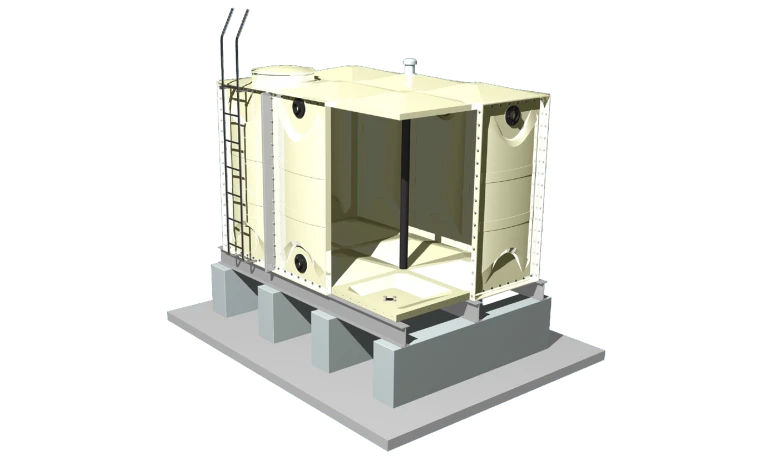
Internal support structures, such as tie rods, distribute the load evenly and maintain the tank\'s shape. Made from stainless steel, tie rods connect walls and roof panels inside the tank, counteracting the water\'s outward pressure and securing the panels.
The design and placement of support structures are carefully calculated based on the tank\'s dimensions, capacity, and site-specific requirements. Engineers use advanced modeling and simulation techniques to determine the optimal support structure configuration, considering factors like wind loads, seismic activity, and temperature fluctuations.
Support structures also enhance the overall safety and accessibility of GRP panel water tanks. External structures, like ladders and walkways, provide safe access for maintenance and inspection, complying with relevant health and safety regulations.
Materials for support structures are chosen for durability, strength, and corrosion resistance. Hot-dipped galvanized steel is popular for its excellent corrosion resistance and cost-effectiveness, while stainless steel grades 304 and 316 are used for superior strength and chemical and atmospheric corrosion resistance.
Proper installation and maintenance of support structures are essential for the long-term performance and reliability of GRP panel water tanks. Manufacturers provide detailed installation guidelines and recommend regular inspections to identify wear, damage, or corrosion. Adhering to these guidelines and conducting timely repairs or replacements maximizes the lifespan of water storage systems and minimizes failure or leak risks.
In summary, support structures are vital for reinforcing GRP panel water tanks. Made from high-quality materials like hot-dipped galvanized steel or stainless steel, these structures maintain the tank\'s structural integrity, distribute loads evenly, and provide safe access for maintenance and inspection. Proper design, installation, and maintenance ensure GRP panel water tanks remain reliable, efficient, and long-lasting.
Base Support: Providing Stability
The base support of a GRP panel water tank is crucial for stability, longevity, and overall performance. The choice of base support depends on the tank\'s specifications, such as size, capacity, and design, and site conditions, including soil properties, seismic activity, and environmental factors.
For externally flanged base (EFB) tanks, common base support options are pier walls or close center beams. Pier walls are concrete structures placed at regular intervals, providing a stable foundation while allowing for self-draining. The space between pier walls enables easy access for maintenance and inspection of the tank\'s underside and drainage system installation.
Close center beams are steel supports placed parallel at specified distances, designed to withstand the tank\'s weight and water load, ensuring even load distribution and minimizing structural failure risks. Close center beams offer a compact base support system, advantageous in limited-space sites.
For internally flanged base (IFB) and internally built tanks (IBT), the common base support option is a flat concrete foundation. The concrete foundation must be perfectly level and extend at least 150 mm beyond the tank\'s internal dimensions, providing stable, uniform support. Leveling steels may be used to ensure foundation flatness, as minor irregularities can cause stress concentrations and compromise tank integrity.
Another option for IFB and IBT tanks is close center beams or bearer beams. These steel supports, placed at specific intervals, provide a level, stable base for the tank. Steel supports are advantageous in sites where concrete foundations are not feasible or when the tank needs elevation for drainage or maintenance.
Regardless of the chosen base support system, it is crucial to ensure the foundation is designed and constructed to withstand the tank\'s weight and external forces like wind, snow, or seismic loads. The base support must also be corrosion-resistant, either through corrosion-resistant materials like stainless steel or protective coatings like hot-dip galvanization or epoxy paint.
In summary, the base support of a GRP panel water tank is vital for its stability, longevity, and overall performance. Pier walls, close center beams, and flat concrete foundations are common base support options, each with advantages and considerations. Proper design, construction, and maintenance of the base support system ensure the tank remains stable and reliable throughout its lifespan.
Accessories: Enhancing Functionality
Various accessories can enhance the functionality, safety, and accessibility of GRP panel water tanks. These accessories include internal and external ladders, cat ladders, level indicators, manhole covers, roof access hatches, and floats.
Internal ladders are essential for safe access and maintenance within the tank, made from corrosion-resistant materials like stainless steel or hot-dipped galvanized steel. Internal ladders typically feature non-slip rungs and handrails to ensure safety when climbing in wet conditions.
External ladders and cat ladders provide safe access to the tank\'s roof for maintenance and inspection, also made from corrosion-resistant materials. These ladders often include safety cages or platforms to prevent falls and comply with relevant health and safety regulations.
Level indicators, like float or ultrasonic level sensors, monitor water levels within the tank. Accurate water level monitoring is crucial for efficient water management, preventing overflows or shortages. Float sensors are mechanical devices that rise and fall with the water level, while ultrasonic sensors use sound waves to measure the water level, offering higher accuracy and reliability.
Manhole covers and roof access hatches provide access to the tank\'s interior for maintenance, inspection, and cleaning. These access points are designed to be secure and watertight, preventing unauthorized access and contamination. Manhole covers are typically located on the tank\'s roof or side, while roof access hatches are on the top.
Floats control water inflow and outflow, maintaining the desired water level within the tank. Floats work in conjunction with level indicators, automatically opening or closing valves to regulate water levels. Floats are essential for tanks used in water supply systems, ensuring consistent water availability.
These accessories are designed to be compatible with GRP panel water tanks, offering customization options to meet specific requirements. Proper selection, installation, and maintenance of accessories enhance the tank\'s functionality, safety, and accessibility, ensuring a reliable and efficient water storage system.
In conclusion, accessories like ladders, level indicators, manhole covers, roof access hatches, and floats enhance the functionality, safety, and accessibility of GRP panel water tanks. Made from high-quality, corrosion-resistant materials, these accessories are designed to be compatible with GRP panel water tanks, offering customization options to meet specific needs. Proper selection, installation, and maintenance of these accessories ensure a reliable and efficient water storage system.
Conclusion
In conclusion, GRP panel water tanks are essential for reliable, efficient water storage solutions in various settings, including residential, commercial, and industrial applications. The components that make up GRP panel water tanks, such as GRP panels, fasteners, sealants, gaskets, support structures, base supports, and accessories, work together to ensure the tank\'s structural integrity, watertightness, and functionality.
Each component is carefully designed, selected, and installed to meet the tank\'s specific requirements and withstand internal and external pressures, ensuring long-term performance and reliability. Regular inspection and maintenance of these components are crucial to identify and address potential issues, prolonging the tank\'s lifespan and minimizing the risk of leaks, failures, or contamination.
Overall, GRP panel water tanks offer a versatile, durable, and customizable water storage solution, making them ideal for a wide range of applications. By understanding the key components and their roles in GRP panel water tanks, users can make informed decisions and ensure their water storage systems remain reliable and efficient for years to come. Contact Solico Tanks for all your water solution needs!











Sign in to leave a comment.