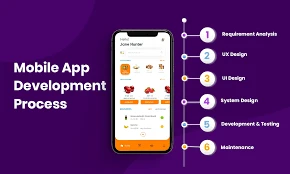

Introduction: Mobile app development has undergone a significant evolution over the years, revolutionizing the way we interact with technology. As smartphones have become an integral part of our lives, mobile apps have emerged as powerful tools that offer convenience, accessibility, and endless possibilities. This article explores the evolution and trends in mobile app development, highlighting the impact of in shaping the future of digital innovation.
The Evolution of Mobile App Development: 1.1 Early Days of Mobile Apps:The emergence of basic mobile applications.Limited functionalities and simplistic user interfaces.Primitive operating systems and hardware constraints.1.2 Introduction of App Stores:
Apple's App Store and Google Play Store revolutionize app distribution.App discovery becomes more accessible to users.Developers gain a global platform to showcase their creations.1.3 Native App Development:
Development focused on platform-specific languages (Java for Android, Objective-C for iOS).Enhanced performance and access to device-specific features.Challenges of maintaining separate codebases for different platforms.The Rise of Mobile Web Services: 2.1 Mobile Web Apps:Web technologies (HTML, CSS, JavaScript) utilized for app development.Cross-platform compatibility and reduced development time.Limitations in accessing device capabilities and offline functionality.2.2 Introduction of Progressive Web Apps (PWAs):
PWAs bridge the gap between native apps and mobile web apps.Enhanced user experience, including offline capabilities.Push notifications and app-like interactions on the web.2.3 Accelerated Mobile Pages (AMP):
AMP technology improves mobile web performance.Faster loading times and improved user engagement.AMP-powered content achieves higher visibility in search results.Trends Shaping the Future of Mobile App Development: 3.1 Internet of Things (IoT) Integration:Connecting mobile apps with smart devices for seamless experiences.Interactions with wearables, home automation systems, and more.3.2 Artificial Intelligence (AI) and Machine Learning (ML):
Integration of AI/ML capabilities in mobile apps for personalized experiences.Voice assistants, image recognition, and predictive analytics.3.3 Augmented Reality (AR) and Virtual Reality (VR):
AR and VR technologies enhancing user engagement and interaction.Gaming, training, and immersive experiences through mobile apps.3.4 Chatbots and Natural Language Processing (NLP):
Chatbots revolutionizing customer service and app interactions.Natural language processing enabling seamless communication.Conclusion: Mobile app development has come a long way, transforming the digital landscape and influencing how we live, work, and connect. The integration of mobile web services has played a pivotal role in this evolution, offering developers new avenues for creating powerful, cross-platform applications. As trends like IoT, AI/ML, AR/VR, and chatbots continue to shape the future, mobile app development will undoubtedly be at the forefront of digital innovation, providing users with extraordinary experiences and pushing technological boundaries.









Sign in to leave a comment.