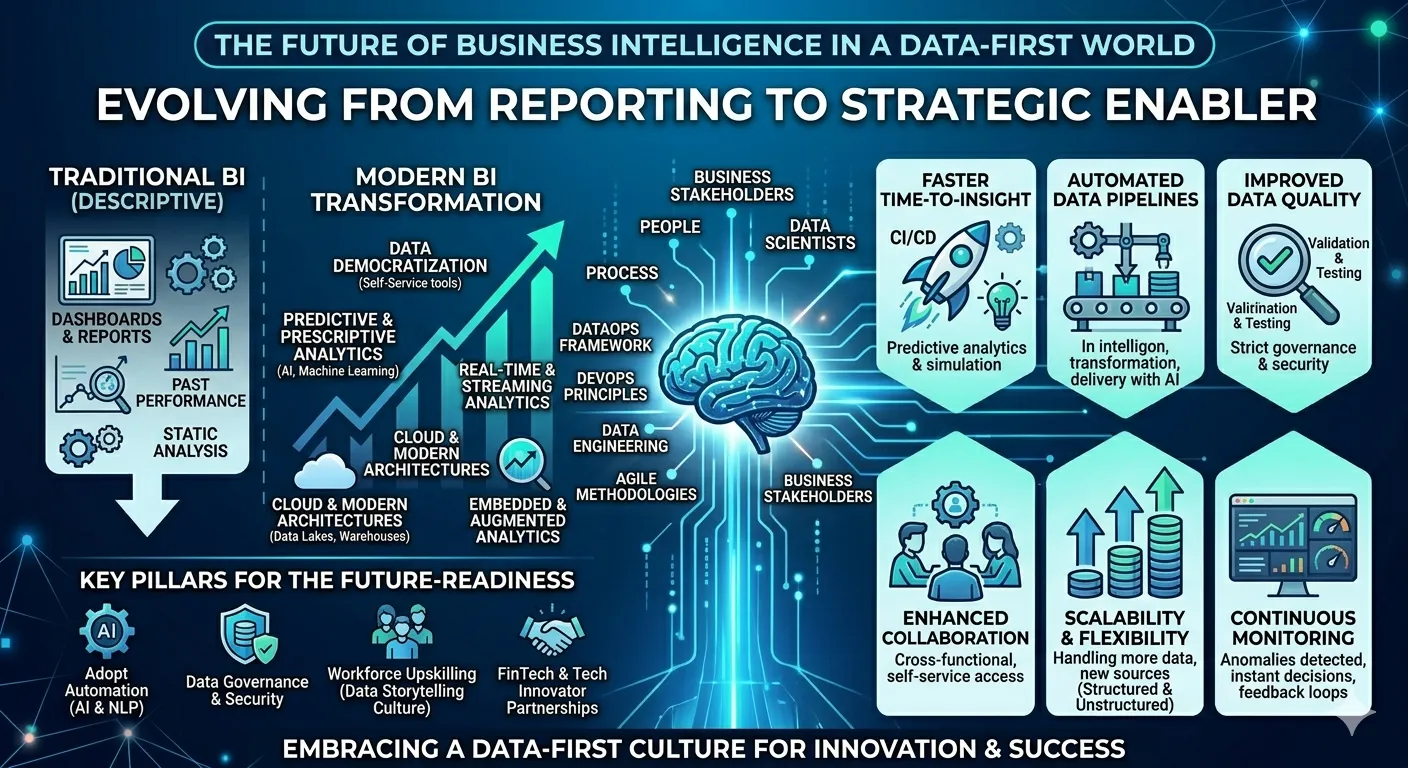

In today's fast-paced, ever-changing digital environment, companies are no longer guided by intuition. Data has become key to decision-making and innovation. As organizations adopt data-driven approaches, business intelligence is undergoing a major transformation. BI is not only about creating dashboards and reports but also about enabling faster, better decision-making. The role of BI in a data-first world is evolving toward greater intelligence and integration across all aspects of business processes.
The Shift to a Data-First Culture
In a data-driven world, data is at the forefront of all organizational levels, from strategy to operations. Decisions across the organization are based on data and insights rather than assumptions. The use of BI tools is undergoing a transformation due to these cultural and strategic shifts. BI tools are becoming available for everyone in the company because self-service BI platforms allow non-technical users to explore data and make informed decisions without relying heavily on data specialists.
Democratizing access to data has become one of the most significant trends influencing business intelligence development.
From Descriptive to Predictive and Prescriptive Analytics
BI technology was traditionally focused on descriptive analysis, which involved analyzing data from the past. In today’s data-centric environment, organizations have begun shifting towards more advanced forms of analysis, such as predictive and prescriptive analytics.
Predictive analytics uses historical data, statistics, and machine learning algorithms to predict future outcomes. Organizations can predict customer behavior, market trends, and potential risks. Prescriptive analysis takes things one step further and offers recommendations on how an organization should act on those predictions.
These advanced analytics capabilities help organizations better position themselves by anticipating change.
The Role of Artificial Intelligence and Automation
AI and automation have become a significant part of modern BI systems. AI-powered BI platforms can analyze vast amounts of data in a matter of seconds by identifying patterns that humans cannot easily recognize. Many companies have turned to BI analytics services to leverage these capabilities.
In addition, the process of data preparation, report generation, and analysis is automated with advanced technology solutions. This improves efficiency and enables teams to focus on higher-value initiatives rather than repetitive tasks.
Another emerging trend in business intelligence is natural language processing, which enables communication with the BI system via natural language queries.
Real-Time and Streaming Analytics
In a fast-paced business environment, timing is critical. It is no longer enough to wait until the end of the week or month to receive reports. In the coming years, BI will increasingly be driven by real-time and streaming analytics.
Real-time BI allows an enterprise to monitor processes and respond to any changes immediately. This means companies can detect anomalies, spot new trends, and react instantly to achieve better results.
This approach works best in industries such as finance, logistics, and retail, where decisions must be made quickly.
Integration with Cloud and Modern Data Architectures
Cloud computing plays an essential role in shaping the future of business intelligence. It enables scalability, flexibility, and cost-efficiency in handling big data. Modern data architecture solutions, including data lakes and warehouses, are evolving to meet the needs of advanced BI. Integrating structured and unstructured data into a single source creates a holistic perspective of the business.
Cloud-based BI enables access to data and insights from anywhere. Thus, employees can collaborate remotely without difficulty.
Embedded and Augmented Analytics
Embedded analytics is another major development in which BI functionality is embedded directly within business applications. Users do not need to switch between tools, as they can access insights directly within the applications they already use.
Augmented analytics solutions, which leverage AI and machine learning, will further advance BI capabilities by automating the discovery and visualization of information.
This technology delivers information faster and in a more relevant manner, as users do not have to seek it themselves.
Data Governance and Security
With the increasing importance of data in business activities, ensuring the integrity, accuracy, and security of data is paramount. Lack of proper data management may lead to incorrect conclusions drawn from the analysis, negatively affecting decision-making.
The future of business intelligence will be characterized by strict data governance measures, including standardized procedures, data validation, and adherence to data protection policies.
The Rise of Data Storytelling
In today’s data-centric world, insights are valuable only when they can be effectively communicated. This has led to the evolution of data storytelling skills, which combine data visualization with narrative techniques to effectively convey insights.
Modern BI tools are adopting visualization capabilities to enable users to build interactive reports and dashboards, making it easier for decision-makers to understand and act on data. Data storytelling helps bridge the gap between data and decisions.
Conclusion
Business Intelligence in a data-first world is transformative. Business Intelligence is evolving from a reporting tool to a strategic enabler of innovation, efficiency, and success. With the advent of technologies such as artificial intelligence, real-time analysis, cloud computing, and democratized access to data, companies will be able to fully leverage data.
Companies that adopt such a future-oriented approach by embracing innovations in business intelligence will be well-equipped for future success in a world where data is crucial.


























Sign in to leave a comment.