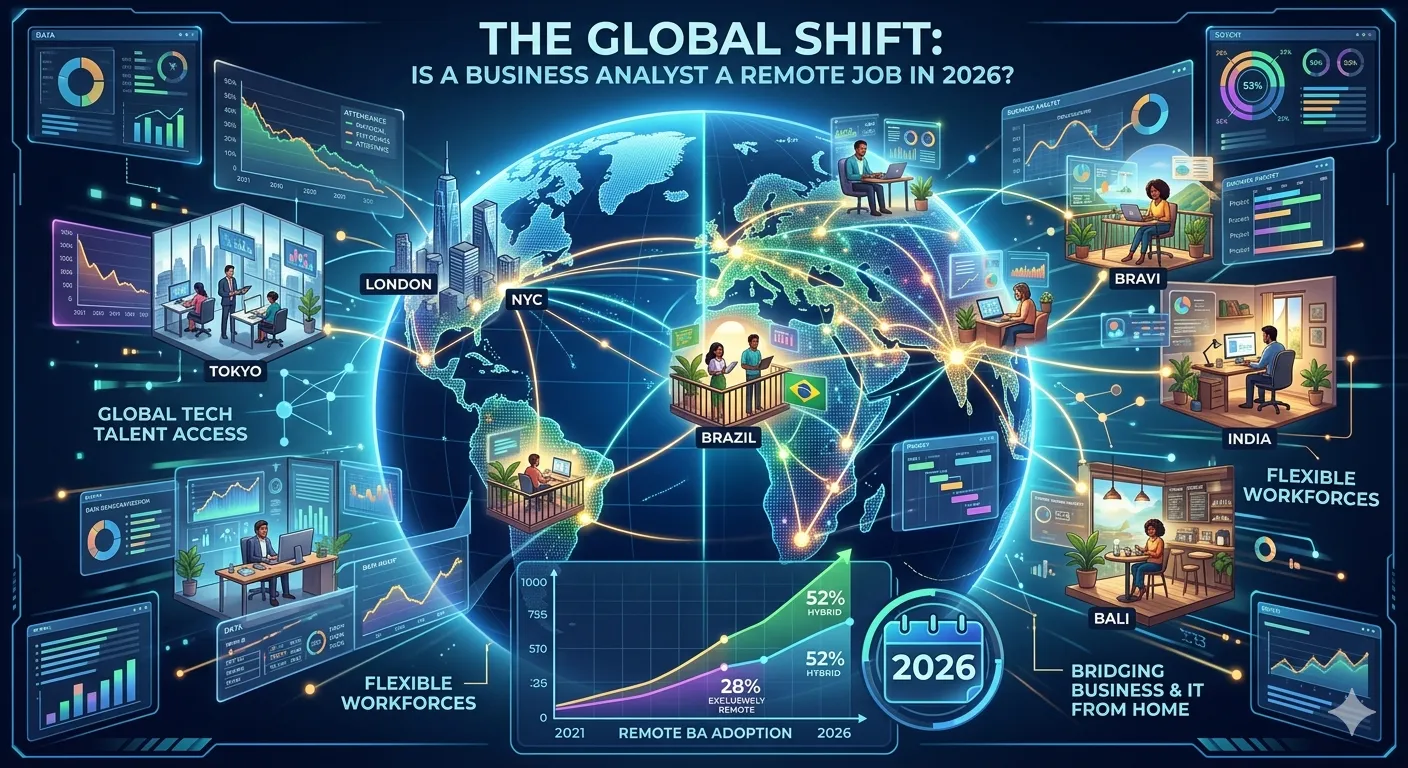

The question of whether a Business Analyst (BA) can work from home has shifted from a "maybe" to a resounding "yes" over the last few years. As of 2026, the landscape of work has settled into a new normal where the bridge between business needs and technical solutions is increasingly built from home offices and co-working spaces across the globe.
If you are considering a career change or looking to upgrade your skills through a business analyst course online, understanding the remote potential of this role is essential. This 900+ word deep dive explores the current state of remote BA work, the tools that make it possible, and how a ba analyst course online can prepare you for this flexible career path.
The Current Reality: Remote BA Statistics in 2026
By early 2026, data suggests a significant stabilization in remote work trends. While many large enterprises have settled into a "3-2" hybrid model (three days in the office, two days out), a substantial 26% of remote-capable roles—including Business Analysis—remain exclusively remote.
For BAs, the "remote-first" approach is particularly common in startups and tech-heavy sectors like Fintech, Healthtech, and SaaS. These companies prioritize global expertise over physical presence, allowing a BA in Hyderabad to solve operational bottlenecks for a firm in London.
Why the BA Role is Inherently "Remote-Ready"
A Business Analyst's primary job is to act as a translator. They take complex business problems and translate them into technical requirements for developers. In 2026, the "translation" happens through digital documentation, video conferencing, and collaborative software. Here is why the role fits the remote mold so well:
1. Digital Requirement Gathering
Gone are the days of sticky notes on a physical whiteboard. Modern BAs use digital requirement management systems to collect, track, and manage stakeholder feedback. Whether you are in the same room or a different continent, the documentation lives in the cloud.
2. Virtual Stakeholder Management
A large part of a BA's day involves interviewing stakeholders. In a remote setting, tools like Zoom and Microsoft Teams, integrated with AI note-takers, have made these sessions more efficient than in-person meetings. AI can now transcribe and highlight key requirements in real-time, allowing the BA to focus on the conversation rather than scribbling notes.
3. Asynchronous Collaboration
With teams spread across time zones, the ability to work asynchronously is a superpower. BAs now use "living documents" in platforms like Notion or Confluence where stakeholders can leave comments at their convenience, ensuring that progress doesn't stop when the BA logs off for the day.
Essential Tools for the Remote Business Analyst
If you want to land a remote role, your "tech stack" is just as important as your analytical mind. Most business analyst course online programs now dedicate entire modules to these essential remote tools:
- Data Visualization: Tools like Power BI, Tableau, and Zoho Analytics allow BAs to turn raw data into interactive dashboards. Presentation of these insights is easily done via screen sharing.
- Process Modeling: Creating "AS-IS" and "TO-BE" process maps is now handled by cloud-based tools like Lucidchart or Miro. These allow for real-time, multi-user editing, simulating the experience of standing at a whiteboard together.
Agile Project Tracking: Jira and Azure DevOps remain the industry standards for managing backlogs and user stories in 100% remote Agile environments.
The Financial Incentive: Remote BA Salaries
One might worry that remote work leads to "location-based" pay cuts, but in 2026, the "remote premium" is real. Companies are willing to pay competitive rates to secure top-tier talent regardless of geography.
In India, for instance, a remote Business Analyst can expect an average annual salary of approximately ₹14,28,768, with high-end roles in specialized sectors like Salesforce CPQ or ServiceNow reaching ₹56L+ for experienced professionals. The cost savings from not commuting, combined with these high salaries, makes the remote BA path one of the most financially rewarding career choices today.
Challenges of Working Remotely as a BA (and How to Overcome Them)
While the benefits are many, remote work isn't without its hurdles. Success as a remote BA requires intentional effort in these areas:
- The "Context" Gap: Without "watercooler talk," you might miss subtle shifts in business priority. Solution: Schedule regular 15-minute "coffee chats" with key stakeholders just to stay in the loop.
- Over-Communication: In a remote world, if it isn't written down, it didn't happen. Solution: Master the art of the follow-up email and maintain a "Source of Truth" document for every project.
Cybersecurity: Handling sensitive business data from a home Wi-Fi requires strict adherence to company VPN and BYOD (Bring Your Own Device) policies.
How to Get Started: The Importance of a BA Analyst Course Online
The barrier to entry for a remote BA role is higher because you must prove you can work independently from day one. This is where a formal business analyst course online becomes invaluable.
A good ba analyst course online provides:
- Hands-on Projects: Look for courses that let you work on real-world case studies (e.g., "Designing a remote onboarding workflow for a global bank").
- Tool Certification: Gaining a badge in Jira or Power BI as part of your training makes your resume stand out to remote recruiters.
Networking: Many online platforms have alumni networks that specifically share "remote-first" job postings.
Conclusion: Your Remote Career Awaits
Is a business analyst a remote job? In 2026, the answer is a definitive yes. The role has evolved into a digital-first profession that values clarity, technical proficiency, and the ability to bridge gaps across a virtual divide.
By enrolling in a business analyst course online, you aren't just learning how to analyze data; you are learning how to operate in the modern, distributed economy. The flexibility of working from your favorite café while managing high-impact projects for global giants is no longer a dream—it’s a standard career path for the modern BA.



























Sign in to leave a comment.