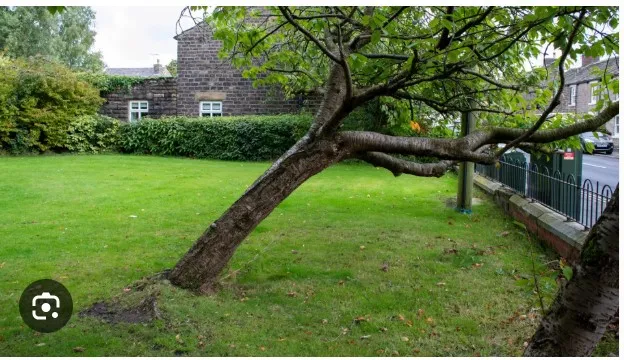

There is something deeply reassuring about a mature tree. It has been standing longer than the house beside it. It shades the garden in summer, shelters birds year-round and gives the property a sense of permanence that newly planted landscaping simply cannot replicate. Most homeowners feel a genuine attachment to the large trees on their property — and that attachment, while understandable, is one of the reasons so many tree-related emergencies happen every year.
The problem is not the trees themselves. It is the gap between how trees look and how trees are. A tree can appear completely healthy from the street while harbouring decades of internal decay that has hollowed out the structural wood at its core. It can look stable in calm conditions while its root system is quietly failing beneath the soil. Understanding what actually makes a tree dangerous — and acting on that understanding before something goes wrong — is one of the most important and most neglected aspects of responsible property ownership. Across the country, tree removal in USA is one of the most frequently requested emergency services after major storm events, precisely because the warning signs that should have prompted action months earlier were missed or ignored.
This article explains the specific hazards that homeowners most commonly overlook, the warning signs that warrant professional assessment, and the decisions that protect both property and people before a tree becomes a crisis.
Why Trees Fail When They Look Fine
The most dangerous trees are almost never the obviously dead ones. Those get noticed. They get removed. The trees that cause the most damage and the most injuries are the ones that looked perfectly healthy the day before they fell — because the processes that caused them to fail were invisible from the outside.
Internal decay is the most common and most deceptive of these processes. Fungal organisms that colonise the heartwood of a tree consume the structural wood from the inside out while leaving the outer layers intact. The canopy stays green. The bark stays on. The tree looks alive because the outer living tissue is alive. But the load-bearing core — the wood that transfers the weight of the canopy through the trunk and into the root system — has been progressively replaced by soft, structurally worthless material.
A tree with 50 percent internal decay at its base can survive years of normal conditions. But its margin for wind, ice loading, or soil saturation has been dramatically reduced. The storm that a sound tree would shrug off pushes a decayed one past its structural limit. And from the outside, there was no warning.
"The trees that cause the most damage are not the ones that look dangerous. They are the ones that look fine right up until the moment they are not."
Root Failure: The Hazard Nobody Sees
The root system of a mature tree is enormous. It extends outward in all directions, often to a distance two to three times the width of the canopy, and it is the anchor that holds the entire weight of the tree against wind, rain and gravity. When that anchor is compromised, the visible tree above ground gives almost no indication that anything is wrong — right up until the root plate releases and the tree tips over in one piece.
Root failure happens for several reasons. Construction work near the tree — trenching for utilities, grading for new buildings, paving over root zones — can sever or damage structural roots in ways that do not become apparent for years. Soil compaction from heavy foot or vehicle traffic reduces oxygen and moisture in the root zone, slowly weakening the root system from the outside in. Fungal infections can attack the roots directly, consuming their structural integrity before any above-ground symptoms appear.
The one reliable visible indicator of root plate failure is soil heaving on the side of the tree opposite its lean — a slight lifting or cracking of the ground where the anchor roots are being pulled upward as the tree tips. If you see this around any tree near your home, it is a same-day emergency, not a monitor-and-wait situation.
The Warning Signs Most Homeowners Walk Past Every Day
Most tree failure events are preceded by warning signs that were present for months or years before the failure occurred. Learning to recognise these signs is one of the most practical things a homeowner can do to protect their property.
- Fungal growth at the base — mushrooms or shelf fungi growing from the base of the trunk or from surface roots are visible evidence of active internal decay. The extent of the decay is always greater than the fruiting bodies suggest.
- Dead wood in the canopy — branches that have died back from the tips, failed to produce leaves in spring, or show peeling bark are structurally compromised and can fall without warning. Dead wood does not bend under wind load the way living wood does.
- Cracks in the trunk — longitudinal cracks running parallel to the grain of the wood indicate structural failure within the trunk. At major branch unions, cracks suggest the attachment is weakening.
- Visible lean that has changed — a lean that has been stable for years is different from one that has noticeably increased recently. Progressive lean change indicates an active failure process.
- Included bark at branch unions — where two stems or branches join with bark growing between them rather than a clean collar, the attachment is structurally weak and prone to splitting under load.
- Soil disturbance at the base — heaving, cracking or lifting of the soil around the root zone indicates root plate movement. This is among the most urgent warning signs.
None of these signs individually guarantees imminent failure. But any combination of them, particularly in a tree within falling distance of a structure, walkway or frequently occupied area, warrants professional assessment rather than continued observation.
The Cost of Waiting vs the Cost of Acting
The financial case for proactive tree management is straightforward and consistent. A tree removed on a planned schedule, before it becomes a hazard, costs between $500 and $3,000 for most residential trees. A tree that falls onto a roof generates structural repair costs of $10,000 to $80,000 or more depending on the damage. An emergency removal after a storm failure costs two to three times what a planned removal would have cost.
The gap between the cost of prevention and the cost of the event it prevents is one of the most consistent patterns in residential property management. And yet homeowners routinely defer tree assessment and removal for years, either because the tree does not look dangerous or because the cost of removal feels avoidable until it is no longer avoidable.
The trees that end up costing the most are almost always the ones that someone was watching and planning to deal with eventually. Eventually, in tree management as in most maintenance contexts, has a way of arriving at the worst possible moment.
When to Call a Professional and What to Ask
A certified arborist assessment is the only reliable way to evaluate whether a specific tree on your property presents an actual risk. The assessment covers the trunk condition including any visible or detectable decay, the root zone and any indicators of root system compromise, the canopy structure and any dead or structurally weak branches, the lean angle and direction relative to potential targets, and species-specific failure characteristics.
The result is a risk rating and a recommendation: remove, monitor, mitigate through cabling or pruning, or no action required. That information is what a yard-level visual inspection cannot produce, and it is what homeowners need to make decisions that are based on actual risk rather than appearance.
When scheduling an assessment, ask specifically for a Level 2 Tree Risk Assessment using the ISA framework, ask whether the findings will be provided in writing, and ask the arborist to explain their reasoning for the risk rating they assign. A written assessment serves multiple purposes: it guides your decision, supports any insurance claim, and documents your professional management of the risk if the tree is subsequently monitored rather than removed.
A Final Word on Attachment
The trees that are hardest to remove are usually the ones that have been on the property the longest. There is genuine grief in taking down a tree that has been part of a landscape for decades. That feeling is worth acknowledging and is not a reason for embarrassment.
But attachment to a tree and accurate assessment of its risk are two separate things. A homeowner can value a tree deeply and still recognise that it needs to come down. The goal of professional assessment is not to justify removing trees. It is to give homeowners accurate information about the trees they are responsible for so that their decisions are based on facts rather than hope.
A tree that needs to come down is not a loss to be avoided. It is a problem to be solved before it solves itself at a time and in a direction of its own choosing.


























Sign in to leave a comment.