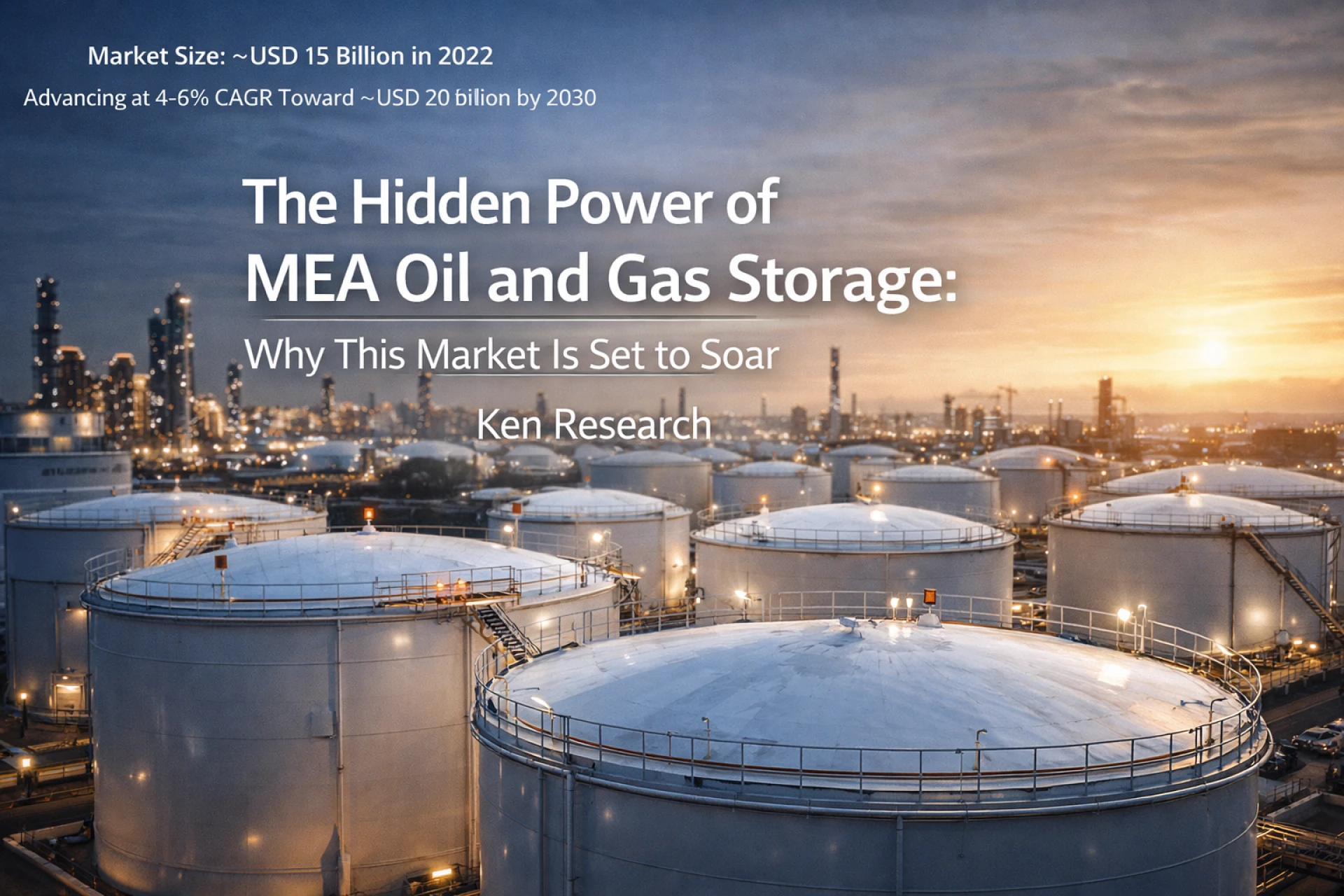

The Middle East and Africa oil and gas storage market's power is hidden not because it is small, but because it is understood primarily as infrastructure when it is more accurately understood as geopolitical strategy made physical. Based on market research insights from Ken Research, the market valued at approximately USD 15 billion in 2022 and advancing at 4-6% CAGR toward USD 20 billion by 2030 represents a material that provides the GCC with supply reliability assurance, geopolitical leverage, and commercial flexibility simultaneously. Storage capacity determines how long a producer can sustain exports during demand disruptions, how effectively it can respond to price arbitrage opportunities, and how credibly it can guarantee supply reliability to premium-paying Asian buyers.
The MEA oil and gas storage market size belies its strategic significance. Saudi ARAMCO alone controls more crude oil storage capacity than many countries' entire energy infrastructure, using it to manage production smoothly, respond to OPEC+ quota adjustments, and maintain the supply reliability that justifies the Saudi crude premium in Asian markets.
Key Data Insights
- Market size: approximately USD 15 billion in 2022, projected toward USD 20 billion by 2030 at 4-6% CAGR
- UAE Fujairah underground storage: 42 million barrels providing Strait of Hormuz bypass strategic supply security for Asian buyers
- Saudi ARAMCO's international storage footprint: strategic crude reserves in Japan (Okinawa) and Netherlands (Rotterdam) providing proximity to Asian and European premium market access
- LNG storage is the fastest-growing MEA storage segment, driven by Qatar NFE targeting 126 mtpa LNG capacity by 2027
- GCC downstream industrial diversification: SABIC, ADNOC Refining, and OCI creating large-volume chemical storage demand within the broader hydrocarbon storage market
- East Africa LNG programs: Mozambique (~13 mtpa Total Energies) and Tanzania creating new MEA storage geography for the first time
Source: Ken Research - MEA Oil and Gas Storage Market Strategic Intelligence
The Geopolitical Power of Storage: How GCC Uses Capacity as Strategy
Saudi ARAMCO's international storage network - maintaining strategic crude reserves in Okinawa, Japan and Rotterdam, Netherlands in addition to its domestic Saudi storage facilities - is a physical embodiment of geopolitical strategy. By pre-positioning crude oil in customer markets, ARAMCO can guarantee 72-96 hour delivery to Asian and European refiners independent of shipping schedule and Suez Canal transit, creating supply reliability that commands a market premium and sustains customer loyalty through commodity price cycles.
The UAE's Fujairah underground storage program takes this logic to its strategic extreme. By excavating approximately 42 million barrels of underground crude storage capacity in caverns adjacent to the Gulf of Oman, the UAE has created the ability to supply Asian buyers even in a scenario where the Strait of Hormuz is disrupted. This strategic asset - protecting approximately 21 million barrels per day of global crude oil transit - transforms the UAE's position from vulnerable strait-dependent exporter to guaranteed supply provider, justifying premium pricing and long-term customer relationships that are difficult to disrupt.
The MEA oil and gas storage market growth through 2030 therefore includes not just commercial storage expansion but strategic storage investment - capacity built not to maximise commercial return on storage revenue but to maximise the commercial and geopolitical premium available to producers with credible supply reliability assurances.
The LNG Storage Surge: Qatar's North Field Expansion as Market Catalyst
LNG storage is the fastest-growing segment within MEA's oil and gas storage market, and Qatar's North Field Expansion is the primary catalyst. Expanding from 77 mtpa to 126 mtpa requires building multiple new liquefaction trains at Ras Laffan, each needing dedicated cryogenic LNG storage tanks of approximately 200,000-260,000 cubic metres capacity. The dedicated storage infrastructure component of this expansion represents approximately USD 4-6 billion in capital expenditure - a project-level investment scale that would constitute a significant market in isolation.
Beyond Qatar, the MEA LNG storage market is being expanded by East African LNG development programs that are creating an entirely new storage geography in the region. Mozambique's Total Energies LNG project (approximately 13 mtpa target capacity), Tanzania's LNG program, and Ethiopia's potential gas exports through the Horn of Africa corridor are collectively generating LNG storage and export terminal investment requirements that are bringing Sub-Saharan Africa into the MEA storage market as a meaningful growth driver for the first time.
Ken Research's strategic intelligence for the MEA oil and gas storage market includes geopolitical storage strategy analysis, LNG infrastructure development modelling, and the commercial premium quantification of supply reliability positioning. Explore Ken Research for the complete strategic intelligence framework.
The Downstream Diversification Storage Demand: GCC's Industrial Transformation
The MEA oil and gas storage market forecast includes a structural demand category that is frequently overlooked: downstream petrochemical integration creating large-volume chemical storage demand. The GCC's USD 150-200 billion downstream investment through 2030 - SABIC's Jubail complex, ADNOC's Ruwais expansion, Kuwait's Olefins 3 program - requires substantial chemical product storage for ethylene, propylene, polyethylene, polypropylene, and commodity chemicals.
Chemical product storage is qualitatively different from crude oil storage: it requires specialised tank designs for various hazard classes, temperature control systems for volatile products, advanced safety systems, and certification infrastructure that increases capital cost per unit of storage capacity by 30-50% above equivalent crude storage. This quality premium creates higher margin storage construction contracts for EPC contractors and specialist storage operators with chemical product handling expertise.
MEA oil and gas storage market challenges include geopolitical execution risk in sub-regions experiencing political instability, the capital intensity requiring long-term project finance and offtake commitment, climate execution challenges from extreme heat and humidity, and the regulatory complexity of coordinating large storage projects across multiple national jurisdictions in East Africa.
Conclusion: The Hidden Power Becomes Visible at USD 20 Billion
The MEA oil and gas storage market's hidden power - its role as geopolitical strategy made physical, as commercial premium generator, as energy security architecture, and as downstream industrial transformation enabler - will become fully visible when the market reaches approximately USD 20 billion by 2030. The 4-6% CAGR growth rate is the reflection of this strategic infrastructure investment as much as it is the result of commercial storage demand growth.
The MEA oil and gas storage market outlook through 2030 belongs to EPC contractors with deep GCC relationship networks, storage terminal operators with LNG technology specialisation, and strategic investors who understand that the USD 20 billion market destination is a floor - not a ceiling - for a region where energy infrastructure is simultaneously commercial investment and geopolitical strategy.
Related Report: Asia Pacific Hydrogen Fuel Gas Station Market - Explore complementary clean energy infrastructure investment across Asia Pacific
Explore More Market Intelligence
For comprehensive MEA energy infrastructure, oil and gas storage, and petrochemical market intelligence, Visit Ken Research for comprehensive sector intelligence, competition benchmarking, and market forecasting across global energy, chemicals, and industrial markets.
Frequently Asked Questions (FAQ)
Q1. Why is the MEA oil and gas storage market described as having 'hidden power'?
The MEA oil and gas storage market's 'hidden power' derives from the fact that storage capacity in this region functions as geopolitical strategy as much as commercial infrastructure. Saudi ARAMCO's international storage network in Japan and the Netherlands provides proximity to Asian and European premium markets, guaranteeing supply reliability that commands pricing premiums and customer loyalty unavailable to producers without forward-positioned storage. The UAE's 42 million barrel Fujairah underground storage program provides supply security against potential Strait of Hormuz disruption - transforming the UAE from a strait-dependent exporter into a guaranteed supply provider to Asian buyers. These strategic dimensions of MEA storage investment are poorly captured in commercial market size metrics, making the market appear smaller and simpler than its actual economic and geopolitical significance.
Q2. What is driving MEA oil and gas storage market growth toward USD 20 billion by 2030?
Four simultaneously executing investment programs drive the USD 20 billion trajectory. Qatar's North Field Expansion (USD 28.75 billion total, approximately USD 4-6 billion in dedicated storage infrastructure) is the most capital-intensive single program. Saudi ARAMCO's crude oil storage capacity expansion supporting production growth toward 12+ million barrels per day is the largest volume addition. UAE's ADNOC Fujairah underground storage expansion adds strategic premium-pricing capability. Sub-Saharan Africa's Mozambique LNG program, Nigeria's Dangote Refinery downstream storage, and Tanzania's LNG project are creating new MEA storage geography for the first time. The combined effect of these committed programs drives the market from approximately USD 12-15 billion in 2022 toward the USD 20 billion 2030 target at approximately 4-6% CAGR.
Q3. What are the MEA oil and gas storage market competitors?
The MEA storage market competitors span three tiers. State-owned asset owners (Saudi ARAMCO, ADNOC, Qatar Energy, SOCAR, SONATRACH) own the majority of storage assets and determine capital investment programs. EPC contractors (Technip Energies, Wood Group, McDermott International, Saipem, Samsung Engineering, CB&I Storage Solutions) design and construct storage infrastructure under contract to state-owned companies and project developers. Independent storage terminal operators (Oiltanking, Vopak, Brooge Holdings at Fujairah) provide commercial third-party storage services in locations where market structure allows independent operator participation. The competitive landscape is concentrated among EPC contractors with established GCC relationship networks and track records, creating significant barriers to entry for new market participants without demonstrated regional project execution capability.
Q4. How does chemical product storage fit into the MEA oil and gas storage market?
Chemical product storage is a growing segment within MEA's traditionally crude oil and natural gas dominated storage market, driven by the GCC's downstream industrial diversification strategy. SABIC's Jubail petrochemical complex, ADNOC's Ruwais expansion (adding significant polypropylene, polyethylene, and specialty chemical production capacity), and Kuwait's Olefins 3 program collectively require billions of dollars in chemical product storage infrastructure. Chemical storage commands 30-50% higher capital cost per unit volume compared to crude oil storage due to specialised tank design for various hazard classes, temperature control systems for volatile and cryogenic products, advanced safety systems, and certification requirements. This premium creates higher-margin construction opportunities for EPC contractors with specialised chemical storage engineering capability.
Q5. What is the investment outlook for the MEA oil and gas storage market?
The MEA oil and gas storage market investment outlook through 2030 is positive for participants with the right positioning. EPC contractors with deep GCC state-owned company relationships (particularly with ARAMCO, ADNOC, and Qatar Energy) are best positioned for the highest-value contracts. LNG storage specialists (TechnipFMC, CB&I) are positioned for the Qatar NFE and East Africa LNG programs. Independent storage terminal operators at strategic locations (Fujairah, Salalah, Djibouti) benefit from geopolitical premium demand. The primary investment risk is geopolitical instability in sub-regions (Libya, Yemen, Iraq) that prevents storage infrastructure deployment despite resource richness, and project execution risk in extreme climate conditions that increases cost overrun probability for projects without robust climate management protocols.
Q6. Where can I access MEA oil and gas storage market research?
Ken Research publishes the comprehensive MEA oil and gas storage market intelligence covering country-level storage investment analysis, geopolitical strategy assessment, LNG infrastructure development, downstream petrochemical storage demand, competitive EPC contractor benchmarking, and 2030 market forecast.
























Sign in to leave a comment.