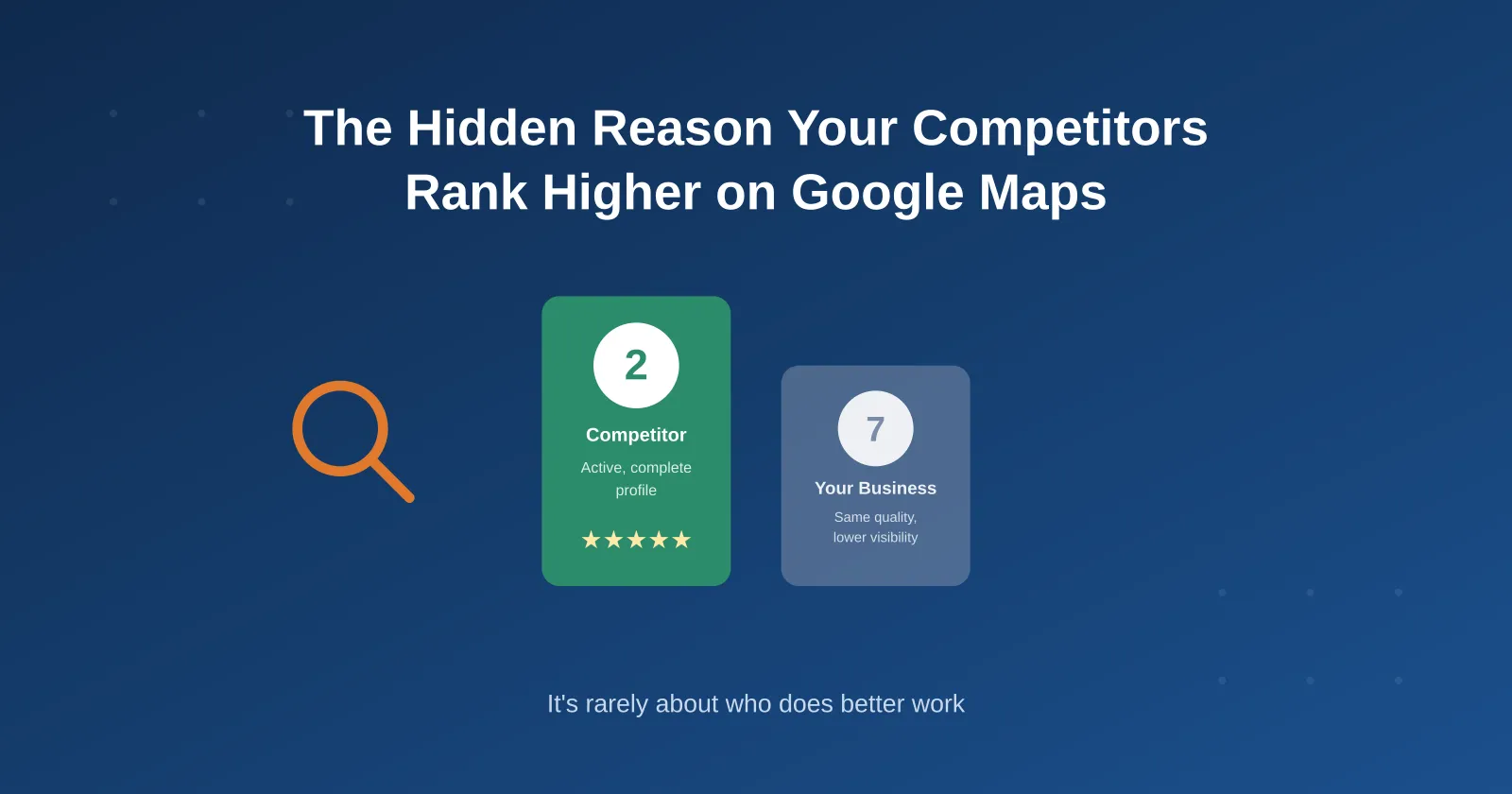

Same industry, same city, sometimes even the same street, and yet when a customer searches for what you do, a competitor’s listing shows up in the Map Pack, and yours doesn’t. It’s tempting to assume they’re simply a bigger or better-known business. Most of the time, that’s not it at all. The gap usually comes down to a set of profile signals that have nothing to do with the quality of the business itself, and everything to do with how well the Google Business Profile behind it has been managed.
Google Isn’t Ranking the Better Business, It’s Ranking the Better Profile
Google’s local algorithm doesn’t know how good your service actually is, how friendly your staff are, or how many years you’ve been in the neighborhood. It only knows what’s on the profile and how customers interact with it. A newer, smaller business with an active, complete profile will regularly outrank an older, more established one that hasn’t been touched since it was created. That’s an uncomfortable idea for a lot of business owners, but it’s also good news: the fix doesn’t require becoming a bigger business, just a better-managed profile.
The Signals That Actually Carry Weight
There isn’t one single ranking factor Google relies on. It’s a combination of signals, weighted and recalculated for every search.
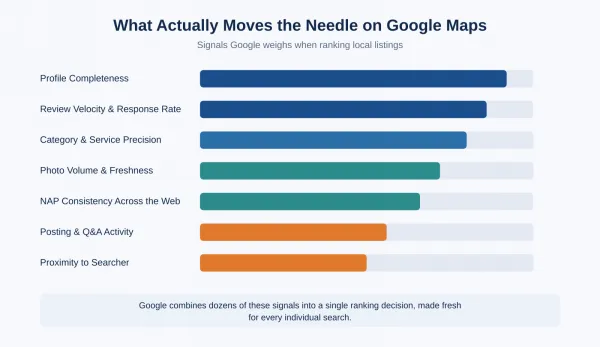
Profile completeness and review activity tend to carry the most weight, which is exactly why two businesses that look identical on paper can end up several positions apart in the results.
Reviews Are Doing More Than Building Trust
Most business owners think of reviews purely as social proof for customers. Google treats them as an activity signal too: how many are coming in, how recently, and whether the business is responding. A profile that hasn’t earned a new review in months reads to Google as a business that’s gone quiet, even if it’s busier than ever in real life. Responding to reviews, especially critical ones, adds another layer of engagement that Google’s systems pick up on.
A Side-by-Side That Explains a Lot
Here’s what that gap typically looks like in practice: two profiles competing for the same search, with very different upkeep behind them.

Nothing in that comparison is about which business does better work. It’s entirely about which one gave Google more reasons to trust it as active and relevant right now.
Category Precision Matters More Than Most Businesses Realize
A profile registered under a broad, generic category is competing against every other business in that category, including ones with far larger review counts and marketing budgets. Narrowing to precise service categories, and listing individual services by name, shrinks the competition down to businesses that actually match what the customer searched for. It’s a five-minute fix that regularly moves a listing several spots on its own.
Location Changes the Answer Too
Rankings aren’t fixed across an entire service area. A business can rank near the top for searches close to its address and drop out of sight entirely just a mile or two further out. Businesses that only check their ranking from one spot, usually their own front door, often have no idea how invisible they are everywhere else. Understanding the full spread of where a profile does and doesn’t show up is usually the first real clue about what to prioritize fixing.
Finding Out Where You Actually Stand
Guessing which of these factors is holding a specific profile back rarely works, since the fix that helped one business gain ground can be irrelevant for another. The only reliable starting point is an honest look at the current profile, measured against what’s actually driving the competitors sitting above it.
Search Berg’s free GMB profile audit tool checks a listing against these exact ranking signals and shows precisely where it’s losing ground to competitors, along with what to fix first.


























Sign in to leave a comment.