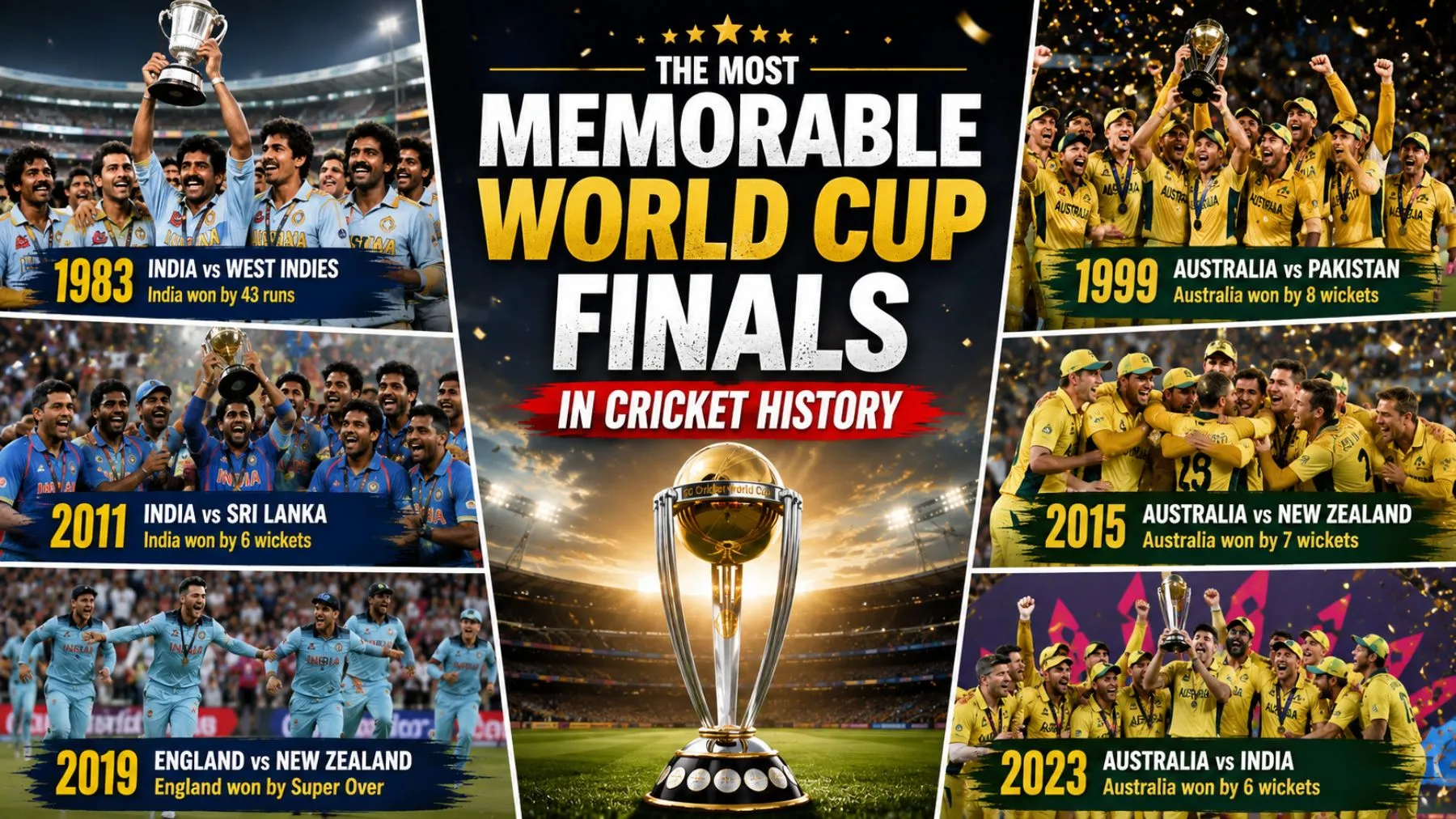

The ICC Cricket World Cup is the absolute pinnacle of international cricket. Every four years, national teams embark on grueling campaigns, enduring high-pressure qualifiers, intense group stages, and nerve-shredding knockout encounters, all aiming for a single objective: playing in the World Cup final. While every tournament yields a champion, only a select few final matches achieve true immortality. These are the encounters where underdog stories culminate in historic glory, tactical masterpieces unfold under immense pressure, and matches are decided by the narrowest, most dramatic margins imaginable. From classic 60-over duels in the 1970s to modern Super Over thrillers at Lord's, certain finals have forever altered the landscape of the sport. Here is an in-depth breakdown of the most memorable World Cup finals in cricket history, ranked by their drama, historical significance, and lasting impact on the global game.
1. 2019 World Cup Final: England vs. New Zealand (Lord's, London)
The 2019 World Cup final at Lord's is widely regarded by sports historians as the most agonizingly dramatic ODI match ever played. Hosted at the home of cricket, the contest delivered 102 overs of unrelenting tension that ultimately ended without a definitive winner in regulation play. Batting first on a tricky, overcast surface, New Zealand scraped together a competitive total of 241/8, built around a gritty half-century from Henry Nicholls and disciplined middle-order accumulation. In response, England’s powerful batting lineup faltered under disciplined Kiwi seam bowling, slumping to 86/4. Ben Stokes (84*) and Jos Buttler (59) staged a crucial revival, but the match quickly devolved into chaotic late over theatre. With England needing 15 runs off the final over bowled by Trent Boult, a throw from the deep struck the bat of a diving Ben Stokes and deflected to the third man boundary for six total runs (two ran plus four overthrow overthrows). Needing two runs off the final ball to win, Mark Wood was run out coming back for the second, leaving both teams tied on 241. For the first time in World Cup history, a final was decided by a Super Over. England batted first in the extra over and scored 15 runs. New Zealand matched them blow-for-ball, needing two runs off Martin Guptill’s final delivery. Guptill was run out by Jos Buttler inches short of the crease, leaving the Super Over tied at 15–15. England was crowned World Champions on the controversial boundary-count rule (26 boundaries to 17), capping off the most extraordinary finish in sporting history.
2. 1983 World Cup Final: India vs. West Indies (Lord's, London)
If the 2019 final stands as the most dramatic match, the 1983 final remains the most culturally transformative. The mighty West Indies entered the tournament as two-time defending champions, possessing a bowling attack that struck fear into batsmen worldwide and a batting lineup capable of dismantling any target. India, conversely, were rated as 66-1 underdogs, having won just a single match across the previous two World Cup tournaments.
After being sent in to bat by Clive Lloyd, India’s batting order crumbled against the high-velocity pace of Andy Roberts, Malcolm Marshall, Joel Garner, and Michael Holding. India was bowled out for a modest 183 in 54.4 overs, with Krishnamachari Srikkanth top-scoring with 38.
During the mid-innings break, commentators dismissed India's chances of defending 183 against Sir Viv Richards, Gordon Greenidge, and Desmond Haynes. However, Indian captain Kapil Dev delivered an inspiring team talk, emphasizing that they had nothing to lose. Balwinder Sandhu set the tone early by clean bowling Greenidge with a sharp inswinger.
The defining turning point arrived when Viv Richards was threatening to take the game away in minutes. Richards skied a delivery from Madan Lal toward mid-wicket, and Kapil Dev ran backward for nearly 20 yards to pluck a sensational over-the-shoulder catch. The West Indian middle order panicked under relentless seam and swing from Mohinder Amarnath (3/12) and Madan Lal (3/31). West Indies collapsed to 140 all out, handing India a 43-run miracle victory that fundamentally changed world cricket.
3. 2011 World Cup Final: India vs. Sri Lanka (Wankhede, Mumbai)
Twenty-eight years after their historic 1983 triumph, India returned to the World Cup final on home soil at the Wankhede Stadium in Mumbai. Facing subcontinental rivals Sri Lanka, India carried the heavy emotional expectations of 1.2 billion citizens and the desire to send off legendary batsman Sachin Tendulkar with a World Cup trophy in his hometown. Sri Lanka won the toss and elected to bat, setting a formidable target of 274/6. Mahela Jayawardene played a masterclass of touch and timing, scoring an unbeaten 103 off 88 balls to put Sri Lanka in a strong position. India's chase got off to a disastrous start. Lasith Malinga trapped Virender Sehwag lbw for a second-ball duck and shortly after induced an edge from Sachin Tendulkar, sending the Wankhede Stadium into stunned silence at 31/2. Gautam Gambhir and a young Virat Kohli steadied the innings with an 83-run partnership. Following Kohli's dismissal, Indian captain MS Dhoni made a bold tactical gamble by promoting himself ahead of the in-form Yuvraj Singh to counter Sri Lanka’s off-spinners. Gambhir played a heroic, composed knock of 97, while Dhoni crafted a masterpiece of controlled aggression.
With 4 runs needed off 11 balls, Dhoni launched Nuwan Kulasekara high over long-on for an iconic World Cup-winning six, triggering wild celebrations across the nation and making India the first team to win a World Cup on home soil.
4. 1992 World Cup Final: Pakistan vs. England (MCG, Melbourne)
The 1992 World Cup in Australia and New Zealand was revolutionary, introducing colored clothing, white cricket balls, black sightscreens, and floodlit day-night matches. The tournament reached its grand finale at the Melbourne Cricket Ground, where Imran Khan led his Cornered Tigers against Graham Gooch’s England. Pakistan had endured a disastrous start to the tournament, winning just one of their first five matches and escaping elimination only when a rainout saved them against England in the round-robin stage. Yet, captain Imran Khan rallied his team with fierce belief, urging them to play with the instincts of a trapped tiger. In the final, Pakistan recovered from an early top-order slump of 24/2 thanks to a crucial 139-run partnership between Imran Khan (72) and Javed Miandad (58). Late-over power hitting from Inzamam-ul-Haq (42 off 35) and Wasim Akram (33 off 18) propelled Pakistan to 249/6. In reply, England’s chase was severely damaged by a spell of reverse-swing bowling from left-arm fast bowler Wasim Akram. In two consecutive deliveries, Akram produced unplayable inswingers to dismiss Allan Lamb and Chris Lewis, breaking England’s middle-order resistance. Imran Khan claimed the final wicket of Richard Illingworth to secure a 22-run victory, handing Pakistan their maiden World Cup title.
5. 1975 World Cup Final: West Indies vs. Australia (Lord's, London)
The inaugural Cricket World Cup final in 1975 established the benchmark for international limited-overs tournaments. Played over 60 overs per side in traditional white clothing, the match brought together two formidable powerhouses: Clive Lloyd’s West Indies and Ian Chappell’s Australia. The headline act of the match was a breathtaking century by West Indian captain Clive Lloyd. Walking to the crease with his side struggling at 50/3, Lloyd launched a counter-attack against Australia's bowling attack of Dennis Lillee and Jeff Thomson. Lloyd smashed 102 off just 85 balls, sharing a 149-run partnership with Rohan Kanhai to elevate the West Indies to 291 all out. Australia’s pursuit of 292 was characterized by desperate, high-risk running between the wickets. Five Australian batsmen were run out—including three directly by a young Vivian Richards, whose athletic fielding in the covers dismantled Australia's middle order. Despite a stubborn 41-run tenth-wicket partnership between Lillee and Thomson, Australia was bowled out for 274, giving the West Indies a 17-run victory and the inaugural World Cup trophy.
6. 1987 World Cup Final: Australia vs. England (Eden Gardens, Kolkata)
The 1987 final was significant as it was the first World Cup played outside of England, reducing the match length from 60 to 50 overs. Played before a crowd of over 70,000 at Eden Gardens in Kolkata, Australia met rival England in what remains the closest margin of victory in a traditional regulation World Cup final. Australia batted first and compiled 253/5, anchored by David Boon’s solid 75 and a late-overs assault from Mike Veletta (45 off 31). In reply, England looked comfortably on track to chase down the target, reaching 135/2 behind solid contributions from Bill Athey and captain Mike Gatting. The turning point occurred when Mike Gatting attempted an unexpected reverse sweep against Australian part-time spinner Allan Border. Gatting top-edged the ball off his shoulder, and wicketkeeper Greg Dyer took the catch. The sudden loss of momentum proved fatal for England. Australia’s bowlers tightened their lines, restricting England to 246/8 to seal a thrilling 7-run victory and capture Allan Border's first World Cup title.
Comparing the Great World Cup Finals
| Tournament | Winner | Runner-Up | Winning Margin | Match Key Highlight |
|---|---|---|---|---|
| 1975 | West Indies | Australia | 17 Runs | Clive Lloyd’s 102 off 85 balls & 5 Australian run-outs |
| 1983 | India | West Indies | 43 Runs | Kapil Dev's catch to dismiss Viv Richards; defending 183 |
| 1987 | Australia | England | 7 Runs | Mike Gatting's reverse sweep turning point; closest regulation win |
| 1992 | Pakistan | England | 22 Runs | Wasim Akram's double-strike reverse swing spell |
| 2011 | India | Sri Lanka | 6 Wickets | MS Dhoni's match-winning 91* & iconic winning six |
| 2019 | England | New Zealand | Boundary Count | Tie in regulation (241) & tie in Super Over (15–15) |
Evaluating Match Dynamics in Modern World Cup Tournaments
Analyzing historical World Cup finals demonstrates how tactical approaches, pitch behavior, and pressure handling shape match outcomes. Evaluating factors such as team chasing records, death-bowling execution, and weather conditions provides valuable insights when studying international fixtures. Fans looking for an accurate online cricket prediction often review past venue data, toss advantages, and player matchups before major matches. When following global tournaments, choosing a reputable platform like Cric Opinion helps enthusiasts access statistical analysis, pitch reports, and form trends to better understand game developments.
Conclusion
The Cricket World Cup final remains the ultimate arena for sporting greatness. Whether defined by the jaw-dropping underdog defense of 1983, the technical brilliance of the 2011 chase, or the unmatched Super Over drama of 2019, these matches stand as timeless masterpieces. As new generations of cricketers take the stage, the rich legacy of these iconic World Cup finals will continue to inspire fans across the globe.
Frequently Asked Questions:
Q1: Which World Cup final is considered the closest in cricket history?
A1: The 2019 World Cup final between England and New Zealand is the closest in history, as both the 50-over match (241 runs) and the subsequent Super Over (15 runs) ended in ties, with England winning on boundary count.
Q2: What was the lowest total ever successfully defended in a World Cup final?
A2: India holds the record for defending the lowest total in a World Cup final, successfully defending 183 runs against the West Indies at Lord's in 1983 by bowling them out for 140.
Q3: Has any team won the Cricket World Cup on home soil?
A3: Yes, India became the first team to win the World Cup on home soil in 2011 at Wankhede Stadium. Australia followed suit by winning in Melbourne in 2015, and England won at Lord's in 2019.




























Sign in to leave a comment.