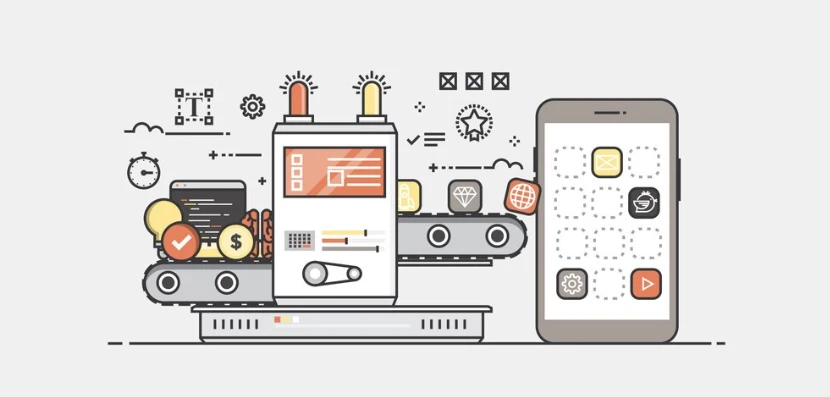

99% of all apps are created for the two most widely used mobile platforms, iOS and Android. You may be thinking, why not develop your product for both platforms at the same time?
Actually, everything is rather clear: the money is the main concern in this situation. Not everyone has the time or resources to launch on two platforms at the same time. As a result, developers almost often start out creating products only for one particular platform.
There\'s even a joke about how you can make several times as much money selling the identical program by just porting it to a different platform. (To be honest, it\'s not exactly ground-breaking.) Actually, because both developers and consumers would gain from this, there is nothing wrong with doing it.
For many others, however, many things are not so clear-cut. For this reason, we will now discuss the key benefits of converting applications from Android to iOS or vice versa.
Some Important Justifications for Converting an Android App to an iOS One (or Vice Versa)
You most likely already have an iOS or Android application created if you are reading this post. Furthermore, it\'s probable that you have already considered if it would be worthwhile to move it from one platform to another and whether it is even doable.
The simple response is that it is worthwhile. Here are several solid explanations for this:
creating an audience. First of all, users of devices using this platform comprise every operating system. The nations in Eastern Europe, South Korea, China, Brazil, and Mexico are the ones where Android is most popular. But in the US, Australia, and Canada, iOS is ahead. Businesses may reach a much larger audience by being active on both channels.
Boost income. Your revenue will increase if you transfer your application, even if there is a sizable audience on a certain platform. The explanation is straightforward: you\'ll be able to reach a wider audience.
An edge over competitors. You will be able to get a significant edge and capture a bigger portion of the new market if the majority of your rivals are focused on a single platform.
Additional information for analysis. Good analytics are crucial because the more you understand about user behavior, the more likely it is that your product will be ready for sale. In actuality, it all boils down to the reality that companies have chances to increase the likelihood that they will draw in new target markets, earn more money, and outperform rivals.
These are more than reasonable reasons in a contemporary economic setting where intense rivalry is characteristic of all fields.
Important Things to Think About When Porting Applications
The Linkitsoft team has a strong background in both iOS and Android app development as well as cross-platform app porting. These helpful hints, gleaned from our own experience, can assist you in avoiding expensive mistakes.
Remember the following if you have chosen to convert an Android app to an iOS app.
1. Architectural differences. The functionality and application architecture of each platform vary. Initially, features that can be implemented using built-in tools in one operating system may not be available in another. This covers features like file management, push notifications, navigation, menus, information organization, and interoperability with other installed apps on the device.
2. Architectural elements. Without modifications, app design components won\'t function. These systems come from two distinct worlds in terms of user interface. This holds true for the overall principles of the elements as well as their size and form. Whereas Android is built on the Material Design philosophy, Apple employs flat design. One illustration would be the appearance of the Share symbol, a little but significant design element.
3. The components and code. Recompiling an Objective-C/Swift iOS program for an Android platform is not feasible. You\'ll need to start from scratch when writing code, particularly on the server side. Because of the large degree of fragmentation in the Android OS, porting an app from iOS to Android might take even longer than designing an original program.
4. Supported devices. In contrast to the iPhone, there are thousands, if not hundreds, of Android-powered smartphones available on the worldwide market. Developers are unable to optimize a program for each of them. We can provide you some straightforward advice: identify the top ten devices in your target market and develop applications specifically for them.
5. Examination. The criteria for testing need to be rather obvious. It\'s useful to keep in mind that because the success of the app relies on quality assurance, it should always come first in app development. Your little investment of time in this will undoubtedly pay off.
6. Optimization and troubleshooting. It is important to ensure that the source application is free of defects and problems before transferring it to a new platform. If not, they will be repeated in the product designed for the alternative operating system. Additionally, you may use the app transfer process as a chance to qualitatively improve for increased efficiency, reduced battery usage, etc.
How We Port an Android App to an iOS One
It is essential to pay close attention to details in order to properly finish any assignment. As a result, when we convert a program from Android to iOS or vice versa, we follow a detailed work plan. Following this method enables us to provide exceptional outcomes to our clients:
• UI/UX design examination of the source app
• Creation of adaptation plans
• Identification of technology and tool stack
• Analysis of source app business logic
• Creation and evaluation
We ensure that our clients will obtain a high-quality output that satisfies their business objectives by outlining these processes in sequential order.
Lastly
Choosing to port an app to a new platform is essentially an attempt to break into a new market, which has its share of challenges and exciting possibilities. You don\'t need to worry since you can reduce the risks and take advantage of the chances to grow your company.
Android app development is the process of developing mobile apps for Android-powered devices that provide consumers access to a variety of features and services that are catered to their individual requirements.











Sign in to leave a comment.