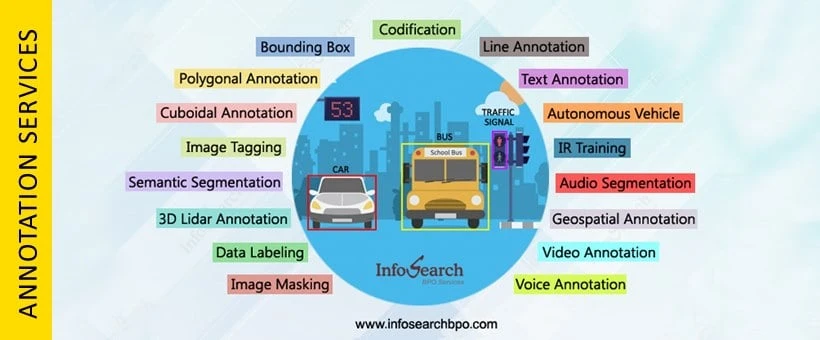

Infosearch BPO is a leading provider of data annotation services for various industries.
The present-day artificial intelligence relies on data annotation. High-quality labelled data defines the accuracy of AI models in learning and performance in areas such as computer vision and natural language processing, speech recognition, and recommendation systems. And Infosearch is well-versed in providing them.
Still, data annotation is also a highly sophisticated and underestimated AI lifecycle phase. There are usually issues that face organisations that may impact data quality, scalability, cost, and ethics. It is necessary to learn about such challenges and how to overcome them to create reliable and production-ready AI systems.
1. Ensuring Quality of High Annotation.
The Challenge
The performance of a model can be severely affected. Poor-quality annotations are caused by human error, lack of clarity and subjective interpretation.
How to Overcome It
• Formulate annotation rules to be followed in detail.
• Training and certification of annotators.
• Introduce multi-pass inspection and quality supervision.
• Evaluate inter-rater reliability to discover discrepancies.
Clear, organised, and continuous feedback is the beginning of high-quality annotation.
2. Efficiency in scaling Annotation Efforts.
The Challenge
With increased datasets, manual annotation is costly and time-consuming. The first barrier is the possibility of scaling annotation teams and not losing quality.
How to Overcome It
• It will involve incorporating human annotation with AI-assisted labelling tools.
• Use active learning to give priority to high-impact data.
• Collaborate with seasoned service providers of annotation.
• Automate or automate low-complex or repetitive tasks.
Scalability needs the appropriate balance between human control and automation.
3. Managing Costs and Budgets
The Challenge
Data annotation may constitute a considerable part of the costs to develop AI, in particular with large or complex data.
How to Overcome It
• Begin with smaller and more valuable datasets.
• Be data- quality oriented and not merely data- quantity oriented.
• Reduce and re-use labelled existing data.
• Measures the performance of annotation investment using performance metrics.
Costs are controlled with the help of strategic planning, and the impact of the models is maximised.
4. Managing Subjectivity.
The Challenge
Certain annotation activities, including sentiment analysis or content moderation, are subjective in nature. The same data can be perceived by different annotators.
How to Overcome It
• Characterize edge cases in annotation guidelines.
• Apply labelling techniques that are consensus-based.
• Outsource complex cases to annotators of senior or specialisation.
• It should constantly improve rules in the light of practical experience.
Enhancements of ambiguity enhance the uniformity and reliability of the models.
5. Protecting Data Privacy and Security.
The Challenge
There is annotated information in sensitive or personal form, and this may be in fields such as healthcare, finance and legal services.
How to Overcome It
• Pre-annotation sensitive data have been anonymised or masked.
• Implement stringent security measures and protection.
• Make sure that the regulations (GDPR or HIPAA) are observed.
• Collaborate with annotation partners of high security standards.
Building trust and complying cannot be compromised in data annotation.
6. Educating Pathways to Prevent Bias & Support Ethical AI.
The Challenge
Prejudiced information results in prejudiced artificial intelligence. The decision to annotate can be biased towards social, cultural, or demographic backgrounds.
How to Overcome It
• Employ annotation teams of different levels.
• Test audit data regularly to detect bias.
• Create equality and review ethics procedures.
• Integrate detection and mitigation strategies of bias.
Responsible AI systems can be established with the help of ethical annotation.
7. Maintaining Updates on Changing Data and Models.
The Challenge
AI models keep on changing, as does the information they depend on. The old annotated datasets can be obsolete or incorrect in correspondence to new goals.
How to Overcome It
• Approach annotation as a continuous procedure and not a task.
• Periodically update and change labels of data.
• Track the performance of the model to detect annotation gaps.
• Closed learning and feedback loops.
Dynamic annotation provides long-term AI usefulness.
The worth of the Human-in-the-Loop Approach.
Although automation is increasingly important in data annotation, human expertise is still important, particularly in complicated, high-risk, or subjective work.
Infosearch's human-in-the-loop approaches are a combination of:
• Machine efficiency
• Human judgment
• Continuous improvement
This hybrid solution provides quality and more reliable AI results.
Final Thoughts
Annotation of data is a technical and strategic issue. Organisations investing in the clarity of processes, expertise of annotators, ethics, and scalable solutions earn a tremendous edge in AI development.
Through the identification of the most significant issues in the process of data annotation and their active mitigation, businesses will be able to create more robust datasets, enhanced models, and more credible AI tools capable of providing real-world utility.
Contact Infosearch for your data annotation requirements.
Sign in to leave a comment.