
Raised in a world where God and a cast of saints dictated everything, my childhood felt suffocated. "The" God, along with Jesus, knew what was best for all of us, or so I was taught. It felt like a convenient deal – obedience now for rewards later, like a woodpile stacking up in heaven. Even earthly desires were frowned upon, replaced by building temples and churches while denying ourselves any earthly "treasures" or "hearts."
Fast forward to the day I was talking to a friend, a woman with a radiant face and a life overflowing with cheerfulness. We chat about our children, how time flies, and how her Christian faith promises a future where time itself ceases to exist. She finds comfort in believing that the past, present, and future will all be present in heaven, where loved ones reunite in their prime. It\'s a beautiful image, a glorious eventuality.
But watching her, I wonder: is this happiness genuine? Does it stem from her faith, or is it a way to ignore the richness of the present moment?
There\'s a subtle criticism here of that belief system. People become obsessed with a "heavenly plan," a future reward that excuses them from experiencing life fully now. They deny themselves earthly desires in exchange for a future that may or may not exist. It makes you wonder, is all this piety just a disguise for greed? People compete for control and possessions while pretending to be good, all with an eye on a bigger mansion in the sky.
Then comes a turning point: a date and a simple question. On a second date with a woman named Kris—the blue-eyed woman, the conversation takes a deeper turn. She asks, “What do you think about life, Richard?” It\'s a question that catches me off guard. My initial response is flippant, a way to deflect the weight of the question. I brag about my physical pursuits, a further attempt to avoid genuine vulnerability.
But deep in my heart, there\'s the jar of sweets left on my porch with a message inscribed on the lid: "Wherever you go in life, there you are." It\'s a gentle reminder of the question I so desperately tried to ignore.
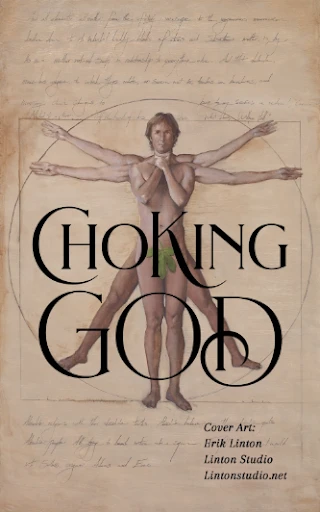
The narrative then shifts. There\'s an acceptance of the complexity of human belief. There are theists, atheists, pacifists, nihilists – all with their own perspectives. This leads to the core message of my journey that I engraved in my memoir “Choking God”: embracing the present moment. You see, the rewards we seek and the experiences we cherish all exist now, in the here and now. We just need to look at ourselves and appreciate who we are—for real—for ourselves, not confined to societal expectations and self-made gods and monsters. Living without regret means embracing each moment, fulfilling or not, and not letting others decide our lives or faith.
We often stumble upon people and things that influence our lives. Be it teachers, bosses, friends, lovers, social exceptions, or fear of something. These different experiences and self-made gods and monsters can hinder our growth process. Therefore, we should always be apt to make our own decisions and take control of our lives—to be free and find peace. "Choking God" by me (Richard Carlston) is a great read that will lead you to freedom. Based on my experiences, dismantling the cages of religion, societal expectations, dominance, and even relationships, urging readers to discover their own truths, this raw and honest memoir uses humor, insightful reflection, personal experiences, and musses to guide you on a path of self-discovery and independence. Prepare to question assumptions, challenge limitations, and ultimately break free from the shackles of external forces—the monsters and teachers and the self-made gods—to find the freedom and fulfillment that resides within you!











Sign in to leave a comment.