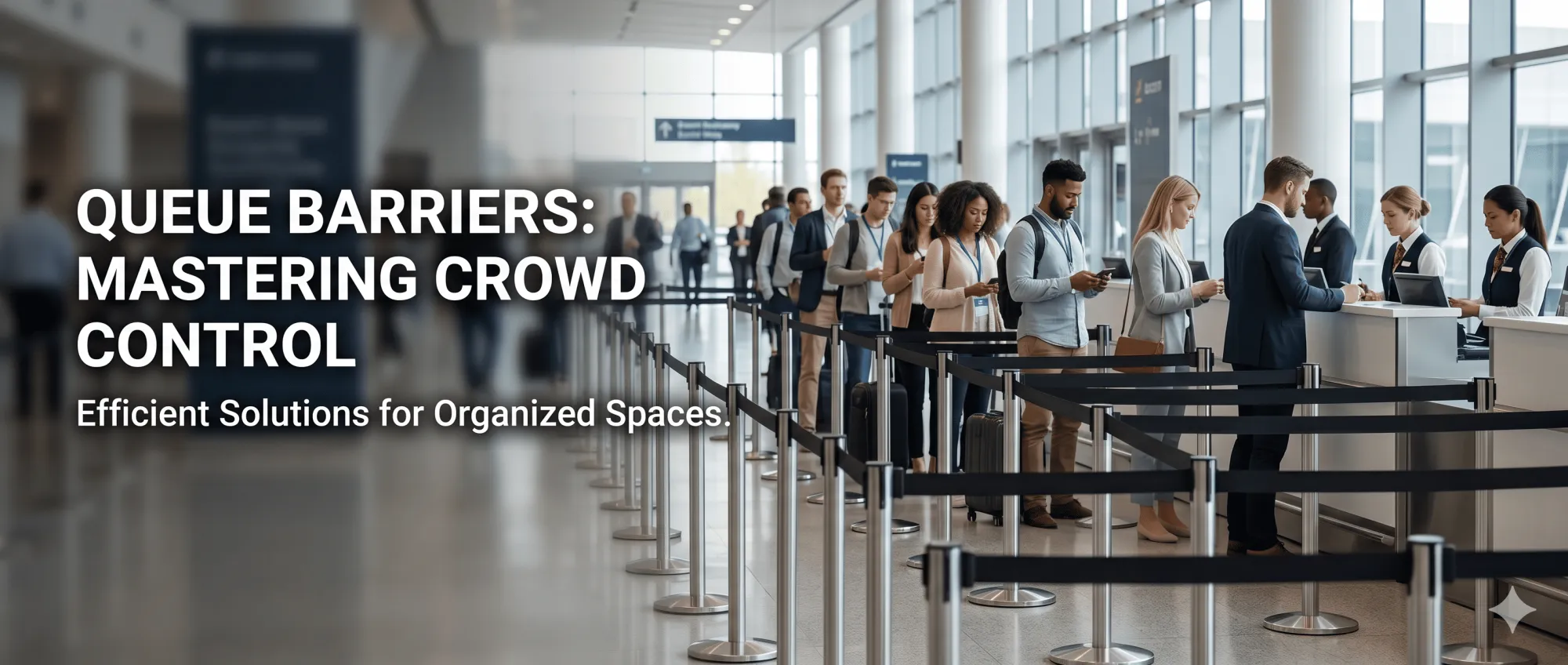

Unorganized waiting areas actively destroy businesses. They cause lost revenue, frustrate your customers, and introduce serious safety risks. When people do not know where to stand, anxiety spikes.
Enter the silent operational hero of the business world: the queue barrier.
A well-placed barrier completely transforms a chaotic mob into a smooth, efficient, and profitable flow of foot traffic. If you want to keep your customers happy and your operations running flawlessly, you need to master crowd control. Here is your complete guide to doing exactly that.
What is a Queue Barrier and Why Does It Matter?
At its core, a queue barrier is a physical tool designed to guide pedestrian traffic. You probably know them by their everyday names: stanchions, velvet ropes, or retractable belts. Facility managers use these tools to create structured paths, block off restricted zones, and manage the flow of human movement.
But why do these simple posts matter so much? The answer lies deep in human psychology.
In 1985, Harvard Business School professor David Maister published a groundbreaking paper titled The Psychology of Waiting Lines. He discovered a simple truth: occupied time feels drastically shorter than unoccupied time. When you leave customers standing in an open room with no clear direction, time drags on. Their stress levels rise because they constantly worry about someone cutting in front of them.
Structured lines solve this problem instantly. A clear physical boundary eliminates the "line anxiety." Research shows that perceived wait time—how long a customer feels they waited—drives up to 72% of their total satisfaction. Queue barriers give customers a sense of fairness and order. They prove that you respect their time, which ultimately keeps them coming back.
The 4 Main Types of Queue Barriers
Not all crowd control tools do the same job. You need the right tool for your specific environment. Use this comparison table to quickly identify the best fit for your space.
| Barrier Type | Best Used For | Key Feature |
|---|---|---|
| Retractable Belt Barriers | Retail, airports, banks | High flexibility, easy to reconfigure, clean modern look. |
| Post and Rope Stanchions | VIP events, theaters, hotels | High-end aesthetic, premium feel, velvet/braided ropes. |
| Wall-Mounted Barriers | Cashier aisles, warehouses | Saves floor space, blocks off restricted areas quickly. |
| Heavy-Duty Barricades | Concerts, construction, outdoors | Maximum physical security, interlocking steel frames. |
Retractable Belt Barriers (The Industry Standard)
Walk into any modern airport or retail store, and you will see retractable belt barriers. They dominate the industry for a good reason. These stanchions feature a nylon belt that pulls out of one post and clips directly into the next.
They offer unmatched flexibility. You can expand a queue during the holiday rush and shrink it down on a slow Tuesday afternoon in minutes. When buying these, always look for models with built-in safety braking systems. A cheap belt that snaps back too quickly can easily injure a customer's hands.
Post and Rope Stanchions (The VIP Aesthetic)
Sometimes, you need to sell an experience. Post and rope stanchions provide that classic, high-end look. You will spot these outside exclusive nightclubs, historic theaters, and luxury hotels.
Instead of a nylon belt, these systems use heavy brass or chrome posts paired with velvet or braided ropes. They do not just guide traffic; they elevate your brand image. Think of them as a gentle, stylish way to tell people they are entering a premium space.
Wall-Mounted Barriers (The Space Saver)
Floor space costs money. If you operate a tight retail aisle or a busy warehouse, you cannot afford to clutter the floor with heavy stanchion bases.
Wall-mounted barriers solve this exact problem. You bolt the cassette directly to a wall or a structural pillar. When you need to close a checkout lane or block a hazardous spill, you simply pull the belt across the aisle and clip it to the opposite wall. They provide instant crowd control without eating up a single inch of your floor plan.
Steel Barricades (For Heavy Crowd Control)
Velvet ropes work great for VIPs, but they will not stop a surging crowd of thousands. For outdoor festivals, parades, and construction sites, you need heavy-duty steel barricades.
Manufacturers build these interlocking metal frames to withstand massive physical pressure and brutal weather conditions. They lock together to form an unbreakable wall. If you need to manage mass crowds safely, steel barricades are your only logical choice.
3 Key Benefits of Effective Waiting Line Management
Buying queue barriers requires an upfront investment, but the return on that investment is massive. Here are the three main ways effective line management boosts your business.
Eliminates Line Jumping and Confusion
Nothing sparks adult tantrums quite like someone cutting the line. When you rely on an invisible, "honor system" queue, customers constantly jockey for position.
Barriers draw a hard line in the sand. They remove all ambiguity. Customers know exactly where the line starts, where it ends, and who is next. This structure drastically reduces customer anxiety and prevents conflicts before they ever start. Happy, relaxed customers treat your staff better and leave better reviews.
Boosts Impulse Sales (In-Line Merchandising)
This is where queue barriers directly make you money. According to retail data, an astonishing 9 out of 10 shoppers make impulse purchases that were never on their shopping list.
If your customers just stare at the back of someone's head while they wait, you leave money on the table. Smart retailers use in-line merchandising. They attach display bowls, shelves, and sign boards directly to their retractable stanchions. You can surround your captive audience with travel-sized items, snacks, or accessories. By transforming a boring wait into a browsing experience, you increase your profit margins instantly.
Ensures Health and Safety Compliance
Queue barriers do more than organize people; they protect them. During busy sales events, crowds can easily violate local fire codes by blocking vital exit routes.
Properly placed stanchions keep pathways clear. They help you manage safe occupancy limits by controlling exactly how fast people enter your building. In industrial settings, bright yellow safety barriers keep unaware visitors far away from moving forklifts and dangerous machinery.
How to Choose the Right Queue Barrier for Your Space
Do not just buy the first stanchion you see on sale. You need to match the equipment to your unique environment. Consider these three factors before making a purchase.
Assessing Foot Traffic Volume
High-traffic environments destroy cheap equipment. If you manage a bustling international airport or a massive theme park, you need heavy-duty bases and ultra-thick belts. Low-traffic environments, like a quiet boutique or a small art gallery, can easily get away with lighter, standard-duty posts. Always match the durability of the barrier to the sheer volume of your daily visitors.
Indoor vs. Outdoor Use
Mother Nature destroys indoor equipment quickly. If you place a standard steel stanchion outside, the rain will rust the base, and the sun will fade the belt within months.
For outdoor crowd control, you must buy weatherproof barriers. Look for PVC posts, galvanized steel, or heavy rubber bases that resist rust. Furthermore, outdoor barriers need heavier bases to prevent strong winds from blowing them over.
Custom Branding Opportunities
Why waste prime advertising real estate? Retractable belts offer a brilliant opportunity for custom branding.
You can print your company logo, website URL, or a catchy slogan directly onto the nylon belts. In industrial environments, managers often print bold safety messages like "CAUTION: DO NOT ENTER" on the belts. Custom branding turns a functional piece of equipment into an active marketing tool.
Best Practices for Designing a Queue Layout
Having the right equipment only solves half the problem. You also must arrange that equipment intelligently. Follow these layout best practices to maximize efficiency.
The Serpentine (Zig-Zag) Line vs. Linear
If you run a bank or a busy retail checkout, never use multiple linear lines. We have all picked the "wrong" line at the grocery store, only to watch the line next to us move twice as fast. This triggers massive frustration.
Instead, use a serpentine layout. This is a single, zig-zagging line that feeds into multiple service registers. Mathematically, the serpentine line moves faster. More importantly, it guarantees absolute fairness. The first person to arrive is always the first person served. It eliminates the "wrong line" anxiety completely.
ADA Compliance and Accessibility
You must design your queues to accommodate everyone, including individuals using wheelchairs or mobility aids. The Americans with Disabilities Act (ADA) sets strict guidelines for queue layouts.
Your queue aisles must maintain a minimum clear width of 36 inches to allow wheelchairs to pass through easily. Furthermore, if your line requires a wheelchair to make a 180-degree turn, you must provide a 60-inch turning radius. Many modern stanchions also offer dual-line belts. The lower belt sits a maximum of 27 inches off the floor, allowing visually impaired customers to detect the barrier safely with a walking cane. Always prioritize accessibility; it is both the law and the right thing to do.
Frequently Asked Questions (FAQ)
What is the standard distance between queue barriers?
The industry standard distance between two queue posts is a maximum of 6 feet (72 inches). Stretching a belt further than this causes it to sag in the middle, which looks unprofessional and creates a tripping hazard.
What are queue barriers called?
People call them by many names based on their design. The most common professional terms include stanchions, crowd control barriers, retractable belt barriers, rope posts, and barricades.
How do you calculate how many stanchions you need?
First, determine the total linear length of the line you want to build in feet. Divide that total number by 6 (the standard distance between posts). Finally, add one extra post to account for the very end of the line.
Are retractable belt barriers safe?
Yes, high-quality retractable belt barriers are incredibly safe. However, you must purchase models equipped with internal centrifugal braking systems. This mechanism ensures the belt retracts slowly and safely, preventing it from snapping back and causing injuries.





















Sign in to leave a comment.