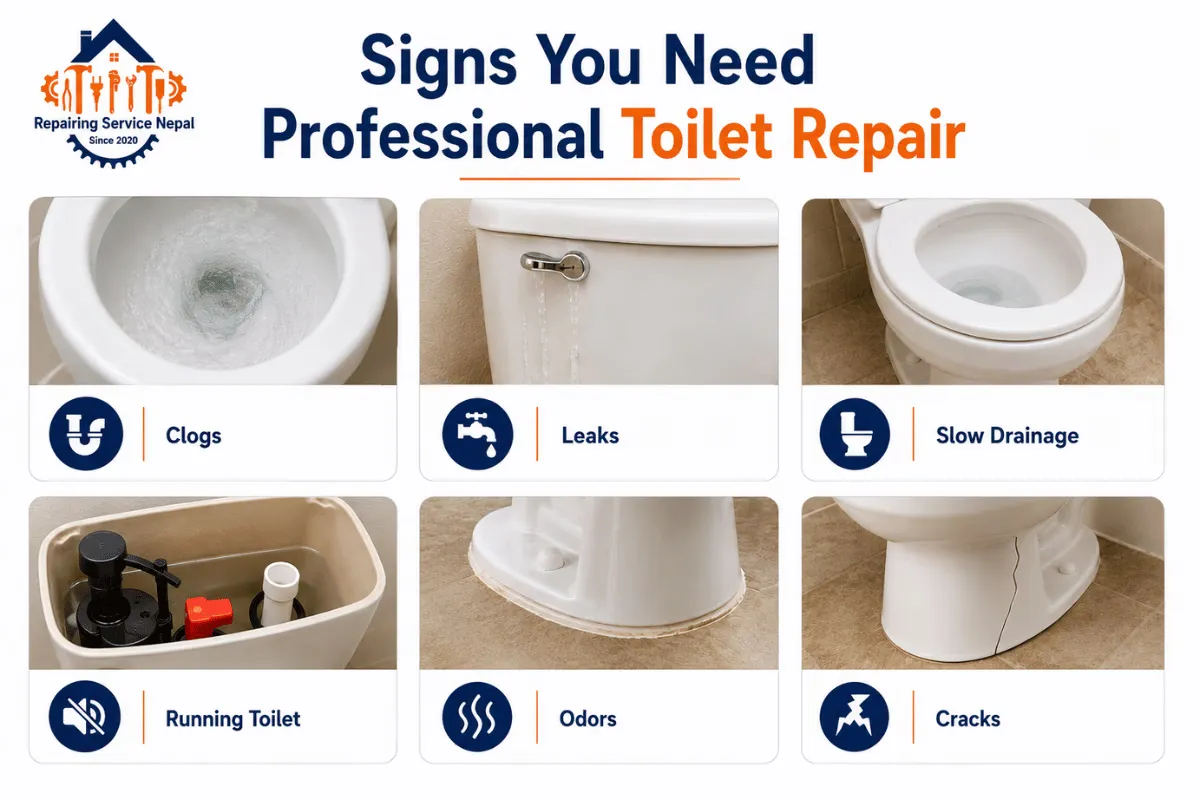

A toilet rarely stops working without giving some warning first.
A toilet that runs continuously, develops a leak, flushes more slowly than usual, or becomes blocked repeatedly may be showing signs of a small component failure or a larger plumbing issue. While some problems can be handled with a simple adjustment, others need proper inspection to prevent recurring trouble.
For homeowners, landlords, offices, and other property owners in Kathmandu, understanding these common toilet problems can make it easier to recognize when something needs attention.
What Can Go Wrong With a Toilet?
A toilet depends on several components working together. The tank needs to fill correctly, the flushing mechanism needs to release the right amount of water, and the drainage system needs to carry wastewater away properly.
A problem with any of these areas can affect how the toilet operates.
Common issues include:
- Running toilets
- Water leaks
- Frequent blockages
- Weak flushing
- Broken flush mechanisms
- Faulty tank components
- Gurgling or bubbling sounds
- Toilet overflow
The visible symptom does not always reveal the actual cause, which is why recurring problems deserve closer attention.

A Toilet That Keeps Running
A toilet should stop filling shortly after it has been flushed.
If water continues flowing into the bowl or tank, the flapper may not be creating a proper seal. A faulty fill valve, incorrectly positioned float, or damaged flushing component can also cause continuous running.
A running toilet is more than an annoying sound. Continuous water flow can increase water consumption over time.
If checking the obvious tank components does not solve the issue, the flushing mechanism may need to be inspected.
Water Around the Toilet Base
Water collecting around the bottom of a toilet can have several causes.
A worn seal between the toilet and floor may allow water to escape when the toilet is flushed. Water can also come from the tank, supply connection, or another nearby fitting and eventually collect around the base.
Finding the source is important because simply drying the floor does not solve the underlying leak.
Persistent moisture can also affect flooring and surrounding materials, so a leak that keeps returning should be investigated promptly.
Frequent Toilet Blockages
An occasional clog is not necessarily a sign of a serious plumbing problem.
However, repeated blockages are different. If the toilet becomes clogged regularly despite normal use, there could be a partial obstruction or a restriction somewhere in the drainage system.
Repeated plunging may clear the bowl temporarily without addressing the reason the blockage keeps coming back.
If blockages are becoming a pattern, inspecting the drainage system can help determine whether the problem is limited to the toilet or extends further into the plumbing.
Weak or Slow Flushing
A toilet that does not flush with its usual strength can become inconvenient very quickly.
Several things can affect flushing performance. Mineral deposits may restrict the openings responsible for directing water into the bowl. The tank may not be filling correctly, or a partial obstruction may be affecting drainage.
A weak flush is especially worth investigating when the toilet requires multiple flushes to clear normally.
When a Toilet Will Not Flush
A toilet that refuses to flush may have a relatively simple mechanical fault.
The handle could be broken, the chain or internal linkage may have become disconnected, or the flush valve may no longer be working properly.
Before replacing the whole toilet, it is worth determining whether one component is responsible.
In many situations, replacing a damaged internal part can restore normal operation without replacing the fixture itself.
Strange Gurgling or Bubbling Sounds
Changes in the sound of a toilet can provide useful clues.
Gurgling or bubbling may occur when air and water are not moving normally through the drainage system. It can sometimes be associated with a developing blockage or another drainage restriction.
Pay closer attention if unusual sounds occur together with slow drainage, recurring clogs, or water movement in nearby fixtures.
One unusual sound does not necessarily mean there is a major problem, but persistent changes should not be ignored.
What to Do if the Toilet Overflows
An overflowing toilet needs immediate attention.
Stop flushing and turn off the water supply valve behind the toilet if it is safely accessible. Continuing to flush can cause additional water to spread across the bathroom floor.
After stopping the water flow, determine whether the problem appears to be a simple blockage or something more serious.
Repeated overflow, sewage backup, or problems affecting several fixtures can indicate a deeper drainage issue that needs professional attention.
When Should You Call a Professional?
Not every toilet problem requires professional help immediately. Some simple adjustments can resolve minor issues.
Professional inspection becomes more appropriate when:
- The same problem keeps returning.
- A leak cannot be located or stopped.
- The toilet remains blocked after basic measures.
- The toilet keeps running.
- Flushing requires repeated attempts.
- Water is appearing around the base.
- The toilet repeatedly overflows.
- Gurgling is accompanied by other drainage problems.
For property owners who need toilet repair services in Kathmandu, the appropriate repair depends on the actual cause of the problem.
A proper diagnosis can prevent unnecessary replacement of parts and help identify issues that may otherwise continue to return.

What Does Toilet Repair Usually Include?
Toilet repair can involve more than clearing a blocked bowl.
Depending on the problem, repair work may include:
- Replacing worn flappers
- Repairing or replacing fill valves
- Adjusting floats
- Repairing flush handles
- Replacing damaged seals and gaskets
- Fixing tank connections
- Repairing leaks
- Clearing persistent blockages
- Investigating drainage problems
The goal should be to correct the cause rather than repeatedly treat the visible symptom.
Repair or Replace?
A faulty toilet does not automatically need to be replaced.
If the bowl and tank are structurally sound, replacing a damaged internal component may be all that is necessary.
Replacement may be more appropriate when the toilet has a cracked bowl or tank, replacement parts are no longer available, or multiple components are failing repeatedly.
Water efficiency is another consideration. An older toilet may consume more water per flush than a newer model, so replacement can sometimes make practical sense even when repair is technically possible.
What Can You Do Before a Technician Arrives?
A few basic precautions can reduce the risk of further damage.
If the toilet is overflowing, shut off its water supply if you can safely reach the valve. Avoid flushing a blocked toilet repeatedly.
Move rugs and other belongings away from standing water. If there is visible damage or a leaking component, a photograph can also help explain the issue to a technician.
Avoid using aggressive chemical drain cleaners on a blocked toilet. They may not address the underlying obstruction and can complicate subsequent repair work.
How to Prevent Common Toilet Problems
Good bathroom habits can reduce the risk of many toilet problems.
Do not flush wipes, sanitary products, cotton items, or other materials that are not designed to break down in water.
Avoid putting excessive amounts of toilet paper into one flush. It is also useful to check the area around the toilet base and tank periodically for signs of moisture.
If a toilet begins running continuously, flushing weakly, or becoming blocked more often than usual, deal with the warning sign rather than waiting for the problem to become more serious.
Regular property maintenance can also help identify plumbing issues before they cause significant disruption. Broader repair and maintenance services may be useful when a toilet problem is connected to other plumbing or property-maintenance concerns.
When Is a Toilet Problem an Emergency?
Some toilet problems should be dealt with as quickly as possible.
Consider urgent assistance when there is:
- A major uncontrolled leak
- Continuous overflowing
- Sewage backup
- Water reaching the floor or ceiling below
- A severe blockage affecting other fixtures
- No other usable toilet available at the property
The first priority in an emergency is to limit water or sewage damage. Turning off the water supply can help while professional assistance is arranged.

Final Thoughts
Toilet problems can be caused by something as simple as a worn flapper or as complicated as a drainage obstruction.
Running water, leaks, recurring blockages, weak flushing, unusual sounds, and overflow are all signs worth paying attention to.
Knowing these warning signs allows property owners to respond earlier and avoid relying on temporary fixes that only solve the problem for a short time.
When a toilet problem keeps returning or its cause is unclear, proper inspection can help determine whether a component repair, drainage repair, or complete replacement is the most practical solution.
























Sign in to leave a comment.