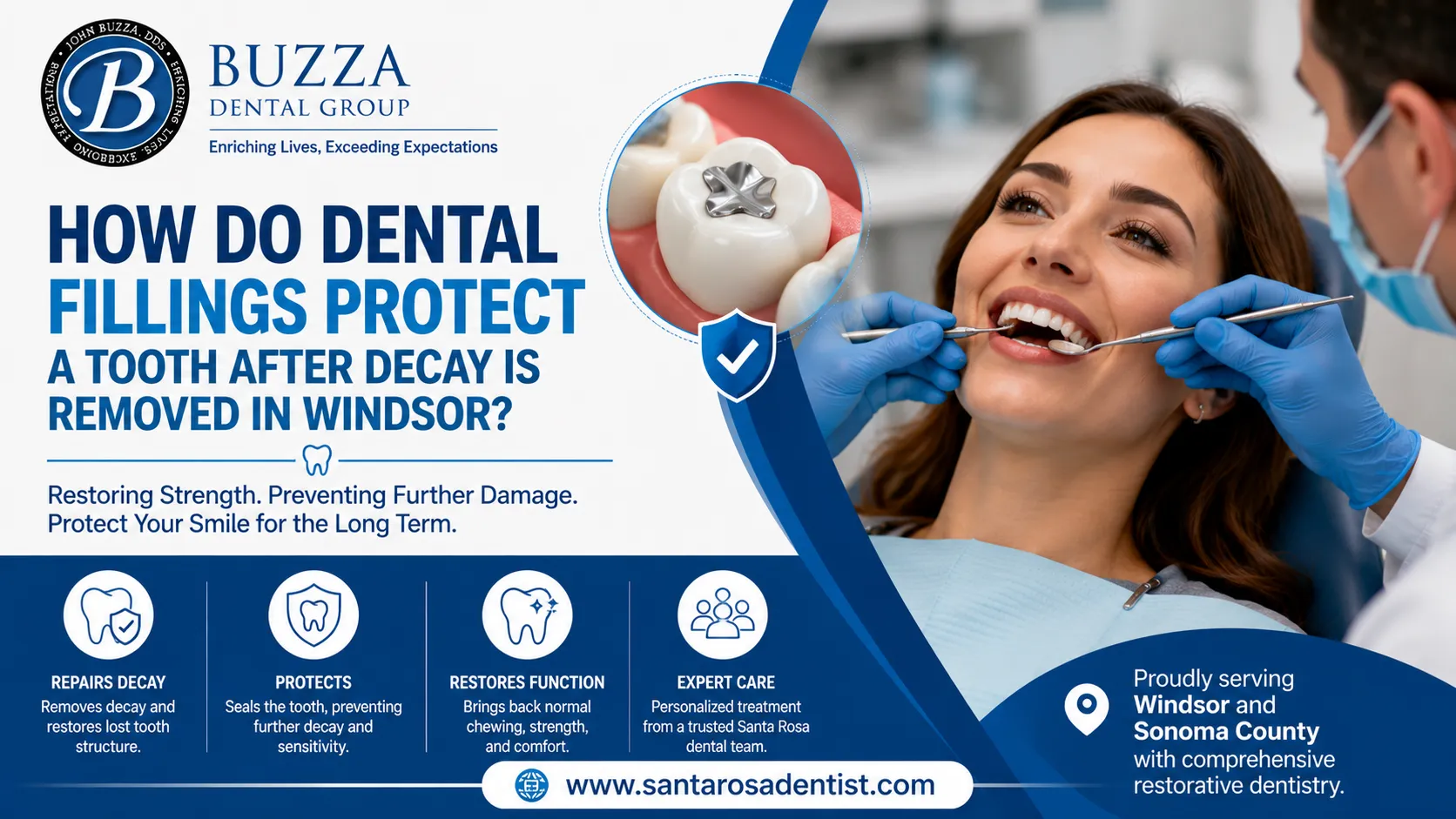

When tooth decay creates a cavity, a tooth filling in Santa Rosa can restore the space left after the decayed tissue is removed and help the tooth return to normal function. Although a filling may look like a simple repair, the treatment has an important purpose: remove diseased tooth structure, seal the resulting cavity, and restore the tooth so it can function during everyday biting and chewing.
For patients in Windsor, this distinction matters because an untreated cavity does not simply remain unchanged. As decay progresses, it can cause pain, infection, and potentially tooth loss. The appropriate restoration depends on how much healthy tooth structure remains, the cavity's location and size, and the tooth's functional demands.
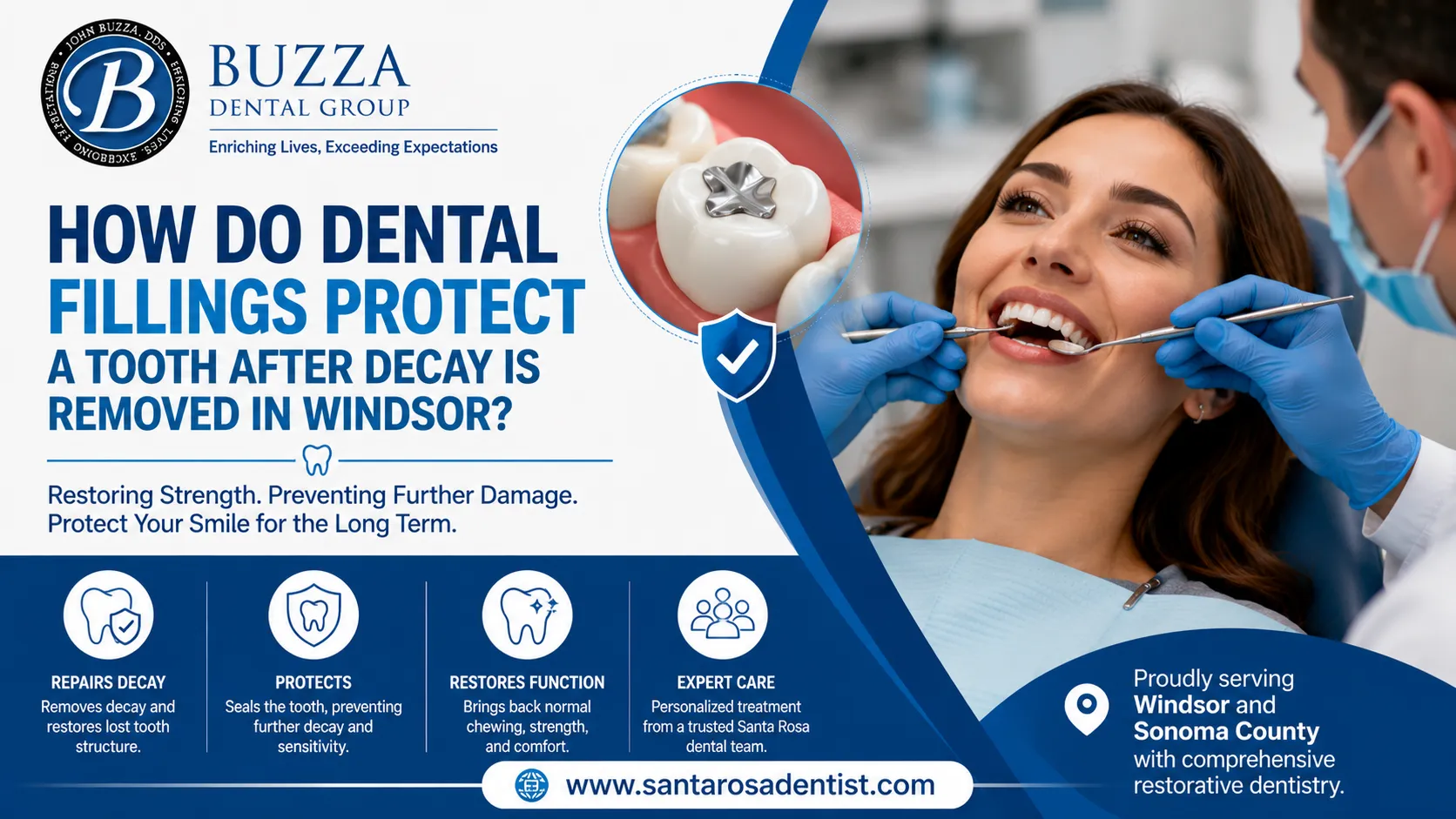
Key Takeaways
- A dental filling replaces tooth structure lost to a cavity after decay is removed.
- Treating decay early can help prevent progression to deeper damage, infection, or tooth loss.
- Composite resin is one commonly used filling material and can provide a tooth-colored restoration.
- The appropriate filling material depends on factors such as cavity size, location, durability requirements, appearance, and cost.
- A filling is not always sufficient when extensive tooth structure has been lost; a crown may be more appropriate in some cases.
- Buzza Dental Group provides tooth fillings and broader restorative and general dentistry services for patients in Windsor and surrounding Sonoma County communities.
- Good oral hygiene and regular dental examinations remain important because a filling does not make the surrounding tooth permanently immune to future decay.
What happens to a tooth when decay is removed?
Tooth decay develops when acids produced by bacteria gradually remove minerals from the tooth. If the process continues, the weakened enamel and underlying tooth structure can break down and form a cavity. Once a true cavity has developed, restorative treatment may be necessary.
During filling treatment, the dentist first removes the decayed portion of the tooth. This leaves a space where the damaged tissue used to be. The filling material is then placed into that space and shaped to restore the tooth's form.
The National Institute of Dental and Craniofacial Research describes a filling as a treatment in which decayed tooth tissue is removed and the resulting space is filled with restorative material.
In practical terms:
Decay → Removal of damaged tissue → Restoration of the cavity → Re-established tooth shape and function
The filling does not regenerate the removed enamel or dentin. Instead, it replaces the missing structure with a restorative material.
How does a filling protect the tooth?
A filling provides several important functions after decay has been removed.
1. It replaces lost tooth structure.
A cavity leaves the tooth with less material to withstand normal chewing forces. Filling the space restores part of the tooth's structure and helps return it to usable form.
2. It closes the cavity.
Restorative material occupies the space created by decay removal, helping create a finished surface that can be maintained through normal oral hygiene.
3. It restores chewing function.
A properly shaped filling helps the tooth participate in normal biting and chewing rather than leaving a cavity that can interfere with function.
4. It can preserve the tooth when damage is limited.
When decay has not destroyed too much of the tooth, a filling may allow the natural tooth to remain in service rather than requiring a more extensive restoration.
Buzza Dental Group describes tooth fillings as a way to restore a damaged tooth to its normal shape and prevent further decay.
Why is treating a cavity early important?
The extent of decay affects the type of treatment that may ultimately be required.
Early decay may sometimes be managed before a cavity develops, but once a cavity has formed, restorative treatment may be necessary. If decay continues untreated, it can become progressively deeper and may eventually affect the tooth's pulp, cause infection, or contribute to tooth loss.
This creates an important decision point for patients searching for a general dentist in Santa Rosa, CA:
Smaller cavity → Filling may be appropriate
More extensive structural damage → Crown or another restoration may be necessary
Buzza Dental Group similarly explains that most cavities can be treated with fillings, while teeth with more extensive damage may require a dental crown.
That is why delaying treatment simply because a cavity does not hurt can be risky. Some cavities produce few or no noticeable symptoms.
What filling material is used?
There is no single filling material that is ideal for every cavity.
The American Dental Association identifies several common options, including composite resin, amalgam, and gold restorations. The decision can depend on the cavity's size and location, expected durability, cosmetic considerations, insurance coverage, and out-of-pocket cost.
Composite resin fillings are tooth-colored and can provide a natural-looking result. They are commonly used for small-to-medium restorations and can be used on front and back teeth where appropriate.
Buzza Dental Group states that its office uses mercury-free resin fillings and describes them as durable, tooth-colored restorations.
The important point is that material selection should follow an examination rather than a one-size-fits-all rule.
Are fillings and dental bonding the same thing?
No. Although both can involve tooth-colored composite resin, their purposes can differ.
Dental fillings primarily restore tooth structure lost through decay.
Dental bonding is commonly used to improve or repair the appearance of teeth affected by relatively minor chips, cracks, discoloration, gaps, or shape irregularities.
Buzza Dental Group offers both services as separate treatment categories.
For patients comparing dental bonding in Santa Rosa with fillings, the key question is therefore not simply which material looks better. It is what caused the tooth defect and how much structural repair is required.
When might a filling not be enough?
A filling is most useful when sufficient healthy tooth structure remains to support the restoration.
If decay has substantially weakened or destroyed a tooth, a crown may provide more appropriate coverage and protection. NIDCR notes that crowns may be used to repair badly broken-down teeth.
Buzza Dental Group's Windsor information explains that when a cavity becomes deep and little natural tooth remains after decay is removed, a filling alone may not be sufficient and a crown can be used to protect and strengthen the tooth.
This is one reason a Santa Rosa restorative dentist evaluates the remaining tooth structure before deciding on treatment.
What should Windsor patients expect during filling treatment?
The process generally begins with an examination to determine whether decay is present and how extensive it is. Buzza Dental Group states that its cavity evaluation involves examining the teeth before removing decay and placing a filling when appropriate.
For patients concerned about discomfort, the practice states that fillings are performed under local anesthesia and may also be combined with dental sedation for patients who need additional help relaxing.
After treatment, maintaining the restoration depends partly on controlling the factors that caused the original decay.
The ADA recommends brushing twice daily with fluoride toothpaste, cleaning between teeth daily, limiting added sugar, drinking water, and maintaining regular dental visits.
How can you protect a filled tooth long term?
A filling repairs the consequences of decay; it does not remove the underlying risk factors that can cause another cavity.
A practical maintenance framework is:
Clean → Monitor → Maintain → Recheck
- Brush twice daily with fluoride toothpaste.
- Clean between teeth every day.
- Limit frequent exposure to sugary foods and drinks.
- Attend recommended dental examinations.
- Report new sensitivity, pain, roughness, or a damaged filling.
- Avoid using teeth to bite extremely hard objects.
NIDCR also notes that fillings and crowns do not last forever and may eventually need replacement.
For Windsor residents, Buzza Dental Group provides comprehensive dental care from its Santa Rosa office and lists Windsor among the communities it serves. Its services include general, restorative, emergency, cosmetic, and preventive dental care.
Conclusion
A dental filling protects a tooth after decay is removed by replacing lost tooth structure, restoring the tooth's shape and function, and closing the cavity with restorative material. When decay is detected while the tooth still has sufficient healthy structure, a filling may help preserve the natural tooth and avoid more extensive treatment.
However, not every damaged tooth is a filling candidate. The size and location of the cavity, remaining tooth structure, chewing forces, and overall oral health all influence the appropriate restoration. For Windsor patients considering tooth fillings in Santa Rosa, a professional examination can determine whether a filling, bonding, crown, or another restorative approach is appropriate.
Buzza Dental Group provides tooth fillings along with general and restorative dentistry services for patients from Windsor and surrounding Sonoma County communities.
FAQs
How long does a dental filling last?
There is no single lifespan for every filling. Longevity depends on the material, size and location of the restoration, chewing forces, oral hygiene, and future decay. NIDCR notes that fillings do not last a lifetime and may eventually need replacement.
Can a cavity be treated without a filling?
Very early tooth decay may sometimes be stopped or reversed before a cavity forms through remineralization and fluoride. Once a true cavity has developed, however, restorative treatment may be necessary. A dentist can determine the appropriate approach after examining the tooth.
Are tooth-colored fillings available in Santa Rosa?
Yes. Composite resin is a commonly used tooth-colored filling material. Buzza Dental Group states that it uses mercury-free resin fillings and offers tooth-colored restorations for appropriate patients.
Is a filling better than a crown?
Neither is universally better. A filling may be appropriate when enough healthy tooth structure remains, while a crown may be recommended when a tooth has been substantially weakened or broken down. The decision depends on the condition and structural needs of the individual tooth.
Can a filled tooth develop another cavity?
Yes. A filling repairs an existing cavity but does not make the surrounding tooth permanently resistant to decay. Continued exposure to cavity-causing acids can produce new decay around or elsewhere on the tooth. Fluoride, daily cleaning, diet, and regular dental care remain important.



























Sign in to leave a comment.