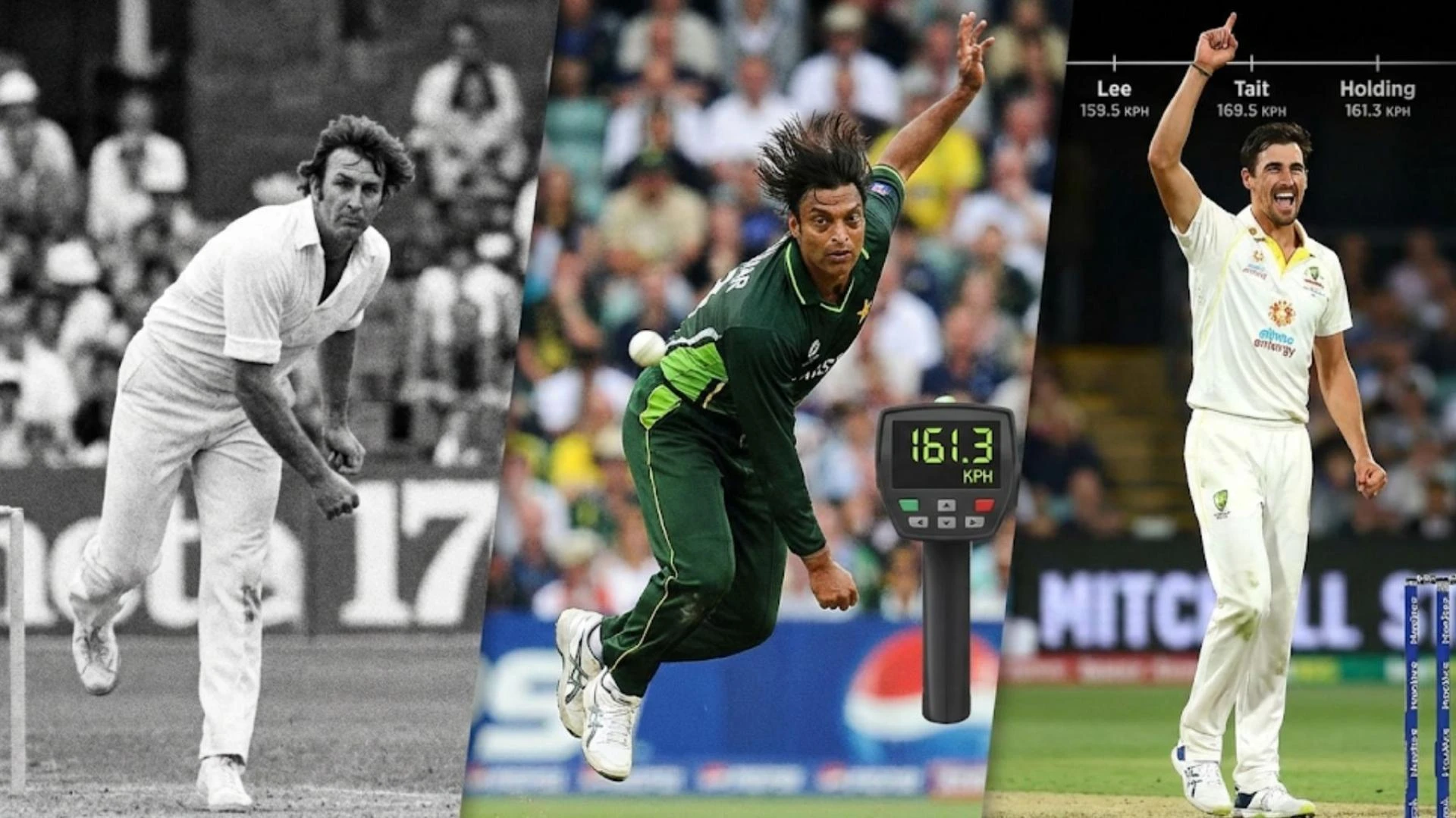

There is a primal sound in cricket that stops everyone in the stadium mid-conversation. It’s not the crack of the bat; it’s the sickening thud of a leather ball hitting the wicketkeeper’s gloves at over 150 kilometers per hour.
Pace bowling isn't just a skill; it’s an act of intimidation. It's about the 22 yards of turf becoming a gladiatorial arena where a bowler tries to breach the batsman's defenses before their brain even registers the ball has been released. Throughout history, certain individuals have pushed the boundaries of human physiology to hurl thunderbolts that terrified generations of batsmen.
While modern radar guns give us precise numbers, the legacy of pace goes back decades, live by eyewitness accounts of broken stumps and bruised bodies.
Here is a detailed look at the Top 10 fastest bowlers in cricket history, exploring the raw speed, unique actions, and lasting impact they left on the game.
The Criteria: A Note on Speed Measurement
Before we dive in, a quick disclaimer: reliable speed measurement technology only really became standard in the late 1990s. The speeds of legends from the 70s and 80s are often based on anecdotal evidence, grainy footage analysis, or less reliable early radar systems. However, their impact makes them undeniable. This list balances recorded top speeds with historical terror.
1. Shoaib Akhtar (Pakistan) – The Rawalpindi Express
Top Recorded Speed: 161.3 kph (100.2 mph) vs. England, 2003 WC
The Action & Impact: Shoaib Akhtar was pure theatre. His run-up started near the boundary ropes, a long, rhythmic build-up of kinetic energy that exploded at the crease. He was a hyperextending force of nature who didn't just want to take wickets; he wanted to break toes and egos.
Shoaib remains the first and only bowler to officially break the 100mph barrier twice in his career. When he was in the mood, the atmosphere changed visibly. Batsmen backed away. The crowd roared. He was erratic, injury-prone, and controversial, but for sheer, unadulterated pace that made you gasp, Shoaib is the undisputed king.
2. Brett Lee (Australia) – Binga
Top Recorded Speed: 161.1 kph (100.1 mph) vs. New Zealand, 2005
The Action & Impact: If Shoaib was raw power, Brett Lee was athletic perfection. With a smooth, classic side-on action and a powerful follow-through, Lee made bowling 150kph look almost easy. He was the golden boy of Australian cricket during their dominant era, forming terrifying partnerships with Glenn McGrath and Jason Gillespie.
Lee’s impact was his consistency at extreme pace. He could maintain 150kph+ for an entire spell, wearing batsmen down mentally and physically. In his prime, Lee’s spells could single-handedly shift match momentum, causing panic not just in the opposition dressing room but also for punters watching live odds shift on Sports Betting Platforms India.
3. Shaun Tait (Australia) – The Wild Thing
Top Recorded Speed: 161.1 kph (100.1 mph) vs. England, 2010
The Action & Impact: Shaun Tait was chaos theory in human form. His career was short, ravaged by injuries due to the immense strain his action put on his body. He had a short, explosive run-up and a slinging action that made the ball skid off the pitch at frightening speeds.
Tait wasn't about line and length; he was about four overs of absolute mayhem in T20s and ODIs. When he got it right, he was unplayable, capable of destroying stumps with yorkers that batsmen didn't even see.
4. Jeff Thomson (Australia) – Thommo
Top Speed (Estimated): Variously clocked between 160 kph and even 170kph in non-standard tests of the 70s.
The Action & Impact: Before radar guns, there was Thommo. Considered by many veterans, including Viv Richards and Sunil Gavaskar, as the fastest they ever faced. Thomson had a unique, javelin-thrower style action, slinging the ball from behind his back. You couldn't see the ball in his hand until the last second.
His impact was visceral fear. In the 1974-75 Ashes, he and Dennis Lillee terrorized England. Thomson wasn't interested in swing; he just wanted to hit the pitch hard and make the ball fly past the batsman’s nose.
5. Mitchell Starc (Australia) – The Modern Missile
Top Recorded Speed: 160.4 kph (99.7 mph) vs. New Zealand, 2015
The Action & Impact: The only active player on this list consistently hitting these heights. Starc is the prototype modern left-arm quick. Tall, with a high arm action, he generates tremendous pace and, crucially, late swing.
His delivery that clocked 160.4 kph to Ross Taylor remains a modern marvel. Starc’s greatest impact is his lethal yorker, arguably the best in the world today, which makes him a nightmare in the death overs of white-ball cricket.
6. Andy Roberts (West Indies) – The Hitman
Top Speed: Estimated 155kph+
The Action & Impact: The father of the famed West Indies pace quartet of the 70s and 80s. Roberts was terrifying because he was emotionless. He had a chillingly calm run-up and a deceptively fast release.
His impact lay in his tactical genius. Roberts was famous for having two bouncers. The first one was fast; the second one, delivered with the exact same action, was even faster. Batsmen would hook the first one, get confident, and have their helmets rattled by the second.
7. Dale Steyn (South Africa) – The Steyn Remover
Top Recorded Speed: 156.2 kph (97 mph) vs. Kolkata Knight Riders, IPL 2010
The Action & Impact: Dale Steyn wasn't just fast; he was an artist with a sledgehammer. Perhaps the most complete fast bowler of the 21st century, Steyn combined extreme pace with wicked outswing. His veins-popping, crazy-eyed celebration became iconic.
His impact on Test cricket was immense. He could reverse swing the old ball at 150kph on dead Asian pitches, a skill that made him a generation talent. Steyn’s legendary spells defied predictions and often upset the odds on online bookies in India who bet against him on flat tracks.
8. Michael Holding (West Indies) – Whispering Death
Top Speed: Estimated 155kph+
The Action & Impact: If you want to see the most beautiful bowling action in history, watch Michael Holding. He didn't run; he glided to the crease like a sprinter. The nickname "Whispering Death" came because umpires said they couldn't hear him approaching, but the end result was lethal.
His over to Geoff Boycott in Barbados in 1981 is widely regarded as the greatest, fastest over in Test history a crescendo of pace and hostility that ended with Boycott’s stumps cartwheeling.
9. Fidel Edwards (West Indies)
Top Recorded Speed: 157.7 kph (97.9 mph) vs. South Africa, 2003
The Action & Impact: Often overlooked in historic lists, Fidel Edwards was genuinely rapid. With a short stature and a very round-arm, slinging action reminiscent of Jeff Thomson, he generated incredible pace through shoulder rotation. His burst onto the scene with a 5-wicket haul on Test debut signalled the arrival of a new speedster, though injuries hampered his long-term impact.
10. Shane Bond (New Zealand)
Top Recorded Speed: 156.4 kph (97.1 mph) vs. India, 2003 WC
The Action & Impact: A career tragically cut short by injuries, but Shane Bond was a Ferrari. His action was clean, rhythmic, and generated terrifying pace that troubled even the greatest batsmen like Sachin Tendulkar and Ricky Ponting. When fit, Bond was arguably the best fast bowler in the world in the mid-2000s, possessing the ability to swing the ball at 150kph.
The Enduring Legacy of Pace
The game has evolved. T20 has brought in slower balls, knuckleballs, and wide yorkers. But nothing absolutely nothing replaces the thrill of watching a fast bowler steam in, knowing the next ball could be a 155kph thunderbolt. These ten men didn't just bowl fast; they changed the way the game felt.


Sign in to leave a comment.