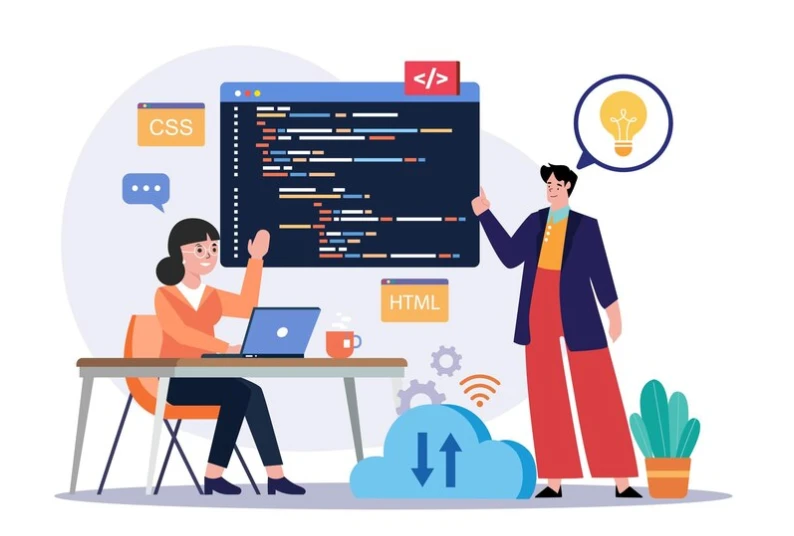

There are a lot of web development frameworks out there right now, and even the most seasoned developers might become confused by their wide selection. Your choice of framework will have a major impact on how your future website functions and appears.
The field of web development is always evolving, and it\'s critical to recognize the direction in which these developments are heading. We made a list of the top web development frameworks of 2024 to make it easier for you to stay current with the newest developments. We hope this will help you make an easier decision.
Angular.JS
The most widely used open source JavaScript framework that Google supports is called Angular.JS. Its extensive standard library is complemented by a plethora of extensions created by users. But one of the things that sets this framework apart is how MVC is used.
The incredible mix of a vast feature set and a low entry barrier is offered by Angular.JS. You\'ll need a few hours of free time to begin creating little apps on it. But learning to understand and use all of its potential will take months.
Ajax, DOM structure management, animation, patterns, routing, and other technologies are supported by Angular.JS. An increasing number of web apps are using the robust framework and its extensive features.
Laravel
The web application framework Laravel has a sophisticated and expressive syntax. It is a front-end and back-end developer\'s full-stack solution. Experts generally agree that the platform documentation is almost flawless.
Important components of the framework:
It has a script collector built right in, and the required SCSS modules are attached as service provider packages.
With the amazing Blade template that Laravel employs, users may deal with multiple databases, file storage, and website slicing independently of PHP code caching.
Task schedulers, task queues, consoles, and SSH work
Support for WebSockets to build really interactive applications
Multilingual support: The Laravel-lang package offers numerous options for writing REST APIs and makes it simple to add new languages to the translations that are currently there.
Laravel is updated often to stay current with emerging trends. You won\'t fall behind in the field of web development if you study Laravel. The important thing is to go forward with the framework and not get stuck on any one version.
React.js
One of the most widely utilized libraries for developing intricate front-end solutions is React.js. It was first made available on Facebook in 2013 and rapidly became well-known. These days, it is used in production by several well-known firms, such as Instagram, AirBnB, eBay, Netflix, Yahoo, and others.
The foundation of React is the idea of breaking up the user interface into discrete, self-contained components that are easy to extend and maintain. Even better, you can create independent parts that you may utilize in several projects, making it simple to move them from one to the next.
The liberty to act One of the key characteristics of React.js is that it lets you employ a plethora of methodologies (like redux, mobx, and others) for app development. They are part of the architectural superstructures of React.js, which are always evolving, rather than the framework itself.
Ruby on Rails
This comprehensive, multi-level framework is built on the MVC architecture and is intended for use in the development of web applications with databases. Since its release, this framework has grown to be among the most effective resources for developing websites and online apps for new businesses.
The rapidity of development is the primary benefit of the Ruby on Rails framework. First and foremost, the large number of readily usable standard RoR tools, the vast array of pre-made solutions in the community, the Ruby programming language, and the straightforward coding all contribute to the rapid development pace.
Any project may be structured as much as feasible by following the basic programming principles in Ruby on Rails, the standards for adding files to a project, and the standards for writing code in a project. This method makes the project very legible and allows new participants to join any project right away.
ASP.NET MVC
A framework for building websites and web applications that use the MVC pattern is the ASP.NET MVC platform. This technique is popular among programmers because to its extensive use, versatility, and ease of use.
In addition to all the benefits of ASP.NET, it offers a very productive coding paradigm that enables users to create code architectures that are more pure and allows for testing-based development.
All of these characteristics lead to the implementation of the shared responsibility idea. As a result, managing work on distinct components is simpler. Furthermore, this functionality improves the application\'s testability.
YII
YII is a PHP framework built on components that is very efficient and intended to create massive web projects rapidly. It can greatly accelerate web development and lets you make the most of the idea of code reuse.
It is a framework that works with all kinds of web applications. It is appropriate for big project development, including portals, forums, CMSs, stores, and RESTful applications, because of its component structure and strong caching support.
The YII framework\'s main advantages and characteristics are:
A high performance rate makes it possible to deal with forms, effectively guaranteeing their creation and validation, and to cache both the whole page and individual fragments.
Integrated permission and authentication;
Easy to use AJAX interfaces;
Connects with jQuery;
Enables third-party libraries to be connected;
Facilitates database migrations;
Permits automated testing;
And supports the REST style via TDD style development.
Symfony
The most widely used PHP framework globally is called Symfony. It doesn\'t place any restrictions on your app and comes with the full suite of tools needed to create web applications rapidly.
Symfony is a collection of independent parts. As they interact with one another, each component creates a web platform, which is a distinct ecosystem. Additionally, the components you choose will rely on your goals and yourself.
The strong aspects of the framework:
high pace of performance because of the broad customisation offered by the template engine
The application may be expanded at any moment by adding new bundles that have no effect on existing bundles. However, stability and long-term support can be configured for each bundle\'s simultaneous operation.
Developer-focused approach: In order to minimize repetitive effort, specialized code may be generated without the need for an engineer by utilizing unique instructions and a handy terminal.
Django
Django is a framework for Python web applications. Don\'t repeat yourself, or DRY, is one of the platform\'s core tenets. Django web systems are composed of one or more applications, each of which should be designed to be separate and able to link. The framework\'s architecture stands apart from several others (like Ruby on Rails) because of this method.
Principal benefits:
Speed: Django is best suited for web developers that prioritize meeting deadlines since it was created to assist them in developing an app as quickly as possible.
Whole bundle: Numerous more capabilities, which are essential for Django\'s operation, include content management, website mapping, user authentication, RSS, and much more.
Defense against security flaws that might jeopardize the project.
Scalability: an excellent option for projects aiming at high-volume online visitors.
Let\'s review
We trust that you will find this collection of frameworks helpful. While each of these platforms has merits of its own, the characteristics of your specific project should ultimately determine which web development framework is best.
In addition to evaluating the platform\'s general functioning, you should determine the degree to which certain features may be used to accomplish specific objectives. After that, you\'ll be able to decide wisely.
Considerations for Web Development Company Chicago include their experience with a range of programming languages, previous clientele, and capacity to create user-friendly websites that complement your company\'s objectives and the tastes of your target market.







Sign in to leave a comment.